



 Chat with AI
Exam 15: Innate Immunity

Exam 1: A Brief History of Microbiology73 Questions
Exam 2: The Chemistry of Microbiology76 Questions
Exam 3: Cell Structure and Function80 Questions
Exam 4: Microscopy, Staining, and Classification80 Questions
Exam 5: Microbial Metabolism77 Questions
Exam 6: Microbial Nutrition and Growth75 Questions
Exam 7: Microbial Genetics75 Questions
Exam 8: Recombinant DNA Technology75 Questions
Exam 9: Controlling Microbial Growth in the Environment75 Questions
Exam 10:Controlling Microbial Growth in the Body: Antimicrobial Drugs75 Questions
Exam 11: Characterizing and Classifying Prokaryotes75 Questions
Exam 12: Characterizing and Classifying Eukaryotes75 Questions
Exam 13: Characterizing and Classifying Viruses, Viroids, and Prions75 Questions
Exam 14: Infection, Infectious Diseases, and Epidemiology76 Questions
Exam 15: Innate Immunity75 Questions
Exam 16: Adaptive Immunity75 Questions
Exam 17: Immunization and Immune Testing75 Questions
Exam 18: Immune Disorders75 Questions
Exam 19: Microbial Diseases of the Skin and Wounds72 Questions
Exam 20: Microbial Diseases of the Nervous System and Eyes71 Questions
Exam 21: Microbial Cardiovascular and Systemic Diseases71 Questions
Exam 22: Microbial Diseases of the Respiratory System70 Questions
Exam 23: Microbial Diseases of the Digestive System70 Questions
Exam 24: Microbial Diseases of the Urinary and Reproductive Systems65 Questions
Exam 25: Applied and Industrial Microbiology73 Questions
Exam 26: Microbial Ecology and Microbiomes73 Questions
Select questions type


Fever is beneficial during viral infection because the higher temperature

Free
(Multiple Choice)
4.8/5  (92)
(92) Correct Answer: Verified
E
Mucous membranes are quite thin and fragile. How can such delicate tissue provide defense against microbial invaders?
Free
(Multiple Choice)
4.7/5 (78)
(78) Correct Answer:Verified
VerifiedE
Which of the following cells increase in number during an infection with parasitic worms?
Free
(Multiple Choice)
4.9/5 (77)
(77) Correct Answer:Verified
VerifiedD
Which of the following is the best definition of "microbial antagonism"?
(Multiple Choice)
4.8/5 (78)
(78) The resident microbiota have no role in defense against pathogen invasion.
(True/False)
4.8/5 (78)
(78) The process of phagocytosis involve all of the following EXCEPT
(Multiple Choice)
4.9/5 (74)
(74) Nonphagocytic (eosinophils/monocytes/NK cells) are a type of lymphocyte which produce toxins to kill abnormal cells.
(Short Answer)
4.9/5 (70)
(70) Intact skin layers are part of the body's (first/second/third) line of defense against pathogens.
(Short Answer)
4.8/5 (79)
(79) The first and second lines of defense against microbial invasion are part of
(Multiple Choice)
4.8/5 (72)
(72) Protection from infection known as species resistance is a result of
(Multiple Choice)
4.8/5 (73)
(73) The alternative pathway of complement cascade activation begins with ________ binding to the surface of a microbe.
(Multiple Choice)
4.8/5 (78)
(78) The second line of defense against invading microbes includes
(Multiple Choice)
4.7/5 (73)
(73) 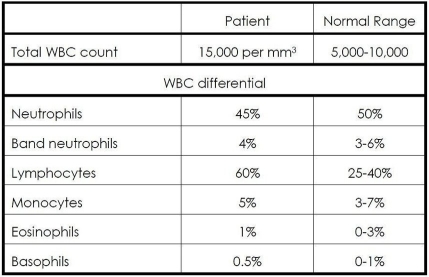 Examine the WBC count and differential data in Table 15.1. What type of disease is indicated by this set of data?
 (Essay)
4.8/5 (92)
(92) Macrophages release (bradykinin/histamine/prostaglandin) in response to microbes and thereby contribute to acute inflammation.
(Short Answer)
4.8/5 (84)
(84) Which of the following contributes to protecting the eyes from microbial invasion?
(Multiple Choice)
4.8/5 (88)
(88) White blood cells known as (basophils/lymphocytes/neutrophils) are the main cells involved in the third line of defense.
(Short Answer)
4.9/5 (80)
(80) Which cell becomes a macrophage when leaving the bloodstream?
(Multiple Choice)
4.9/5 (79)
(79) 
Filters
- Essay(0)
- Multiple Choice(0)
- Short Answer(0)
- True False(0)
- Matching(0)