



 Chat with AI
Exam 23: Microbial Diseases of the Digestive System

Exam 1: A Brief History of Microbiology73 Questions
Exam 2: The Chemistry of Microbiology76 Questions
Exam 3: Cell Structure and Function80 Questions
Exam 4: Microscopy, Staining, and Classification80 Questions
Exam 5: Microbial Metabolism77 Questions
Exam 6: Microbial Nutrition and Growth75 Questions
Exam 7: Microbial Genetics75 Questions
Exam 8: Recombinant DNA Technology75 Questions
Exam 9: Controlling Microbial Growth in the Environment75 Questions
Exam 10:Controlling Microbial Growth in the Body: Antimicrobial Drugs75 Questions
Exam 11: Characterizing and Classifying Prokaryotes75 Questions
Exam 12: Characterizing and Classifying Eukaryotes75 Questions
Exam 13: Characterizing and Classifying Viruses, Viroids, and Prions75 Questions
Exam 14: Infection, Infectious Diseases, and Epidemiology76 Questions
Exam 15: Innate Immunity75 Questions
Exam 16: Adaptive Immunity75 Questions
Exam 17: Immunization and Immune Testing75 Questions
Exam 18: Immune Disorders75 Questions
Exam 19: Microbial Diseases of the Skin and Wounds72 Questions
Exam 20: Microbial Diseases of the Nervous System and Eyes71 Questions
Exam 21: Microbial Cardiovascular and Systemic Diseases71 Questions
Exam 22: Microbial Diseases of the Respiratory System70 Questions
Exam 23: Microbial Diseases of the Digestive System70 Questions
Exam 24: Microbial Diseases of the Urinary and Reproductive Systems65 Questions
Exam 25: Applied and Industrial Microbiology73 Questions
Exam 26: Microbial Ecology and Microbiomes73 Questions
Select questions type


A man reports to his doctor that he is tired all the time and his urine has become darker in color. He has not experienced fever or vomiting recently. The physician notes that his eyes are yellowish and his abdomen is swollen and tender. The man has a history of kidney transplant. The man may be infected with

Free
(Multiple Choice)
4.8/5  (92)
(92) Correct Answer: Verified
B
The accumulation of plaque can lead to the development of (abscesses/caries/ulcers) in the mouth.
Free
(Short Answer)
4.7/5 (74)
(74) Correct Answer:Verified
Verifiedcaries
A diarrhea called "rice-water" stools is diagnostic of (campylobacteriosis/cholera/shigellosis/typhoid).
Free
(Short Answer)
4.9/5 (73)
(73) Correct Answer:Verified
Verifiedcholera
Chronic infection with ________ may progress to hepatic cancer.
(Multiple Choice)
4.9/5 (76)
(76) Dysentery is a severe type of gastroenteritis in which stools contain mucus and blood.
(True/False)
4.8/5 (84)
(84) Helicobacter pylori colonizes the (mouth/liver/stomach/intestine) and can cause severe inflammation and tissue erosion.
(Short Answer)
4.8/5 (75)
(75) A young woman being treated for serious burns develops severe diarrhea accompanied by intense abdominal pain. She passes several watery, foul-smelling, bloody stools a day. A colonoscopy reveals patches of yellowish lesions in the large intestine. The probable causative agent is
(Multiple Choice)
5.0/5 (75)
(75) 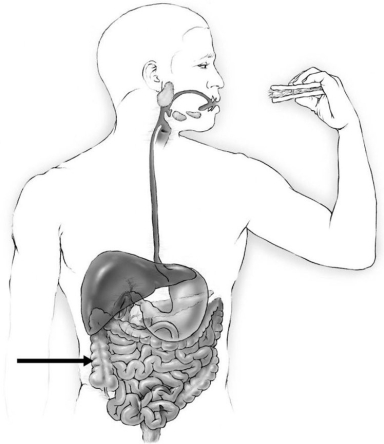 The portion of the gastrointestinal tract indicated by the arrow is the (ascending/descending/sigmoid/transverse) colon.
 (Short Answer)
4.9/5 (70)
(70) The bacterium ________ adheres to and grows on teeth, contributing to dental plaque formation.
(Multiple Choice)
4.8/5 (76)
(76) Which of the following produce the type III secretion system virulence factor?
(Multiple Choice)
4.8/5 (83)
(83) The form of infection with Entamoeba histolytica that is frequently asymptomatic is known as (extraintestinal/dysentery/luminal) amebiasis.
(Short Answer)
4.8/5 (84)
(84) Staphylococcus aureus produces (endotoxin/enterotoxin/toxin B) to cause intoxication.
(Short Answer)
4.8/5 (75)
(75) Which of the following conditions usually results in severe acute liver damage?
(Multiple Choice)
4.9/5 (66)
(66) Salmonella is part of the normal microbiota of virtually all vertebrates except humans.
(True/False)
4.9/5 (73)
(73) The virulence factor of Vibrio cholera, which is primarily responsible for the signs and symptoms of cholera, is
(Multiple Choice)
4.8/5 (76)
(76) Intermediate hosts become infested with tapeworms through ingestion of
(Multiple Choice)
4.9/5 (68)
(68) Care in the handling and disposal of diapers in day care centers may prevent the spread of which of the following?
(Multiple Choice)
4.9/5 (78)
(78) 
Filters
- Essay(0)
- Multiple Choice(0)
- Short Answer(0)
- True False(0)
- Matching(0)