



 Chat with AI
Exam 12: Perfect Competition and the Supply Curve

Exam 1: First Principles233 Questions
Exam 2: Economic Models: Trade-Offs and Trade 25382 Questions
Exam 3: Supply and Demand290 Questions
Exam 4: Consumer and Producer Surplus224 Questions
Exam 5: Price Controls and Quotas: Meddling With Markets227 Questions
Exam 6: Elasticity300 Questions
Exam 7: Taxes298 Questions
Exam 8: International Trade272 Questions
Exam 9: Decision Making by Individuals Firms201 Questions
Exam 10: The Rational Consumer372 Questions
Exam 11: Behind the Supply Curve: Inputs and Costs362 Questions
Exam 12: Perfect Competition and the Supply Curve355 Questions
Exam 13: Monopoly350 Questions
Exam 14: Oligopoly294 Questions
Exam 15: Monopolistic Competition and Product Differentiation262 Questions
Exam 16: Externalities199 Questions
Exam 17: Public Goods Common Resources224 Questions
Exam 18: The Economics of the Welfare140 Questions
Exam 19: Factor Markets and the Distribution of Income369 Questions
Exam 20: Uncertainty, Risk, and Private Information202 Questions
Select questions type


Use the following to answer questions:
Figure: The Perfectly Competitive Firm 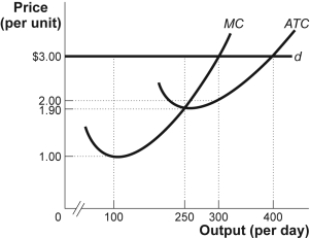 -(Figure: Perfectly Competitive Firm) Look at the figure The Perfectly Competitive Firm. The figure shows a perfectly competitive firm that faces demand curve d and maximizes profit. Given the market price, the firm's total cost per day is:
 (Multiple Choice)
4.7/5  (81)
(81) A perfectly competitive small organic farm produces 1,000 cauliflower heads in the short run. Its ATC = $6 and AFC = $2. The market price is $3 per head and is equal to MC. To maximize profits or minimize losses, this farm should:
(Multiple Choice)
4.8/5 (72)
(72) Suppose that the market for haircuts in a community is perfectly competitive and that the market is initially in long-run equilibrium. Subsequently, a decrease in population decreases the demand for haircuts. In the short run, we expect that the market price will _____ and the output of a typical firm will _____.
(Multiple Choice)
4.7/5 (83)
(83) A perfectly competitive firm maximizes profit in the short run by producing the quantity at which:
(Multiple Choice)
4.9/5 (81)
(81) Use the following to answer question:
Figure: Total Cost for Tomato Producers 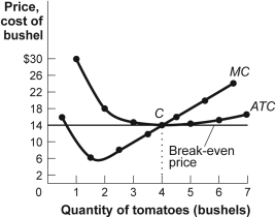 -(Figure: Total Cost for Tomato Producers) Look at the figure Total Cost for Tomato Producers. The market for tomatoes is perfectly competitive. The market price of a bushel of tomatoes is $14. The farmer's total cost at the profit-maximizing number of bushels is:
 (Multiple Choice)
4.9/5 (86)
(86) Use the following to answer questions:
Figure: Game-Day Shirts 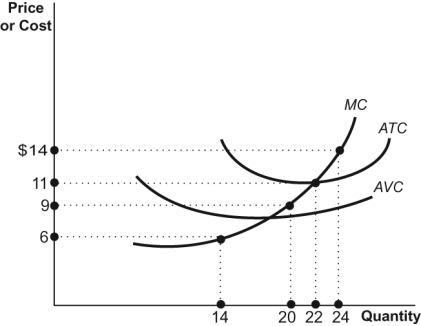 -(Figure: Game-Day Shirts) Rick is one of 10 vendors who sell game-day T-shirts at football games in a perfectly competitive market. His costs are identical to the costs of the other 9 vendors. If the industry is in long-run equilibrium, the price of each shirt will be:
 (Multiple Choice)
4.9/5 (85)
(85) Why does it make sense for a firm to shut down in the short run if the price falls below minimum average variable cost?
(Essay)
4.9/5 (77)
(77) Use the following to answer questions:
Figure: A Perfectly Competitive Firm in the Short Run 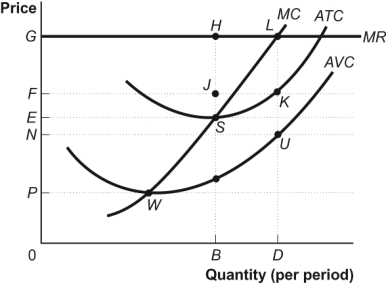 -(Figure: A Perfectly Competitive Firm in the Short Run) Look at the figure A Perfectly Competitive Firm in the Short Run. The firm's total revenue from the sale of its most profitable level of output is:
 (Multiple Choice)
4.9/5 (75)
(75) Use the following to answer questions: 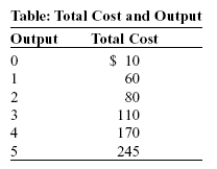 -(Table: Total Cost and Output) Look at the table Total Cost and Output, which describes Sergei's total costs for his perfectly competitive all-natural ice cream firm. If the market price of a tub of ice cream is $20, how much is Sergei's profit at the optimal short-run output?
 (Multiple Choice)
4.8/5 (82)
(82) Use the following to answer questions: 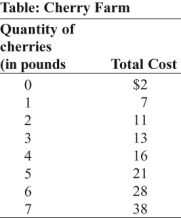 -(Table: Cherry Farm) Look at the table Cherry Farm. If all farms are the same size, how much economic profit will each farm earn when the industry is in long-run equilibrium?
 (Multiple Choice)
4.9/5 (67)
(67) A perfectly competitive industry is said to be efficient because the:
(Multiple Choice)
4.8/5 (72)
(72) Use the following to answer questions:
-(Table: Cherry Farm) Look at the table Cherry Farm. If the price is $10 per pound:
-(Table: Cherry Farm) Look at the table Cherry Farm. If the price is $10 per pound: (Multiple Choice)
4.8/5 (78)
(78) The market for new drugs is not usually perfectly competitive, since the companies manufacturing these drugs are usually granted patents, and this restricts entry into the industry.
(True/False)
4.9/5 (62)
(62) If a perfectly competitive firm sells 300 units of output at $1 per unit, its marginal revenue is:
(Multiple Choice)
4.7/5 (78)
(78) Use the following to answer questions:
-(Table: Total Cost and Output) Look at the table Total Cost and Output, which describes Sergei's total costs for his perfectly competitive all-natural ice cream firm. Which of the following is a point on Sergei's short-run supply curve?
-(Table: Total Cost and Output) Look at the table Total Cost and Output, which describes Sergei's total costs for his perfectly competitive all-natural ice cream firm. Which of the following is a point on Sergei's short-run supply curve? (Multiple Choice)
5.0/5 (88)
(88) Use the following to answer questions:
Figure: The Perfectly Competitive Firm
-(Figure: Perfectly Competitive Firm) Look at the figure The Perfectly Competitive Firm. The figure shows a perfectly competitive firm that faces demand curve d maximizes profit. Given the market price, the firm's total revenue per day is:
-(Figure: Perfectly Competitive Firm) Look at the figure The Perfectly Competitive Firm. The figure shows a perfectly competitive firm that faces demand curve d maximizes profit. Given the market price, the firm's total revenue per day is: (Multiple Choice)
4.9/5 (75)
(75) During the summer, Alex runs a mowing service, and lawn mowing is a perfectly competitive industry. In the short run, Alex will shut down if:
(Multiple Choice)
4.8/5 (76)
(76) Use the following to answer questions:
Figure: The Profit-Maximizing Firm in the Short Run 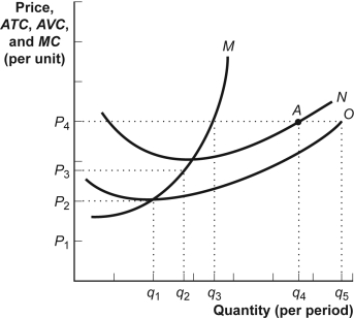 -(Figure: The Profit-Maximizing Firm in the Short Run) Look at the figure The Profit-Maximizing Firm in the Short Run. Which of these curves is the AVC curve?
 (Multiple Choice)
4.9/5 (67)
(67) The short-run supply curve for a perfectly competitive firm is its:
(Multiple Choice)
4.9/5 (78)
(78) 
Filters
- Essay(0)
- Multiple Choice(0)
- Short Answer(0)
- True False(0)
- Matching(0)