



 Chat with AI
Exam 12: Perfect Competition and the Supply Curve

Exam 1: First Principles233 Questions
Exam 2: Economic Models: Trade-Offs and Trade 25382 Questions
Exam 3: Supply and Demand290 Questions
Exam 4: Consumer and Producer Surplus224 Questions
Exam 5: Price Controls and Quotas: Meddling With Markets227 Questions
Exam 6: Elasticity300 Questions
Exam 7: Taxes298 Questions
Exam 8: International Trade272 Questions
Exam 9: Decision Making by Individuals Firms201 Questions
Exam 10: The Rational Consumer372 Questions
Exam 11: Behind the Supply Curve: Inputs and Costs362 Questions
Exam 12: Perfect Competition and the Supply Curve355 Questions
Exam 13: Monopoly350 Questions
Exam 14: Oligopoly294 Questions
Exam 15: Monopolistic Competition and Product Differentiation262 Questions
Exam 16: Externalities199 Questions
Exam 17: Public Goods Common Resources224 Questions
Exam 18: The Economics of the Welfare140 Questions
Exam 19: Factor Markets and the Distribution of Income369 Questions
Exam 20: Uncertainty, Risk, and Private Information202 Questions
Select questions type


Use the following to answer questions:
Figure: Short-Run Costs 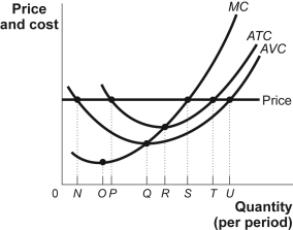 -(Figure: Short-Run Costs) Look at the figure Short-Run Costs. At the given price, the most profitable level of output occurs at quantity:
 (Multiple Choice)
4.8/5  (85)
(85) When a firm cannot affect the market price of the good that it sells, it is said to be a:
(Multiple Choice)
4.8/5 (79)
(79) In a perfectly competitive market, tastes and preferences lead to an increase in the demand for the good. Holding everything else constant, this will lead to an increase in price that will result in _____, which will _____, which will _____.
(Multiple Choice)
4.9/5 (85)
(85) Perfect competition is a model of the market that assumes all of the following EXCEPT:
(Multiple Choice)
4.8/5 (80)
(80) In the long run, when there are economic profits, firms enter the industry, which will increase the market supply and price until economic profits are zero.
(True/False)
4.9/5 (96)
(96) Use the following to answer questions:
Figure: Prices, Cost Curves, and Profits 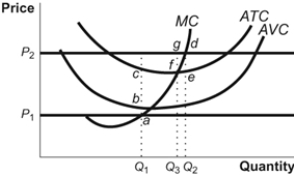 -(Figure: Prices, Cost Curves, and Profits) Look at the figure Prices, Cost Curves, and Profits. If the price is P2 and the firm is profit-maximizing, then the firm's profit is:
 (Multiple Choice)
4.9/5 (81)
(81) If a perfectly competitive firm is producing a quantity where MC < MR, then profit:
(Multiple Choice)
4.9/5 (72)
(72) A perfectly competitive firm will maximize profits when the:
(Multiple Choice)
4.8/5 (84)
(84) For the Colorado beef industry to be classified as perfectly competitive, ranchers in Colorado must have _____ on prices and beef must be a _____ product.
(Multiple Choice)
4.8/5 (97)
(97) If a California avocado stand operates in a perfectly competitive market, that stand owner will be a price:
(Multiple Choice)
4.8/5 (84)
(84) Suppose economic profits exist in perfect competition in the short run. Firms will enter in the long run because of easy entry, the short-run market _____ curve will shift to the right, and _____ will _____.
(Multiple Choice)
4.9/5 (80)
(80) Use the following to answer questions: 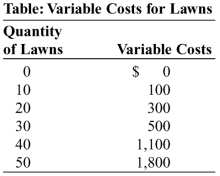 -(Table: Variable Costs for Lawns) Look at the table Variable Costs for Lawns. During the summer, Alex runs a lawn-mowing service, and lawn-mowing is a perfectly competitive industry. Assume that costs are constant in each interval; that is, the variable cost of mowing 1 through 10 lawns is $100. His only fixed cost is $1,000 for the mower. His variable costs include fuel, his time, and mower parts. If the price for mowing a lawn is $70, how much is Alex's total cost at the profit-maximizing output?
 (Multiple Choice)
4.9/5 (80)
(80) Use the following to answer questions:
-(Table: Variable Costs for Lawns) Look at the table Variable Costs for Lawns. During the summer, Alex runs a lawn-mowing service, and lawn-mowing is a perfectly competitive industry. Assume that costs are constant in each interval; that is, the variable cost of mowing 1 through 10 lawns is $100. His only fixed cost is $1,000 for the mower. His variable costs include fuel, his time, and mower parts. Which of the following is a point on the industry short-run supply curve?
-(Table: Variable Costs for Lawns) Look at the table Variable Costs for Lawns. During the summer, Alex runs a lawn-mowing service, and lawn-mowing is a perfectly competitive industry. Assume that costs are constant in each interval; that is, the variable cost of mowing 1 through 10 lawns is $100. His only fixed cost is $1,000 for the mower. His variable costs include fuel, his time, and mower parts. Which of the following is a point on the industry short-run supply curve? (Multiple Choice)
4.7/5 (80)
(80) Use the following to answer questions:
Figure: The Perfectly Competitive Firm II 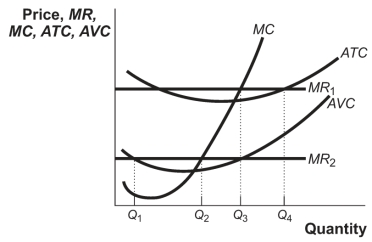 -(Figure: The Perfectly Competitive Firm II) Look at the figure The Perfectly Competitive Firm II. If this firm's MR curve is MR1, the firm will maximize profit by producing _____ units of output, and its economic profit will be _____.
 (Multiple Choice)
4.9/5 (84)
(84) Use the following to answer questions:
Figure: Game-Day Shirts 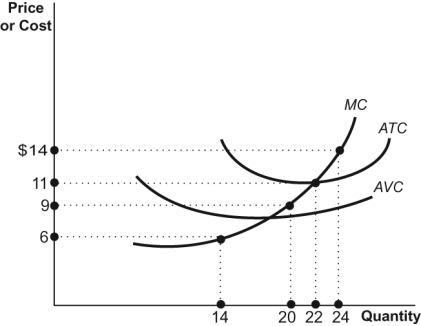 -(Figure: Game-Day Shirts) Rick is one of 10 vendors who sell game-day T-shirts at football games in a perfectly competitive market. His costs are identical to the costs of the other 9 vendors. When the industry is in long-run equilibrium, the price of each shirt will be _____, and the total quantity supplied will be _____.
 (Multiple Choice)
4.7/5 (80)
(80) In the short run, if P = ATC, a perfectly competitive firm:
(Multiple Choice)
5.0/5 (110)
(110) Sam is one of many growers who sell potatoes to a large food-processing plant. The price of a bushel of potatoes is $4, and Sam sells 100 bushels at that price. He has $250 of fixed cost. Sam figures if he produces one more bushel of potatoes, his total variable costs will increase from $175 to $180. Should Sam produce any more potatoes at $4? Explain. Will he earn a positive economic profit? Show how you came to your answer.
(Essay)
4.9/5 (83)
(83) Use the following to answer questions:
-(Table: Variable Costs for Lawns) Look at the table Variable Costs for Lawns. During the summer, Alex runs a lawn-mowing service, and lawn-mowing is a perfectly competitive industry. Assume that costs are constant in each interval; that is, the variable cost of mowing 1 through 10 lawns is $100. His only fixed cost is $1,000 for the mower. His variable costs include fuel, his time, and mower parts. If the price for mowing a lawn is $60, how much is Alex's total revenue at the profit-maximizing output?
-(Table: Variable Costs for Lawns) Look at the table Variable Costs for Lawns. During the summer, Alex runs a lawn-mowing service, and lawn-mowing is a perfectly competitive industry. Assume that costs are constant in each interval; that is, the variable cost of mowing 1 through 10 lawns is $100. His only fixed cost is $1,000 for the mower. His variable costs include fuel, his time, and mower parts. If the price for mowing a lawn is $60, how much is Alex's total revenue at the profit-maximizing output? (Multiple Choice)
4.8/5 (81)
(81) 
Filters
- Essay(0)
- Multiple Choice(0)
- Short Answer(0)
- True False(0)
- Matching(0)