



 Chat with AI
Exam 12: Perfect Competition and the Supply Curve

Exam 1: First Principles233 Questions
Exam 2: Economic Models: Trade-Offs and Trade 25382 Questions
Exam 3: Supply and Demand290 Questions
Exam 4: Consumer and Producer Surplus224 Questions
Exam 5: Price Controls and Quotas: Meddling With Markets227 Questions
Exam 6: Elasticity300 Questions
Exam 7: Taxes298 Questions
Exam 8: International Trade272 Questions
Exam 9: Decision Making by Individuals Firms201 Questions
Exam 10: The Rational Consumer372 Questions
Exam 11: Behind the Supply Curve: Inputs and Costs362 Questions
Exam 12: Perfect Competition and the Supply Curve355 Questions
Exam 13: Monopoly350 Questions
Exam 14: Oligopoly294 Questions
Exam 15: Monopolistic Competition and Product Differentiation262 Questions
Exam 16: Externalities199 Questions
Exam 17: Public Goods Common Resources224 Questions
Exam 18: The Economics of the Welfare140 Questions
Exam 19: Factor Markets and the Distribution of Income369 Questions
Exam 20: Uncertainty, Risk, and Private Information202 Questions
Select questions type


In the short run, if P > ATC, a perfectly competitive firm:
(Multiple Choice)
4.8/5  (68)
(68) Use the following to answer questions:
Figure: A Perfectly Competitive Firm in the Short Run 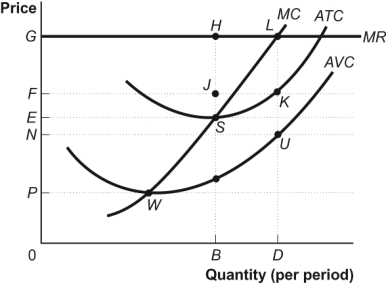 -(Figure: A Perfectly Competitive Firm in the Short Run) Look at the figure A Perfectly Competitive Firm in the Short Run. The firm will produce in the short run if the price is at least as high as point:
 (Multiple Choice)
4.8/5 (87)
(87) The marginal revenue received by a firm in a perfectly competitive market:
(Multiple Choice)
4.8/5 (68)
(68) Use the following to answer questions:
Figure: The Perfectly Competitive Firm 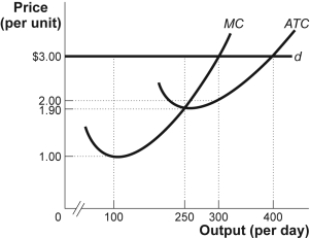 -(Figure: Perfectly Competitive Firm) Look at the figure The Perfectly Competitive Firm. The figure shows a perfectly competitive firm that faces demand curve d and maximizes profit. If the market price is $3, the firm will produce _____ units of output per day.
 (Multiple Choice)
4.8/5 (73)
(73) A perfectly competitive firm will earn a profit in the short run when it produces the profit-maximizing quantity of output and the price is:
(Multiple Choice)
4.8/5 (68)
(68) Microsoft's Windows operating system is a standardized product, since everyone who buys a particular version of the product gets exactly the same thing. This means that Microsoft is a perfectly competitive firm.
(True/False)
4.9/5 (74)
(74) Use the following to answer questions: 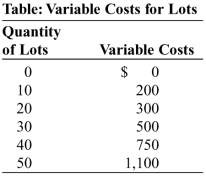 -(Table: Variable Costs for Lots) Look at the table Variable Costs for Lots. During the winter, Alexa runs a snow-clearing service in a perfectly competitive industry. Assume that costs are constant in each interval; that is, the variable cost of clearing anywhere from 1 through 10 lots is $200. Her only fixed cost is $1,000 for a snowplow. Her variable costs include fuel, her time, and hot coffee. Which of the following is a point on Alexa's short-run supply curve?
 (Multiple Choice)
4.7/5 (73)
(73) Use the following to answer questions:
-(Table: Variable Costs for Lots) Look at the table Variable Costs for Lots. During the winter, Alexa runs a snow-clearing service in a perfectly competitive industry. Assume that costs are constant in each interval; that is, the variable cost of clearing anywhere from 1 through 10 lots is $200. Her only fixed cost is $1,000 for a snowplow. Her variable costs include fuel, her time, and hot coffee. If the price per cleared lot is $14, how many lots should Alexa clear?
-(Table: Variable Costs for Lots) Look at the table Variable Costs for Lots. During the winter, Alexa runs a snow-clearing service in a perfectly competitive industry. Assume that costs are constant in each interval; that is, the variable cost of clearing anywhere from 1 through 10 lots is $200. Her only fixed cost is $1,000 for a snowplow. Her variable costs include fuel, her time, and hot coffee. If the price per cleared lot is $14, how many lots should Alexa clear? (Multiple Choice)
4.9/5 (72)
(72) Use the following to answer questions: 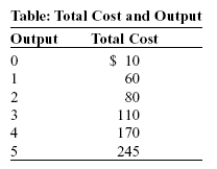 -(Table: Total Cost and Output) Look at the table Total Cost and Output, which describes Sergei's total costs for his perfectly competitive all-natural ice cream firm. If the market price of a tub of ice cream is $67.50, how much is Sergei's profit at the profit-maximizing output?
 (Multiple Choice)
4.8/5 (81)
(81) Which of the following is a necessary condition for perfect competition?
(Multiple Choice)
4.8/5 (76)
(76) Use the following to answer questions: 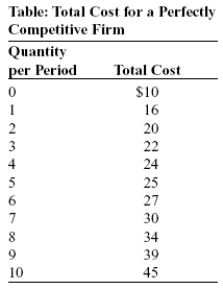 -(Table: Total Cost for a Perfectly Competitive Firm) Look at the table Total Cost for a Perfectly Competitive Firm. If the market price is $3.50, the profit-maximizing output is _____ units.
 (Multiple Choice)
4.8/5 (81)
(81) Use the following to answer questions:
Figure: Cost Curves for Corn Producers 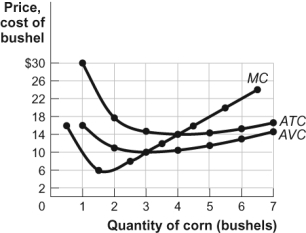 -(Figure: Cost Curves for Corn Producers) Look at the figure Cost Curves for Corn Producers. The market for corn is perfectly competitive. If the price of a bushel of corn is $4, in the short run the farmer will produce _____ bushels of corn and earn an economic _____ equal to _____.
 (Multiple Choice)
4.8/5 (90)
(90) A perfectly competitive firm will incur an economic loss but will continue producing output in the short run if the price is:
(Multiple Choice)
4.7/5 (78)
(78) A perfectly competitive firm's marginal cost curve above the average variable cost curve is its _____ curve.
(Multiple Choice)
4.9/5 (87)
(87) In the long run, all of the firms in a perfectly competitive industry will:
(Multiple Choice)
4.8/5 (73)
(73) The lowest point on a perfectly competitive firm's short-run supply curve corresponds to the minimum point on the _____ curve.
(Multiple Choice)
4.9/5 (83)
(83) Use the following to answer questions: 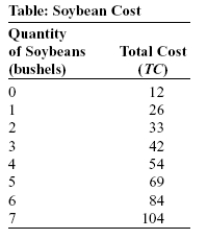 -(Table: Soybean Cost) Look at the table Soybean Cost. If the market price of a bushel of soybeans is $15, how many bushels will the farmer produce to maximize short-run profit?
 (Multiple Choice)
4.8/5 (94)
(94) 
Filters
- Essay(0)
- Multiple Choice(0)
- Short Answer(0)
- True False(0)
- Matching(0)