



 Chat with AI
Exam 12: Perfect Competition and the Supply Curve

Exam 1: First Principles233 Questions
Exam 2: Economic Models: Trade-Offs and Trade 25382 Questions
Exam 3: Supply and Demand290 Questions
Exam 4: Consumer and Producer Surplus224 Questions
Exam 5: Price Controls and Quotas: Meddling With Markets227 Questions
Exam 6: Elasticity300 Questions
Exam 7: Taxes298 Questions
Exam 8: International Trade272 Questions
Exam 9: Decision Making by Individuals Firms201 Questions
Exam 10: The Rational Consumer372 Questions
Exam 11: Behind the Supply Curve: Inputs and Costs362 Questions
Exam 12: Perfect Competition and the Supply Curve355 Questions
Exam 13: Monopoly350 Questions
Exam 14: Oligopoly294 Questions
Exam 15: Monopolistic Competition and Product Differentiation262 Questions
Exam 16: Externalities199 Questions
Exam 17: Public Goods Common Resources224 Questions
Exam 18: The Economics of the Welfare140 Questions
Exam 19: Factor Markets and the Distribution of Income369 Questions
Exam 20: Uncertainty, Risk, and Private Information202 Questions
Select questions type


If a firm in perfect competition sells 10 units of output at $5 per unit, its marginal revenue is:
(Multiple Choice)
4.8/5  (83)
(83) Suppose that the market for haircuts in a community is perfectly competitive and that the market is initially in long-run equilibrium. Subsequently, an increase in population increases the demand for haircuts. In the short run, the typical firm is likely to:
(Multiple Choice)
4.9/5 (84)
(84) Use the following to answer questions:
Figure: The Profit-Maximizing Firm in the Short Run 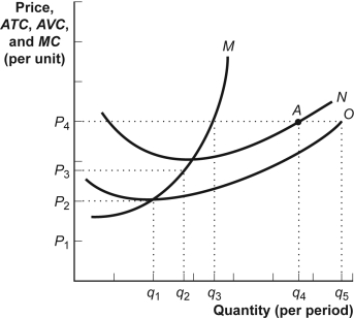 -(Figure: The Profit-Maximizing Firm in the Short Run) Look at the figure The Profit-Maximizing Firm in the Short Run. If the market price is less than P2, the firm will _____ in the short run.
 (Multiple Choice)
4.9/5 (74)
(74) A perfectly competitive tomato industry is in long-run equilibrium. Now suppose that some consumers are getting sick by eating tomatoes that contain salmonella. Describe how this change will affect short-run economic profits. What will happen to the number of tomato growers in the long run? How will price and output in this industry adjust in the long run?
(Essay)
4.8/5 (81)
(81) If a perfectly competitive firm is producing a quantity where P > MC, then the firm can increase profit by:
(Multiple Choice)
5.0/5 (73)
(73) Use the following to answer questions: 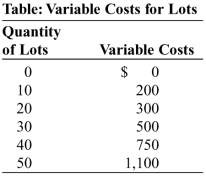 -(Table: Variable Costs for Lots) Look at the table Variable Costs for Lots. During the winter, Alexa runs a snow-clearing service in a perfectly competitive industry. Assume that costs are constant in each interval; that is, the variable cost of clearing anywhere from 1 through 10 lots is $200. Her only fixed cost is $1,000 for a snowplow. Her variable costs include fuel, her time, and hot coffee. At what price does Alexa' s short-run supply curve start?
 (Multiple Choice)
4.8/5 (76)
(76) Suppose that the market for haircuts in a community is a perfectly competitive constant-cost industry and that the market is initially in long-run equilibrium. Subsequently, an increase in population increases the demand for haircuts. In the long run, firms will _____ the market, driving the price of haircuts _____ and the profits of individual firms _____.
(Multiple Choice)
4.8/5 (83)
(83) Maximizing profits also means that a firm is attempting to:
(Multiple Choice)
4.8/5 (77)
(77) Use the following to answer questions:
Figure: A Perfectly Competitive Firm in the Short Run 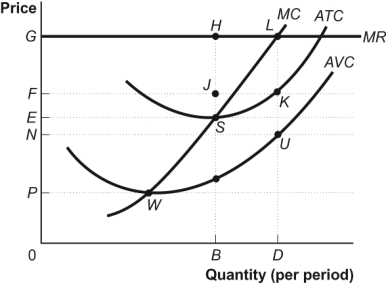 -(Figure: A Perfectly Competitive Firm in the Short Run) Look at the figure A Perfectly Competitive Firm in the Short Run. If the market price is G, the firm's total cost of producing its most profitable level of output is:
 (Multiple Choice)
5.0/5 (80)
(80) Use the following to answer questions:
Figure: The Profit-Maximizing Firm in the Short Run
-(Figure: The Profit-Maximizing Firm in the Short Run) Look at the figure The Profit-Maximizing Firm in the Short Run. If the market price is P4, marginal revenue:
-(Figure: The Profit-Maximizing Firm in the Short Run) Look at the figure The Profit-Maximizing Firm in the Short Run. If the market price is P4, marginal revenue: (Multiple Choice)
4.8/5 (72)
(72) Use the following to answer questions: 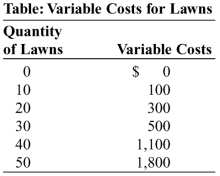 -(Table: Variable Costs for Lawns) Look at the table Variable Costs for Lawns. During the summer, Alex runs a lawn-mowing service, and lawn-mowing is a perfectly competitive industry. Assume that costs are constant in each interval; that is, the variable cost of mowing 1 through 10 lawns is $100. His only fixed cost is $1,000 for the mower. His variable costs include fuel, his time, and mower parts. If the price for mowing a lawn is $60, how much is Alex's profit at the profit-maximizing output?
 (Multiple Choice)
4.8/5 (76)
(76) Suppose that the market for candy canes operates under conditions of perfect competition, that it is initially in long-run equilibrium, that the price of each candy cane is $0.10, and that the market demand curve is downward-sloping. The price of sugar rises, increasing the marginal and average total costs of producing candy canes by $0.05. In the short run a typical producer of candy canes will be making:
(Multiple Choice)
4.9/5 (72)
(72) If the price is less than the average variable cost at the quantity of output where MR = MC, in the short run a perfectly competitive firm will:
(Multiple Choice)
4.7/5 (74)
(74) Use the following to answer questions:
Figure: Revenues, Costs, and Profits for Tomato Producers III 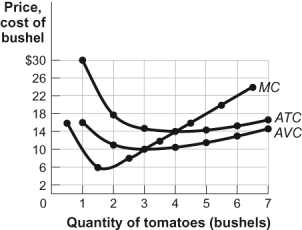 -(Figure: Revenues, Costs, and Profits for Tomato Producers III) Look at the figure Revenues, Costs, and Profits for Tomato Producers III. The market for tomatoes is perfectly competitive. If the market price of a bushel of tomatoes is $12, in the short run this farm will:
 (Multiple Choice)
4.9/5 (83)
(83) Many furniture stores run "going out of business" sales but never go out of business. For the shut-down decision to be the appropriate one, the price of furniture must be _____ than the _____ average variable cost.
(Multiple Choice)
4.9/5 (78)
(78) Consider a perfectly competitive firm in the short run. Assume the firm produces the profit-maximizing output and earns economic profits. Which statement is FALSE?
(Multiple Choice)
4.8/5 (78)
(78) 
Filters
- Essay(0)
- Multiple Choice(0)
- Short Answer(0)
- True False(0)
- Matching(0)