



 Chat with AI
Exam 5: Thermochemistry

Exam 1: Chemistry: the Central Science133 Questions
Exam 2: Atoms, Molecules, and Ions124 Questions
Exam 3: Stoichiometry: Ratios of Combination137 Questions
Exam 4: Reactions in Aqueous Solutions146 Questions
Exam 5: Thermochemistry141 Questions
Exam 6: Quantum Theory and the Electronic Structure of Atoms135 Questions
Exam 7: Electron Configuration and the Periodic Table120 Questions
Exam 8: Chemical Bonding I: Basic Concepts102 Questions
Exam 9: Chemical Bonding II: Molecular Geometry and Bonding Theories139 Questions
Exam 10: Gases137 Questions
Exam 11: Intermolecular Forces and the Physical Properties of Liquids and Solids137 Questions
Exam 12: Modern Materials108 Questions
Exam 13: Physical Properties of Solutions151 Questions
Exam 14: Chemical Kinetics132 Questions
Exam 15: Chemical Equilibrium146 Questions
Exam 16: Acids and Bases137 Questions
Exam 17: Acid-Base Equilibria and Solubility Equilibria133 Questions
Exam 18: Entropy, Free Energy, and Equilibrium107 Questions
Exam 19: Electrochemistry122 Questions
Exam 20: Nuclear Chemistry127 Questions
Exam 21: Environmental Chemistry135 Questions
Exam 22: Coordination Chemistry132 Questions
Exam 23: Metallurgy and the Chemistry of Metals152 Questions
Exam 24: Nonmetallic Elements and Their Compounds117 Questions
Exam 25: Organic Chemistry121 Questions
Select questions type


Using Hess's law, what is ΔH°rxn for the following reaction? NO(g) + O(g) → NO2(g) 
(Multiple Choice)
4.7/5  (82)
(82) A 275-g sample of nickel at l00.0°C is placed in 100.0 g of water at 22.0°C. What is the final temperature of the water? Assume no heat transfer with the surroundings. The specific heat of nickel is 0.444 J/g·°C and the specific heat of water is 4.184 J/g·°C.
(Multiple Choice)
4.9/5 (86)
(86) Which equation has a ΔHrxn that is not equal to ΔHof of the product?
(Multiple Choice)
5.0/5 (70)
(70) The combustion of pentane produces heat according to the following thermochemical equation. C5H12(l) + 8O2(g) → 5CO2(g) + 6H2O(l) ΔH°rxn= -3510 kJ/mol
How many grams of CO2 is produced per 2.50 × 10³ kJ of heat released?
(Multiple Choice)
4.9/5 (88)
(88) How much heat is required to raise the temperature of 22.8 g of copper from 20.0°C to 875.0°C? The specific heat of copper is 0.385 J/g·°C.
(Multiple Choice)
4.8/5 (84)
(84) What is ΔH°rxn for the following reaction? C6H6(l) + 15/2 O2(g) → 6CO2(g) + 3H2O(l)
6C(graphite) + 3H2(g) → C6H6(l) ΔH°rxn = +49.0 kJ/mol
C(graphite) + O2(g) → CO2(g) ΔH°rxn = -393.5 kJ/mol
H2(g) + ½O2(g) → H2O(l) ΔH°rxn = -285.8 kJ/mol
(Multiple Choice)
4.9/5 (65)
(65) Cold packs, whose temperatures are lowered when ammonium nitrate dissolves in water, are carried by athletic trainers when transporting ice is not possible. Which of the following is true of this reaction?
(Multiple Choice)
5.0/5 (78)
(78) Clearly state the thermodynamic standard state of
a. an element or compound.
b. a solute.
(Essay)
4.8/5 (73)
(73) If two solutions are mixed together in a container and the container "feels hot", then
(Multiple Choice)
5.0/5 (84)
(84) What is ΔH°rxn for the following reaction? NO2(g) + CO(g) → CO2(g) + NO(g) 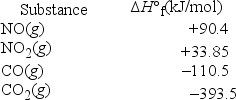
(Multiple Choice)
4.8/5 (60)
(60) The standard temperature is ________; the standard concentration of a solution is ________; and the standard pressure is ________.
(Essay)
4.9/5 (80)
(80) A glass containing 200.0 g of H2O at 20.0°C was placed in a refrigerator. The water loses 11.7 kJ of heat as it cools to a constant temperature. What is its new temperature? The specific heat of water is 4.184 J/g·°C.
(Multiple Choice)
4.9/5 (87)
(87) A 307-g sample of an unknown mineral was heated to 98.7°C and placed into a calorimeter containing 72.4 g of water at 23.6°C. The heat capacity of the calorimeter was 15.7 J/°C. The final temperature in the calorimeter was 32.4°C. What is the specific heat capacity of the mineral?
(Multiple Choice)
4.9/5 (76)
(76) A system contracts from an initial volume of 15.0 L to a final volume of 10.0 L under a constant external pressure of 0.80 atm. What is w? (1 L·atm = 101.3 J)
(Multiple Choice)
4.8/5 (96)
(96) Suppose a new metallic element X is discovered, and its reactions with oxygen gas and chlorine gas at 298 K are studied.  However, it is later discovered that one of the samples was contaminated, and the ΔHºrxn value from this trial is not reliable. Which trial had the contaminated sample, and what should the correct value of ΔHºrxn be for this trial?
 (Multiple Choice)
4.9/5 (71)
(71) Given that CaO(s) + H2O(l) → Ca(OH)2(s), ΔH°rxn = -64.8 kJ/mol, how many grams of CaO must react in order to liberate 525 kJ of heat?
(Multiple Choice)
5.0/5 (98)
(98) Pentaborane B5H9(s) burns vigorously in O2 to give B2O3(s) and H2O(l). What is ΔH° for the combustion of 1 mol of B5H9(s)? Substance ΔH°f (kJ/mol)
B2O3(s) -1273.5
B5H9(s) +73.2
H2O(l) -285.8
(Multiple Choice)
4.9/5 (68)
(68) When heat is absorbed by the system and work is done by the system on the surroundings then
(Multiple Choice)
4.8/5 (69)
(69) Atoms A and Z may form either single bonds or double bonds. Shown is an energy diagram for the formation of a single bond between A and Z from the individual atoms in the gas phase. 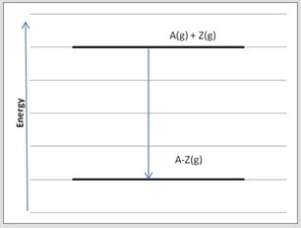 Which diagram below corresponds to the reaction A(g) + Z(g) → A=Z(g)?
 (Multiple Choice)
4.7/5 (72)
(72) 
Filters
- Essay(0)
- Multiple Choice(0)
- Short Answer(0)
- True False(0)
- Matching(0)