



 Chat with AI
Exam 5: Thermochemistry

Exam 1: Chemistry: the Central Science133 Questions
Exam 2: Atoms, Molecules, and Ions124 Questions
Exam 3: Stoichiometry: Ratios of Combination137 Questions
Exam 4: Reactions in Aqueous Solutions146 Questions
Exam 5: Thermochemistry141 Questions
Exam 6: Quantum Theory and the Electronic Structure of Atoms135 Questions
Exam 7: Electron Configuration and the Periodic Table120 Questions
Exam 8: Chemical Bonding I: Basic Concepts102 Questions
Exam 9: Chemical Bonding II: Molecular Geometry and Bonding Theories139 Questions
Exam 10: Gases137 Questions
Exam 11: Intermolecular Forces and the Physical Properties of Liquids and Solids137 Questions
Exam 12: Modern Materials108 Questions
Exam 13: Physical Properties of Solutions151 Questions
Exam 14: Chemical Kinetics132 Questions
Exam 15: Chemical Equilibrium146 Questions
Exam 16: Acids and Bases137 Questions
Exam 17: Acid-Base Equilibria and Solubility Equilibria133 Questions
Exam 18: Entropy, Free Energy, and Equilibrium107 Questions
Exam 19: Electrochemistry122 Questions
Exam 20: Nuclear Chemistry127 Questions
Exam 21: Environmental Chemistry135 Questions
Exam 22: Coordination Chemistry132 Questions
Exam 23: Metallurgy and the Chemistry of Metals152 Questions
Exam 24: Nonmetallic Elements and Their Compounds117 Questions
Exam 25: Organic Chemistry121 Questions
Select questions type


A student used a bomb calorimeter to determine the heat of combustion of an unknown compound. If the student ignored the heat capacity of the bomb calorimeter, the heat capacity of the unknown compound would be ________ the accepted value.
(Multiple Choice)
4.8/5  (86)
(86) A system initially has an internal energy U of 504 J. It undergoes a process during which it releases 111 J of heat energy to the surroundings, and does work of 222 J. What is the final energy of the system, in J?
(Multiple Choice)
4.7/5 (78)
(78) The bond enthalpy of the Br-Cl bond is equal to ΔH°rxn for the following reaction. BrCl(g) → Br(g) + Cl(g)
Using the following data, what is the bond enthalpy of the Br-Cl bond? 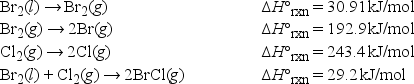
(Multiple Choice)
4.9/5 (87)
(87) A system that does no work but which transfers heat to the surroundings has
(Multiple Choice)
5.0/5 (78)
(78) Styrene, C8H8, is one of the substances used in the production of synthetic rubber. When styrene burns in oxygen to form carbon dioxide and liquid water under standard-state conditions at 25°C, 42.15 kJ are released per gram of styrene. Find the standard enthalpy of formation of styrene at 25°C. ΔH°f(CO2(g)) = -393.5 kJ/mol, ΔH°f(H2O(l)) = -285.8 kJ/mol
(Multiple Choice)
4.9/5 (83)
(83) An important step in the synthesis of nitric acid is the conversion of ammonia to nitric oxide according to the following balanced chemical equation. What is ΔH°rxn for this reaction? 4NH3(g) + 5O2(g) → 4NO(g) + 6H2O(g) 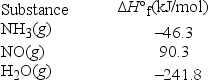
(Multiple Choice)
4.9/5 (96)
(96) A Snickers® candy bar contains 280 Calories, of which the fat content accounts for 120 Calories. What is the energy of the fat content, in kJ? (1 cal = 4.184 J)
(Multiple Choice)
4.8/5 (82)
(82) A system absorbs 21.6 kJ of heat while performing 6.9 kJ of work on the surroundings. If the initial internal energy, U, is 61.2 kJ, what is the final value of U?
(Multiple Choice)
4.9/5 (88)
(88) The sign of q when heat is absorbed by the system is ________.
(Short Answer)
4.8/5 (90)
(90) Suppose a sample of gas undergoes the following change of state. 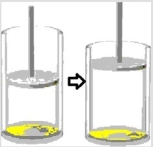 Which statement(s) is/are true concerning this change of state?
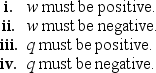
Which statement(s) is/are true concerning this change of state? (Multiple Choice)
4.9/5 (89)
(89) The heat of solution of ammonium chloride is 15.2 kJ/mol. If a 6.134-g sample of NH4Cl is added to 65.0 mL of water in a calorimeter at 24.5°C, what is the final temperature of the solution? The specific heat of water is 4.18 J/g·°C and the heat capacity of the calorimeter is 365 J/°C.
(Multiple Choice)
4.9/5 (73)
(73) Ethylene glycol, used as a coolant in automotive engines, has a specific heat capacity of 2.42 J/g°C. Calculate q when 3.65 kg of ethylene glycol is cooled from 132°C to 85°C.
(Multiple Choice)
5.0/5 (78)
(78) What is the standard enthalpy change for the decomposition of one mole of SO3? 2SO2 + O2→ 2SO3 ΔH°rxn = -198 kJ/mol
(Multiple Choice)
4.7/5 (75)
(75) A system that does no work but which receives heat from the surroundings has
(Multiple Choice)
4.9/5 (91)
(91) How much heat is required to raise the temperature of 12.0 g of water from 15.4°C to 93.0°C? The specific heat of water is 4.184 J/g·°C.
(Multiple Choice)
4.8/5 (83)
(83) The work done on the surroundings by the expansion of a gas is w = -PΔV.
(True/False)
4.9/5 (79)
(79) Which type of system may transfer energy, but not mass, to the surroundings?
(Multiple Choice)
4.8/5 (86)
(86) 
Filters
- Essay(0)
- Multiple Choice(0)
- Short Answer(0)
- True False(0)
- Matching(0)