



 Chat with AI
Exam 5: Thermochemistry

Exam 1: Chemistry: the Central Science133 Questions
Exam 2: Atoms, Molecules, and Ions124 Questions
Exam 3: Stoichiometry: Ratios of Combination137 Questions
Exam 4: Reactions in Aqueous Solutions146 Questions
Exam 5: Thermochemistry141 Questions
Exam 6: Quantum Theory and the Electronic Structure of Atoms135 Questions
Exam 7: Electron Configuration and the Periodic Table120 Questions
Exam 8: Chemical Bonding I: Basic Concepts102 Questions
Exam 9: Chemical Bonding II: Molecular Geometry and Bonding Theories139 Questions
Exam 10: Gases137 Questions
Exam 11: Intermolecular Forces and the Physical Properties of Liquids and Solids137 Questions
Exam 12: Modern Materials108 Questions
Exam 13: Physical Properties of Solutions151 Questions
Exam 14: Chemical Kinetics132 Questions
Exam 15: Chemical Equilibrium146 Questions
Exam 16: Acids and Bases137 Questions
Exam 17: Acid-Base Equilibria and Solubility Equilibria133 Questions
Exam 18: Entropy, Free Energy, and Equilibrium107 Questions
Exam 19: Electrochemistry122 Questions
Exam 20: Nuclear Chemistry127 Questions
Exam 21: Environmental Chemistry135 Questions
Exam 22: Coordination Chemistry132 Questions
Exam 23: Metallurgy and the Chemistry of Metals152 Questions
Exam 24: Nonmetallic Elements and Their Compounds117 Questions
Exam 25: Organic Chemistry121 Questions
Select questions type


Two solutions (the system), each with a volume of 25.0 mL at 25.0°C, are mixed in a beaker. A reaction occurs between them, and the temperature rises to 35.0°C. After the products have equilibrated with the surroundings, the temperature is again 25.0°C and the total volume is 50.0 mL. No gases are involved in the reaction. Which relationship concerning the change from initial to final states (both at 25.0°C) is correct?
(Multiple Choice)
4.9/5  (83)
(83) Naphthalene combustion may be used to calibrate the heat capacity of a bomb calorimeter. The heat of combustion of naphthalene is -40.1 kJ/g. When 0.8210 g of naphthalene was burned in a bomb calorimeter containing 1.000 kg of water, a temperature rise of 4.21°C was observed. What is the heat capacity of the bomb calorimeter excluding the water?
(Multiple Choice)
4.9/5 (88)
(88) If 75.4 J of energy is absorbed by 0.25 mol of CCl4 at constant pressure, what is the change in temperature? The specific heat of CCl4 is 0.861 J/g·°C.
(Multiple Choice)
4.9/5 (94)
(94) When an automobile engine starts, the metal parts immediately begin to absorb heat released during the combustion of gasoline. How much heat will be absorbed by a 165-kg iron engine block when the temperature rises from 15.7°C to 95.7°C? (The specific heat of iron is 0.489 J/g·°C.)
(Short Answer)
4.7/5 (81)
(81) Which represents an enthalpy change at 25 °C and 1 atm that is equal to ΔHof for H2O(l)?
(Multiple Choice)
5.0/5 (69)
(69) A(n) ________ ________ is a process where heat is absorbed from the surroundings.
(Short Answer)
4.9/5 (78)
(78) What is q if 28.6 g of water is heated from 22.0°C to 78.3°C? The specific heat of water is 4.184 J/g·°C.
(Multiple Choice)
4.8/5 (82)
(82) Based on the following thermochemical equations, what is the heat of vaporization of titanium(IV) chloride? Ti(s) + 2 Cl2(g) → TiCl4(l) ΔH = -804.2 kJ/mol
TiCl4(g) → 2 Cl2(g) + Ti(s) ΔH = 763.2 kJ/mol
(Multiple Choice)
4.8/5 (82)
(82) Thunderstorms are powered by the heat released when water vapor changes to rain drops. How much heat is released when a gallon of rain falls? (1 gal = 3,785 g; specific heat of vaporization of water = 2,262 J/g)
(Short Answer)
4.8/5 (82)
(82) The enthalpy change for making one mole of a compound from its elements is called the ________.
(Short Answer)
4.9/5 (78)
(78) Suppose a 0.500-g sample of an organic compound is analyzed via bomb calorimetry. The temperature of the calorimeter is measured over time. At t = 5 min, the combustion reaction is initiated. Below is a plot of the data that are obtained. 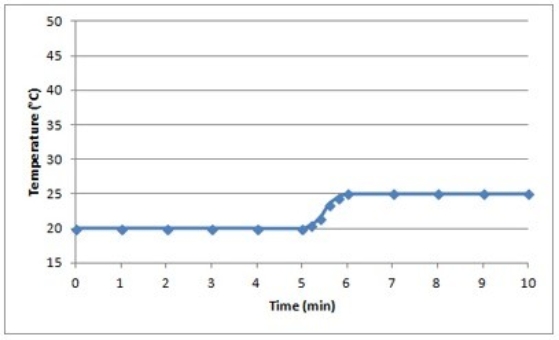 Suppose the experiment is repeated under identical conditions, but with a 1.000-g sample of the organic compound. What might a plot of the resulting data look like?
 (Multiple Choice)
4.9/5 (86)
(86) A system delivers 1275 J of heat while the surroundings perform 854 J of work on it. What is ΔU of the system?
(Multiple Choice)
4.8/5 (79)
(79) What is the change in temperature if a 25.0-g block of aluminum absorbs 10.0 kJ of heat? The specific heat of aluminum is 0.900 J/g·°C.
(Multiple Choice)
4.9/5 (81)
(81) At body temperature 2404 joules of energy are required to evaporate 1.00 g of water. After vigorous exercise, a person feels chilly because the body is giving up heat to evaporate the perspiration. A typical person perspires 25 mL of water after 20. minutes of exercise. How much body heat is this person using to evaporate this water?
(Short Answer)
4.8/5 (89)
(89) The sign of w when work is done by the system on the surroundings is ________.
(Short Answer)
4.9/5 (78)
(78) A system expands from a volume of 1.00 L to 2.00 L against a constant external pressure of 1.00 atm. What is the work (w) done by the system? (1 L·atm = 101.3 J)
(Multiple Choice)
4.8/5 (77)
(77) 
Filters
- Essay(0)
- Multiple Choice(0)
- Short Answer(0)
- True False(0)
- Matching(0)