



 Chat with AI
Exam 5: Thermochemistry

Exam 1: Chemistry: the Central Science133 Questions
Exam 2: Atoms, Molecules, and Ions124 Questions
Exam 3: Stoichiometry: Ratios of Combination137 Questions
Exam 4: Reactions in Aqueous Solutions146 Questions
Exam 5: Thermochemistry141 Questions
Exam 6: Quantum Theory and the Electronic Structure of Atoms135 Questions
Exam 7: Electron Configuration and the Periodic Table120 Questions
Exam 8: Chemical Bonding I: Basic Concepts102 Questions
Exam 9: Chemical Bonding II: Molecular Geometry and Bonding Theories139 Questions
Exam 10: Gases137 Questions
Exam 11: Intermolecular Forces and the Physical Properties of Liquids and Solids137 Questions
Exam 12: Modern Materials108 Questions
Exam 13: Physical Properties of Solutions151 Questions
Exam 14: Chemical Kinetics132 Questions
Exam 15: Chemical Equilibrium146 Questions
Exam 16: Acids and Bases137 Questions
Exam 17: Acid-Base Equilibria and Solubility Equilibria133 Questions
Exam 18: Entropy, Free Energy, and Equilibrium107 Questions
Exam 19: Electrochemistry122 Questions
Exam 20: Nuclear Chemistry127 Questions
Exam 21: Environmental Chemistry135 Questions
Exam 22: Coordination Chemistry132 Questions
Exam 23: Metallurgy and the Chemistry of Metals152 Questions
Exam 24: Nonmetallic Elements and Their Compounds117 Questions
Exam 25: Organic Chemistry121 Questions
Select questions type


Aluminum oxide can be reduced to aluminum metal using carbon, the other reaction product being carbon monoxide. What is the enthalpy change if 12.50 g of aluminum is produced by this method? 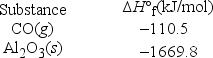
(Multiple Choice)
4.8/5  (77)
(77) The highly exothermic thermite reaction, in which aluminum reduces iron(III) oxide to elemental iron, has been used by railroad repair crews to weld rails together. 2Al(s) + Fe2O3(s) → 2Fe(s) + Al2O3(s) ΔH°rxn= -847.6 kJ/mol
What mass of iron is formed if 725 kJ of heat are released?
(Multiple Choice)
4.8/5 (78)
(78) A system delivers 222 J of heat to the surroundings while delivering 645 J of work. What is the change in the internal energy, ΔU, of the system?
(Multiple Choice)
4.8/5 (80)
(80) When 0.7521 g of benzoic acid was burned in a calorimeter containing 1000. g of water, a temperature increase of 3.60°C was observed. What is the heat capacity of the bomb calorimeter, excluding the water? The heat of combustion of benzoic acid is -26.42 kJ/g.
(Multiple Choice)
4.9/5 (85)
(85) Ozone (O3) in the atmosphere can be converted to oxygen gas by reaction with nitric oxide (NO). (Nitrogen dioxide is also produced in the reaction.) What is the enthalpy change when 8.50 L of ozone at a pressure of 1.00 atm and 25°C reacts with 12.00 L of nitric oxide at the same initial pressure and temperature (R = 0.0821 L atm/mol K)? [ΔH°f(NO) = 90.4 kJ/mol; ΔH°f(NO2) = 33.85 kJ/mol; ΔH°f(O3) = 142.2 kJ/mol]
(Multiple Choice)
4.7/5 (85)
(85) The sign of w when work is done on the system by the surroundings is ________.
(Short Answer)
4.7/5 (72)
(72) The statement, "Energy can neither be destroyed nor created," is the ________.
(Short Answer)
4.8/5 (89)
(89) How much heat is released if 7.15 g CaO(s) is added to 152 g of H2O(l)? CaO(s) + H2O(l) → Ca(OH)2(s) ΔH°rxn = -64.8 kJ/mol
(Multiple Choice)
4.7/5 (74)
(74) A(n) ________ ________ is a process where heat is released to the surroundings.
(Short Answer)
4.8/5 (73)
(73) A piece of copper with a mass of 218 g has a heat capacity of 83.9 J/°C. What is the specific heat of copper?
(Multiple Choice)
4.9/5 (83)
(83) The enthalpy of formation of a liquid is always larger than the enthalpy of formation of the gas of the same compound.
(True/False)
4.9/5 (91)
(91) If, as a pioneer, you wished to warm your room by taking an object heated on top of a pot-bellied stove to it, which of the following 15-pound objects, each heated to 100°C, would be the best choice? The specific heat capacity (in J/g·°C) for each substance is given in parentheses. Iron (0.450), copper (0.387), granite (0.79), gold (0.129), water (4.184).
(Multiple Choice)
4.8/5 (90)
(90) A piece of copper metal is initially at 100.0°C. It is dropped into a coffee cup calorimeter containing 50.0 g of water at a temperature of 20.0°C. After stirring, the final temperature of both copper and water is 25.0°C. Assuming no heat losses, and that the specific heat (capacity) of water is 4.18 J/g·°C, what is the heat capacity of the copper in J/°C?
(Multiple Choice)
4.8/5 (83)
(83) Your favorite candy bar, Gummy Beakers, contains 1.2 × 10⁶ J of energy while your favorite soft drink, Bolt, contains 6.7 × 10⁵ J. If you eat two packs of Gummy Beakers a day and drink 3 cans of Bolt, what percent of your 2000 Calorie daily food intake is left for broccoli, beans, beef, etc.? (1 cal = 4.184 J)
(Multiple Choice)
4.8/5 (68)
(68) What is the standard enthalpy of formation of liquid methanol, CH3OH(l)? C(graphite) + O2(g) → CO2(g) ΔH°rxn = -393.5 kJ/mol
H2(g) + ½O2→ H2O(l) ΔH°rxn = -285.8 kJ/mol
CH3OH(l) + 3/2O2(g) → CO2(g) + 2H2O(l) ΔH°rxn = -726.4 kJ/mol
(Multiple Choice)
4.8/5 (87)
(87) What law states that energy can be converted from one form to another, but cannot be created or destroyed?
(Multiple Choice)
4.8/5 (82)
(82) A 1.00-g sample of octane (C8H18) is burned in a bomb calorimeter that has a heat capacity of 5.80 kJ/°C. The temperature of the calorimeter rises from 25.00oC to 33.20oC. What is ΔU per mole for the combustion of octane?
(Multiple Choice)
4.8/5 (84)
(84) 
Filters
- Essay(0)
- Multiple Choice(0)
- Short Answer(0)
- True False(0)
- Matching(0)