



 Chat with AI
Exam 19: Electrochemistry

Exam 1: Chemistry: the Central Science133 Questions
Exam 2: Atoms, Molecules, and Ions124 Questions
Exam 3: Stoichiometry: Ratios of Combination137 Questions
Exam 4: Reactions in Aqueous Solutions146 Questions
Exam 5: Thermochemistry141 Questions
Exam 6: Quantum Theory and the Electronic Structure of Atoms135 Questions
Exam 7: Electron Configuration and the Periodic Table120 Questions
Exam 8: Chemical Bonding I: Basic Concepts102 Questions
Exam 9: Chemical Bonding II: Molecular Geometry and Bonding Theories139 Questions
Exam 10: Gases137 Questions
Exam 11: Intermolecular Forces and the Physical Properties of Liquids and Solids137 Questions
Exam 12: Modern Materials108 Questions
Exam 13: Physical Properties of Solutions151 Questions
Exam 14: Chemical Kinetics132 Questions
Exam 15: Chemical Equilibrium146 Questions
Exam 16: Acids and Bases137 Questions
Exam 17: Acid-Base Equilibria and Solubility Equilibria133 Questions
Exam 18: Entropy, Free Energy, and Equilibrium107 Questions
Exam 19: Electrochemistry122 Questions
Exam 20: Nuclear Chemistry127 Questions
Exam 21: Environmental Chemistry135 Questions
Exam 22: Coordination Chemistry132 Questions
Exam 23: Metallurgy and the Chemistry of Metals152 Questions
Exam 24: Nonmetallic Elements and Their Compounds117 Questions
Exam 25: Organic Chemistry121 Questions
Select questions type


Which metals may be oxidized by H+ under standard-state conditions? 
(Multiple Choice)
4.8/5  (78)
(78) Which is the half-reaction at the cathode in a lead storage battery?
(Multiple Choice)
4.8/5 (96)
(96) What is E°cell for the following reaction? 2Au(s) + 3Ca2+(aq) → 2Au3+(aq) + 3Ca(s) 
(Multiple Choice)
4.9/5 (94)
(94) A voltaic cell consists of a Cd/Cd2+ electrode (E° = -0.40 V) and a Fe/Fe2+ electrode (E° = -0.44 V). If Ecell = 0 and the temperature is 25°C, what is the ratio [Fe2+]/[Cd2+]?
(Multiple Choice)
4.9/5 (78)
(78) Based on the data presented below, which is the strongest reducing agent? 
(Multiple Choice)
4.8/5 (83)
(83) Consider the following balanced redox reaction. Mn2+(aq) + S2O82-(aq) + 2H2O(l) → MnO2(s) + 4H+(aq) + 2SO42-(aq)
Which of the following statements is true?
(Multiple Choice)
4.9/5 (85)
(85) If ΔG° of the following reaction is -110 kJ/mol, what is E°cell? (F = 96,500 C • mol -1) A3+(aq) + 3B(s) → A(s) + 3B+(aq)
(Multiple Choice)
4.7/5 (89)
(89) What is ΔG° for the reaction of iron(II) ions with one mole of permanganate ions? (F = 96,500 C • mol -1) 
(Multiple Choice)
4.9/5 (79)
(79) How many minutes would be required to electroplate 25.0 g of chromium by passing a constant current of 4.80 A through a solution containing CrCl3?
(Multiple Choice)
4.7/5 (74)
(74) The voltaic cell composed of Co(s), Co2+(aq), Cu(s), and Cu2+(aq) has E°cell = 0.62 V. If E° of the cathode half-cell is 0.34 V, what is E° of the anode half-cell? Cu2+(aq) + Co(s) → Cu(s) + Co2+(aq)
(Multiple Choice)
4.8/5 (73)
(73) What is E°cell for a galvanic cell represented by the combination of the following half-reactions? 
(Multiple Choice)
4.9/5 (85)
(85) What quantity of charge is required to cause reduction of 0.20 mole of Cr3+ to Cr?
(Multiple Choice)
4.9/5 (84)
(84) Which is the correct cell diagram for the following electrochemical cell? 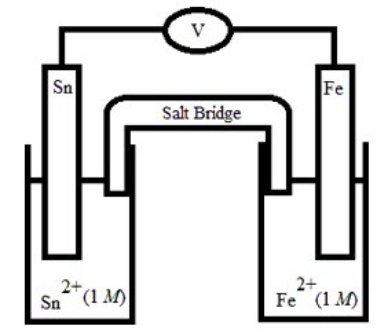

(Multiple Choice)
4.8/5 (84)
(84) What is ΔG° at 200°C for the following reaction? (F = 96,500 C • mol -1) 2Na(l) + FeCl2(s)  2NaCl(s) + Fe(s) E°cell = 2.35 V
 (Multiple Choice)
4.8/5 (77)
(77) What mass of oxygen gas is produced in the electrolysis of water, for every gram of hydrogen gas formed? Reaction: 2H2O(l) → 2H2(g) + O2(g)
(Multiple Choice)
4.9/5 (87)
(87) ________ is the process that uses electrical energy to drive a nonspontaneous chemical reaction.
(Short Answer)
4.7/5 (72)
(72) What is the name given to the apparatus where oxidation occurs in a cell where electricity flows?
(Multiple Choice)
4.9/5 (64)
(64) 
Filters
- Essay(0)
- Multiple Choice(0)
- Short Answer(0)
- True False(0)
- Matching(0)