



 Chat with AI
Exam 19: Electrochemistry

Exam 1: Chemistry: the Central Science133 Questions
Exam 2: Atoms, Molecules, and Ions124 Questions
Exam 3: Stoichiometry: Ratios of Combination137 Questions
Exam 4: Reactions in Aqueous Solutions146 Questions
Exam 5: Thermochemistry141 Questions
Exam 6: Quantum Theory and the Electronic Structure of Atoms135 Questions
Exam 7: Electron Configuration and the Periodic Table120 Questions
Exam 8: Chemical Bonding I: Basic Concepts102 Questions
Exam 9: Chemical Bonding II: Molecular Geometry and Bonding Theories139 Questions
Exam 10: Gases137 Questions
Exam 11: Intermolecular Forces and the Physical Properties of Liquids and Solids137 Questions
Exam 12: Modern Materials108 Questions
Exam 13: Physical Properties of Solutions151 Questions
Exam 14: Chemical Kinetics132 Questions
Exam 15: Chemical Equilibrium146 Questions
Exam 16: Acids and Bases137 Questions
Exam 17: Acid-Base Equilibria and Solubility Equilibria133 Questions
Exam 18: Entropy, Free Energy, and Equilibrium107 Questions
Exam 19: Electrochemistry122 Questions
Exam 20: Nuclear Chemistry127 Questions
Exam 21: Environmental Chemistry135 Questions
Exam 22: Coordination Chemistry132 Questions
Exam 23: Metallurgy and the Chemistry of Metals152 Questions
Exam 24: Nonmetallic Elements and Their Compounds117 Questions
Exam 25: Organic Chemistry121 Questions
Select questions type


Which component of the following cell is the cathode? K|L||M|N
(Multiple Choice)
4.8/5  (77)
(77) A voltaic cell is prepared using copper and silver. Its cell notation is shown below. Cu(s) | Cu2+(aq) || Ag+(aq) | Ag(s)
Which reaction occurs at the cathode?
(Multiple Choice)
4.7/5 (100)
(100) What is ΔG° at 298 K for the following reaction? (F = 96,500 C • mol -1) 
(Multiple Choice)
4.9/5 (77)
(77) What mass of nickel may be electroplated by passing a constant current of 7.2 A through a solution of NiSO4 for 90.0 min?
(Multiple Choice)
4.9/5 (74)
(74) A voltaic cell consists of a Hg/Hg22+ electrode (E°= 0.85 V) and a Sn/Sn2+ electrode (E°= -0.14 V). Calculate [Sn2+] if [Hg22+] = 0.24 M and Ecell = 1.04 V at 25°C.
(Multiple Choice)
4.9/5 (71)
(71) What is E°cell for the following reaction, and is it spontaneous or nonspontaneous under standard-state conditions? 2Fe3+(aq) + 2H2O(l) → H2O2(aq) + 2H+(aq) + 2Fe2+(aq)
Given: 
(Multiple Choice)
4.8/5 (83)
(83) Iron objects such as storage tanks and underground pipelines can be protected from corrosion by connecting them through a wire to a piece of
(Multiple Choice)
4.9/5 (87)
(87) If the following electrochemical cell is constructed, what voltage will be measured on the voltmeter? 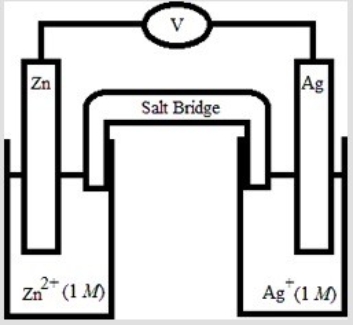

(Multiple Choice)
4.7/5 (81)
(81) Based on the data presented below, which is the strongest oxidizing agent? 
(Multiple Choice)
5.0/5 (60)
(60) What is the cell potential at 25°C for the following reaction if [Zn2+] = 1.0 × 10⁻⁴ M and [Sn2+] = 0.20 M ? (R = 8.314 J/K • mol, F = 96,500 C • mol -1) 
(Multiple Choice)
4.9/5 (70)
(70) Given Cu2+(aq) + 2e- → Cu(s) E° = +0.34 V Al3+(aq) + 3e- → Al(s) E° = -1.66 V
Na+(aq) + e- → Na(s) E° = -2.71 V
Which of the following reactions will occur?
(Multiple Choice)
5.0/5 (85)
(85) If E° for X + e- → Y is larger than E° for A + 2e- → B, then in a spontaneous process under standard-state conditions,
(Multiple Choice)
4.8/5 (86)
(86) For E° and ΔG° the zero (superscript) represents the standard state. What is the standard state?
(Essay)
4.7/5 (85)
(85) A voltaic cell consists of an Au/Au3+ electrode (E° = 1.50 V) and a Cu/Cu2+ electrode (E° = 0.34 V). Calculate [Au3+] if [Cu2+] = 1.20 M and Ecell = 1.15 V at 25°C.
(Multiple Choice)
4.9/5 (74)
(74) What product forms at the cathode during the electrolysis of molten lithium iodide?
(Multiple Choice)
4.8/5 (58)
(58) When the following redox equation is balanced with the smallest whole number coefficients, what is the coefficient of Zn(s)? Zn(s) + ReO4-(aq) → Re(s) + Zn2+(aq) (acidic solution)
(Multiple Choice)
4.8/5 (67)
(67) Consider the following redox equation. Mn(OH)2(s) + MnO4-(aq) → MnO42-(aq) (basic solution)
When the equation is balanced with the smallest whole number coefficients, what is the coefficient for OH-(aq) and on which side of the equation is OH-(aq) present?
(Multiple Choice)
4.8/5 (81)
(81) 
Filters
- Essay(0)
- Multiple Choice(0)
- Short Answer(0)
- True False(0)
- Matching(0)