



 Chat with AI
Exam 19: Electrochemistry

Exam 1: Chemistry: the Central Science133 Questions
Exam 2: Atoms, Molecules, and Ions124 Questions
Exam 3: Stoichiometry: Ratios of Combination137 Questions
Exam 4: Reactions in Aqueous Solutions146 Questions
Exam 5: Thermochemistry141 Questions
Exam 6: Quantum Theory and the Electronic Structure of Atoms135 Questions
Exam 7: Electron Configuration and the Periodic Table120 Questions
Exam 8: Chemical Bonding I: Basic Concepts102 Questions
Exam 9: Chemical Bonding II: Molecular Geometry and Bonding Theories139 Questions
Exam 10: Gases137 Questions
Exam 11: Intermolecular Forces and the Physical Properties of Liquids and Solids137 Questions
Exam 12: Modern Materials108 Questions
Exam 13: Physical Properties of Solutions151 Questions
Exam 14: Chemical Kinetics132 Questions
Exam 15: Chemical Equilibrium146 Questions
Exam 16: Acids and Bases137 Questions
Exam 17: Acid-Base Equilibria and Solubility Equilibria133 Questions
Exam 18: Entropy, Free Energy, and Equilibrium107 Questions
Exam 19: Electrochemistry122 Questions
Exam 20: Nuclear Chemistry127 Questions
Exam 21: Environmental Chemistry135 Questions
Exam 22: Coordination Chemistry132 Questions
Exam 23: Metallurgy and the Chemistry of Metals152 Questions
Exam 24: Nonmetallic Elements and Their Compounds117 Questions
Exam 25: Organic Chemistry121 Questions
Select questions type


Which is the half-reaction at the anode in a lead storage battery?
(Multiple Choice)
4.9/5  (81)
(81) Based on the following electrochemical cell, what is the standard reduction potential of metal M at 298 K? (R = 8.314 J/K • mol, F = 96500 C/mol) 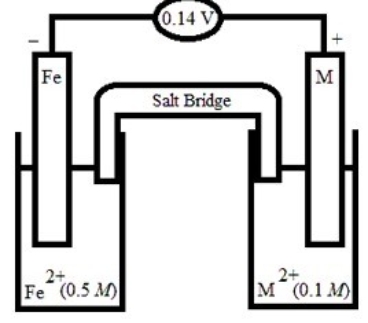

(Multiple Choice)
4.9/5 (78)
(78) When the following equation is balanced with the lowest whole number coefficients, the coefficients are: Cu(s) + H+(aq) + NO3-(aq) → NO(g) + H2O(l) + Cu2+(aq)
(Multiple Choice)
4.9/5 (68)
(68) Given the following standard reduction potentials in acid solution  write the formula of the strongest reducing agent.
 (Short Answer)
4.9/5 (80)
(80) What is the purpose of a salt bridge in an electrochemical cell?
(Multiple Choice)
4.7/5 (75)
(75) When the following redox equation is balanced using the smallest whole-number coefficients, what is the coefficient of NO2? Sn + HNO3 → SnO2 + NO2 + H2O (acidic solution)
(Multiple Choice)
4.8/5 (83)
(83) A certain electrochemical cell has for its cell reaction: Zn + HgO → ZnO + Hg
Which is the half-reaction occurring at the anode?
(Multiple Choice)
4.8/5 (83)
(83) What is the half-reaction that occurs at the cathode during the electrolysis of an aqueous sodium iodide solution? 
(Multiple Choice)
4.9/5 (84)
(84) A SHE has the acid concentration of 1 M and the H2 pressure is 1 atm.
(True/False)
4.8/5 (79)
(79) Based on the data presented below, which is the strongest reducing agent? 
(Multiple Choice)
4.8/5 (73)
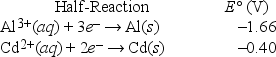
(73) Based on the following electrochemical cell, which statement is true? 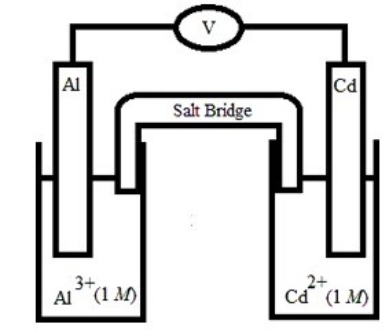
(Multiple Choice)
4.8/5 (59)
(59) What is the equilibrium constant at 25°C for the following reaction? (R = 8.314 J/K • mol, F = 96,500 C • mol-1) 
(Multiple Choice)
4.9/5 (85)
(85) Given the following standard reduction potentials,  calculate the solubility product of AgCN at 25°C.
 (Multiple Choice)
4.8/5 (82)
(82) What is E°cell for the following reaction? 2Fe2+(aq) + Cd2+(aq) → 2Fe3+(aq) + Cd(s) 
(Multiple Choice)
4.8/5 (79)
(79) Consider the following balanced redox reaction. 3CuO(s) + 2NH3(aq) → N2(g) + 3H2O(l) + 3Cu(s)
Which of the following statements is true?
(Multiple Choice)
4.9/5 (72)
(72) 
Filters
- Essay(0)
- Multiple Choice(0)
- Short Answer(0)
- True False(0)
- Matching(0)