



 Chat with AI
Exam 19: Electrochemistry

Exam 1: Chemistry: the Central Science133 Questions
Exam 2: Atoms, Molecules, and Ions124 Questions
Exam 3: Stoichiometry: Ratios of Combination137 Questions
Exam 4: Reactions in Aqueous Solutions146 Questions
Exam 5: Thermochemistry141 Questions
Exam 6: Quantum Theory and the Electronic Structure of Atoms135 Questions
Exam 7: Electron Configuration and the Periodic Table120 Questions
Exam 8: Chemical Bonding I: Basic Concepts102 Questions
Exam 9: Chemical Bonding II: Molecular Geometry and Bonding Theories139 Questions
Exam 10: Gases137 Questions
Exam 11: Intermolecular Forces and the Physical Properties of Liquids and Solids137 Questions
Exam 12: Modern Materials108 Questions
Exam 13: Physical Properties of Solutions151 Questions
Exam 14: Chemical Kinetics132 Questions
Exam 15: Chemical Equilibrium146 Questions
Exam 16: Acids and Bases137 Questions
Exam 17: Acid-Base Equilibria and Solubility Equilibria133 Questions
Exam 18: Entropy, Free Energy, and Equilibrium107 Questions
Exam 19: Electrochemistry122 Questions
Exam 20: Nuclear Chemistry127 Questions
Exam 21: Environmental Chemistry135 Questions
Exam 22: Coordination Chemistry132 Questions
Exam 23: Metallurgy and the Chemistry of Metals152 Questions
Exam 24: Nonmetallic Elements and Their Compounds117 Questions
Exam 25: Organic Chemistry121 Questions
Select questions type


________ - ________ fuel cells provide electrical power and drinking water for space flights.
(Short Answer)
4.8/5  (80)
(80) Which of the following elements can be isolated by electrolysis of the aqueous salt shown?
(Multiple Choice)
4.9/5 (88)
(88) Which of the following elements could be prepared by electrolysis of the aqueous solution shown?
(Multiple Choice)
4.7/5 (90)
(90) What mass of Cu may be deposited from a Cu2+ solution during electrolysis by a current of 3.00 A for 10.0 hours?
(Multiple Choice)
4.8/5 (76)
(76) Two cells are connected in series, so that the same current flows through two electrodes, where the following half-reactions occur: Cu2+(aq) + 2e- → Cu(s) and Ag+(aq) + e- → Ag(s)
For every 1.00 g of copper produced in the first process, how many grams of silver will be produced in the second one?
(Multiple Choice)
4.9/5 (75)
(75) Which, if any, of the following metals would be capable of acting as a sacrificial anode when used with iron pipe? 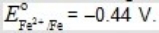
(Multiple Choice)
4.9/5 (72)
(72) Based on the data presented below, which is the strongest oxidizing agent? 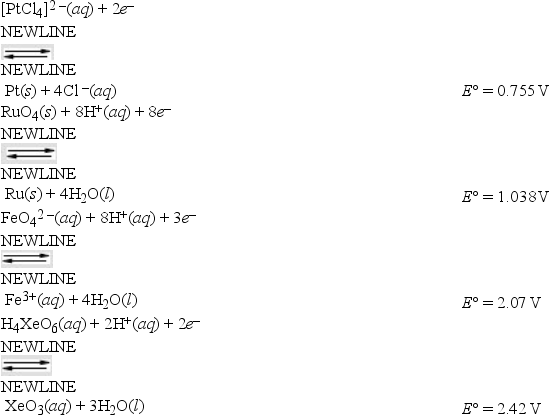
(Multiple Choice)
4.8/5 (84)
(84) A voltaic cell prepared using aluminum and nickel has the following cell notation. Al(s) | Al3+(aq) || Ni2+(aq) | Ni(s)
Which reaction occurs at the anode?
(Multiple Choice)
4.9/5 (72)
(72) A galvanic cell is constructed using the two hypothetical half-reactions  a. Calculate the standard potential of this cell, E°cell .
b. Calculate ΔG° for the cell reaction.(1 faraday = 96,500 C)
a. Calculate the standard potential of this cell, E°cell .
b. Calculate ΔG° for the cell reaction.(1 faraday = 96,500 C) (Short Answer)
4.9/5 (92)
(92) What is the oxidizing agent in the (unbalanced) reaction? Cu(s) + H+(aq) + NO3-(aq) → NO(g) + H2O(l) + Cu2+(aq)
(Multiple Choice)
4.9/5 (92)
(92) Aluminum does not corrode in the same manner as iron does, because
(Multiple Choice)
4.8/5 (71)
(71) What is E°cell for the following reaction? 2 Ag(s) + Sn2+(aq) → 2 Ag+(aq) + Sn(s) 
(Multiple Choice)
4.8/5 (76)
(76) What mass of copper can be deposited by the passage of 12.0 A for 25.0 min through a solution of copper(II) sulfate? [1 C = 1 A•s; F = 96,500 C]
(Multiple Choice)
4.7/5 (75)
(75) ________ is a process used to coat iron in order to protect it from corrosion.
(Short Answer)
4.9/5 (84)
(84) The equilibrium constant for the reaction of Ni2+ with Cd is 1.17 x 10⁵. Calculate the free energy change for the reaction at 25oC.
(Multiple Choice)
4.7/5 (73)
(73) Which is the correct cell notation for the following reaction? Au3+(aq) + Al(s) → Al3+(aq) + Au(s)
(Multiple Choice)
4.8/5 (89)
(89) Complete and balance the following redox equation. Now sum the coefficients of all species in the balanced equation. (Remember to add the coefficients that are equal to one, and to add the coefficients of any species added to the equation.) The sum of the smallest whole number coefficients is Bi(OH)3 + SnO22- → Bi + SnO32- (basic solution)
(Multiple Choice)
4.8/5 (83)
(83) What is the name given to the apparatus where reduction occurs in a cell where electricity flows?
(Multiple Choice)
4.8/5 (101)
(101) When the following redox equation is balanced with the smallest whole number coefficients, what is the coefficient of Sn(OH)3-? Bi(OH)3(s) + Sn(OH)3-(aq) → Sn(OH)62-(aq) + Bi(s) (basic solution)
(Multiple Choice)
4.8/5 (73)
(73) What is the name given to the apparatus that connects the two solutions by a conducting medium through which the cations and anions can move from one half-cell to the other?
(Multiple Choice)
4.9/5 (76)
(76) 
Filters
- Essay(0)
- Multiple Choice(0)
- Short Answer(0)
- True False(0)
- Matching(0)