



 Chat with AI
Exam 22: Frontiers in Microeconomics

Exam 1: Ten Principles of Economics455 Questions
Exam 2: Thinking Like an Economist643 Questions
Exam 3: Interdependence and the Gains From Trade547 Questions
Exam 4: The Market Forces of Supply and Demand693 Questions
Exam 5: Elasticity and Its Application626 Questions
Exam 6: Supply, Demand, and Government Policies668 Questions
Exam 7: Consumers, Producers, and the Efficiency of Markets547 Questions
Exam 8: Applications: the Costs of Taxation509 Questions
Exam 9: Application: International Trade521 Questions
Exam 10: Externalities543 Questions
Exam 11: Public Goods and Common Resources452 Questions
Exam 12: The Design of the Tax System664 Questions
Exam 13: The Costs of Production649 Questions
Exam 14: Firms in Competitive Markets604 Questions
Exam 15: Monopoly662 Questions
Exam 16: Monopolistic Competition649 Questions
Exam 17: Oligopoly522 Questions
Exam 18: The Markets for the Factors of Production592 Questions
Exam 19: Earnings and Discrimination511 Questions
Exam 20: Income Inequality and Poverty478 Questions
Exam 21: The Theory of Consumer Choice570 Questions
Exam 22: Frontiers in Microeconomics461 Questions
Exam 23: Measuring a Nation S Income547 Questions
Exam 24: Measuring the Cost of Living565 Questions
Exam 25: Production and Growth527 Questions
Exam 26: Saving, Investment, and the Financial System637 Questions
Exam 27: Tools of Finance534 Questions
Exam 28: Unemployment and Its Natural Rate701 Questions
Exam 29: The Monetary System540 Questions
Exam 30: Money Growth and Inflation504 Questions
Exam 31: Open-Economy Macroeconomics: Basic Concepts540 Questions
Exam 32: A Macroeconomic Theory of the Open Economy511 Questions
Exam 33: Aggregate Demand and Aggregate Supply572 Questions
Exam 34: The Influence of Monetary and Fiscal Policy on Aggregate Demand523 Questions
Exam 35: The Short-Run Tradeoff Between Inflation and Unemployment536 Questions
Exam 36: Six Debates Over Macroeconomic Policy354 Questions
Select questions type


An airline knows that business travelers have more inelastic demand for travel than vacationers. That is, business travelers are often willing to pay more for airline tickets than vacationers. The airline also knows that business travelers do not like to travel over weekends. When customers request airline tickets that do not involve travel over a weekend, the airline determines that a traveler is likely a business traveler and charges a higher price. This is an example of
(Multiple Choice)
4.8/5  (89)
(89) Explain how the presence of asymmetric information in car insurance markets may lead people who are good drivers or even average drivers to choose not to buy car insurance unless the law requires it.
(Essay)
4.9/5 (85)
(85) A street vendor sells a replica of a pair of designer shoes to a young woman who believes the shoes are authentic. The street vendor is engaging in
(Multiple Choice)
4.9/5 (87)
(87) Table 22-15
Diane, Henry, and Linda are voting for who to promote. They can only promote one candidate. Their preferences are given in the table below.  -Refer to Table 22-15. Which of the following statements is correct regarding the Condorcet paradox and the results of pairwise voting by Henry, Diane, and Linda?
 (Multiple Choice)
4.9/5 (94)
(94) When the buyer knows less than the seller about the characteristics of the good being sold, there is
(Multiple Choice)
4.8/5 (78)
(78) Table 22-18
The following table shows the preferences of four types of voters over four possible alternatives as well as the percentage of the electorate with the given preferences. 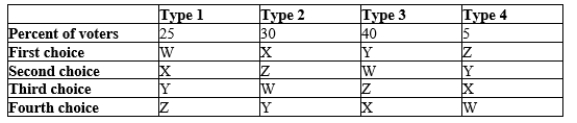 -Refer to Table 22-18. Suppose before any voting takes place that alternative W is eliminated as an option. Based on this information, the median voter's first choice is
 (Multiple Choice)
4.8/5 (75)
(75) Table 22-20
The table below shows the preferred city budget (in millions) for
in the city of Springfield. 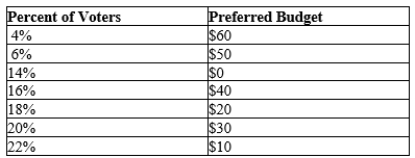 -Refer to Table 22-20. In an election, each voter will select the budget closest to his or her most preferred budget. Using this information, what is the most preferred budget of the median voter?
 (Multiple Choice)
4.9/5 (75)
(75) Scenario 22-6
Shana owns a boutique that sells high-end women's clothing and accessories. Katie works part-time at the boutique and frequently is the only employee in this small store. Shana pays Katie a wage that is higher than the market wage for this type of job. When the store is not full of customers, Katie diligently works on displays and cleans to keep the store looking its best. Belinda is a customer in the store who asks Katie's opinion on the quality of some jeans she is considering purchasing. Katie tells her the quality is great even though she's had several other customers return them due to flaws. Magda is another customer who is returning a necklace without volunteering that a gem is missing.
-Refer to Scenario 22-6. What is the term for the type of wage Shana pays Katie?
(Short Answer)
4.8/5 (90)
(90) Table 22-4
The fortunate residents of Anytown have a budget surplus. The mayor decided that it is only fair to have the residents vote on what to do with the surplus. The mayor has narrowed the options down to three possible projects: a playground, a library, or a swimming pool. The voters fall into three categories and have preferences as illustrated in the table.  -Refer to Table 22-4. If the mayor asks the residents to choose between the library and the swimming pool using pairwise voting,
 (Multiple Choice)
4.9/5 (89)
(89) Table 22-5
The citizens of Anytown will decide whether to build a new library, a recreation center, or an arena. Exactly one of the three choices will prevail, and the choice will be made by way of pairwise voting, with the majority determining the outcome on each vote. The preferences of the voters are summarized in the table below.  -Refer to Table 22-5. Which of the following statements is correct?
 (Multiple Choice)
4.9/5 (93)
(93) An implication of the median voter theorem is that, in a race between Republicans and Democrats,
(Multiple Choice)
4.9/5 (72)
(72) What insight into human behavior do economist learn from observing people playing the ultimatum game?
(Short Answer)
4.8/5 (73)
(73) Table 22-24
The citizens of Mayville are having a severe budget shortage and are faced with eliminating athletics from the town high school. The town administrator has determined that the town can afford to maintain one sport. Exactly one of the three choices will prevail, and the choice will be made by way of pairwise voting, with the majority determining the outcome on each vote. The preferences of the voters are summarized in the table below.  -Refer to Table 22-24. Explain why the Condorcet paradox applies to this voting situation.
 (Essay)
5.0/5 (75)
(75) The Condorcet paradox demonstrates that the result of a majority vote may be affected by
(Multiple Choice)
4.8/5 (103)
(103) Table 22-4
The fortunate residents of Anytown have a budget surplus. The mayor decided that it is only fair to have the residents vote on what to do with the surplus. The mayor has narrowed the options down to three possible projects: a playground, a library, or a swimming pool. The voters fall into three categories and have preferences as illustrated in the table.
-Refer to Table 22-4. If the mayor asks the residents to choose between the playground and the library using pairwise voting,
-Refer to Table 22-4. If the mayor asks the residents to choose between the playground and the library using pairwise voting, (Multiple Choice)
4.9/5 (84)
(84) A safe driver would likely choose an auto insurance policy with a
(Multiple Choice)
4.7/5 (79)
(79) Table 22-12
The following table shows the preferences for the five voters in a city regarding how to deal with the city's diseased trees.  A = do nothing
B = follow the expert's advice to remove every tree
C = remove every 4th tree now and perhaps more later
D = use an untested spraying alternative
-Refer to Table 22-12. Consider the public policy for dealing with diseased trees. Based on the preferences in the table, which of the following statements is correct?
A = do nothing
B = follow the expert's advice to remove every tree
C = remove every 4th tree now and perhaps more later
D = use an untested spraying alternative
-Refer to Table 22-12. Consider the public policy for dealing with diseased trees. Based on the preferences in the table, which of the following statements is correct? (Multiple Choice)
4.9/5 (66)
(66) Experiments show that when real people play the ultimatum game, starting with $100,
(Multiple Choice)
5.0/5 (80)
(80) 
Filters
- Essay(0)
- Multiple Choice(0)
- Short Answer(0)
- True False(0)
- Matching(0)