



 Chat with AI
Exam 22: Frontiers in Microeconomics

Exam 1: Ten Principles of Economics455 Questions
Exam 2: Thinking Like an Economist643 Questions
Exam 3: Interdependence and the Gains From Trade547 Questions
Exam 4: The Market Forces of Supply and Demand693 Questions
Exam 5: Elasticity and Its Application626 Questions
Exam 6: Supply, Demand, and Government Policies668 Questions
Exam 7: Consumers, Producers, and the Efficiency of Markets547 Questions
Exam 8: Applications: the Costs of Taxation509 Questions
Exam 9: Application: International Trade521 Questions
Exam 10: Externalities543 Questions
Exam 11: Public Goods and Common Resources452 Questions
Exam 12: The Design of the Tax System664 Questions
Exam 13: The Costs of Production649 Questions
Exam 14: Firms in Competitive Markets604 Questions
Exam 15: Monopoly662 Questions
Exam 16: Monopolistic Competition649 Questions
Exam 17: Oligopoly522 Questions
Exam 18: The Markets for the Factors of Production592 Questions
Exam 19: Earnings and Discrimination511 Questions
Exam 20: Income Inequality and Poverty478 Questions
Exam 21: The Theory of Consumer Choice570 Questions
Exam 22: Frontiers in Microeconomics461 Questions
Exam 23: Measuring a Nation S Income547 Questions
Exam 24: Measuring the Cost of Living565 Questions
Exam 25: Production and Growth527 Questions
Exam 26: Saving, Investment, and the Financial System637 Questions
Exam 27: Tools of Finance534 Questions
Exam 28: Unemployment and Its Natural Rate701 Questions
Exam 29: The Monetary System540 Questions
Exam 30: Money Growth and Inflation504 Questions
Exam 31: Open-Economy Macroeconomics: Basic Concepts540 Questions
Exam 32: A Macroeconomic Theory of the Open Economy511 Questions
Exam 33: Aggregate Demand and Aggregate Supply572 Questions
Exam 34: The Influence of Monetary and Fiscal Policy on Aggregate Demand523 Questions
Exam 35: The Short-Run Tradeoff Between Inflation and Unemployment536 Questions
Exam 36: Six Debates Over Macroeconomic Policy354 Questions
Select questions type


Economic theory assumes people are always rational. Yet observation indicates that people do not always behave rationally. Which of the following is not a systematic mistake people make in their decisionmaking?
(Multiple Choice)
4.7/5  (80)
(80) Economic policy that appears to be ideal in an economics textbook may not be the final policy that is approved by elected politicians because
(Multiple Choice)
4.7/5 (71)
(71) Majority rule will produce the outcome most preferred by the median voter, as demonstrated by the
(Multiple Choice)
5.0/5 (100)
(100) Suppose that in a Borda count election, outcome X is preferred to outcome Y, and outcome Y is preferred to outcome Z, when outcomes X, Y, and Z are all available options. When Y is removed as an option, however, outcome Z is preferred to outcome X. This would violate Arrow's assumption that voting systems should satisfy
(Multiple Choice)
4.9/5 (87)
(87) Table 22-7
Suppose that residents of a town are asked to vote on the best way to improve the safety of an intersection. The three choices are: a stoplight, a 4-way stop, and a 2-way stop. The voters are divided into three groups based on their preferences.
Voter Type  -Refer to Table 22-7. Which of the following statements is correct regarding the Condorcet paradox and the results of pairwise voting on how to improve the safety of the intersection?
 (Multiple Choice)
4.9/5 (77)
(77) Studies of human decision-making have found that people do not give enough weight to a small number of vivid observations.
(True/False)
4.9/5 (71)
(71) The Condorcet paradox implies that the order in which items are voted on under majority rule is unimportant.
(True/False)
4.8/5 (92)
(92) Table 22-3
Three family members -- Seamus, Maeve, and Siobhan -- are deciding what type of movie to attend. The three choices are an action adventure, comedy, or horror. The first, second, and third choices for each person are as indicated in the table below. 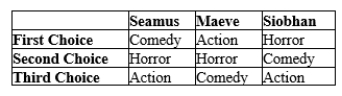 -Refer to Table 22-3. If the voting method is a Borda count, which alternative will be chosen?
 (Multiple Choice)
4.9/5 (77)
(77) A survey of 1,500 frequent restaurant patrons revealed that, Chang Cheng, a local Chinese restaurant, offers high-quality food at low prices. Based on one dining experience, a restaurant critic gave Chang Cheng a poor review, saying the food was not very good. As a result, you decide not to dine at Chang Cheng. This decision is an example of which of the following systematic mistakes that people make when making decisions?
(Multiple Choice)
4.9/5 (82)
(82) One way that employers respond to the moral-hazard problem is by monitoring their employees.
(True/False)
5.0/5 (92)
(92) Table 22-1
Three friends -- Linda, Stephanie, and Jamie -- are deciding where to go together for vacation. They all agree that they should go to one of three places: France, Greece, or Italy. They also agree that they will have two pairwise votes to determine where to go on vacation, with the majority determining the outcome on each vote. The first, second, and third choices for each person are as indicated in the table below.  -Refer to Table 22-1. If the first vote pits Greece against Italy and the second vote pits France against the winner of the first vote, then the outcome is as follows:
 (Multiple Choice)
4.8/5 (84)
(84) Table 22-8
The citizens of Mayville are having a severe budget shortage and are faced with eliminating athletics from the town high school. The town administrator has determined that the town can afford to maintain one sport. Exactly one of the three choices will prevail, and the choice will be made by way of pairwise voting, with the majority determining the outcome on each vote. The preferences of the voters are summarized in the table below. 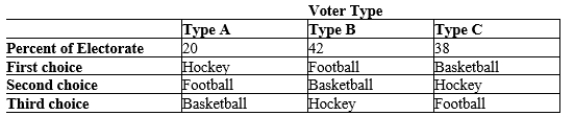 -Refer to Table 22-8. The town administrator is a huge basketball fan. If he wants to ensure that basketball is the winning sport, how should he set up the voting?
 (Multiple Choice)
4.8/5 (87)
(87) Table 22-14
Amy, Beth, and Connie are on a hiring committee. They have interviewed 3 candidates identified by their last names and are going to vote on which one is hired.  '
-Refer to Table 22-14. Which of the following is correct for this election? There is
'
-Refer to Table 22-14. Which of the following is correct for this election? There is (Multiple Choice)
4.8/5 (76)
(76) According to behavioral economics, if people taking an exam were asked to guess the score they would receive, it would be most likely that
(Multiple Choice)
4.8/5 (88)
(88) Table 22-9 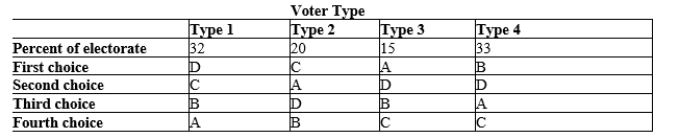 -Refer to Table 22-9. The table shows the preferences of four types of voters over four possible outcomes: A, B, C, and D. In addition, the table shows the percentage of voters of each type. Suppose a Borda count election is held in which each voter ranks the four outcomes, giving 1 point to last place, 2 points to second to last, 3 points to the second best, and 4 points to the best. In this case, which outcome would win?
 (Multiple Choice)
4.7/5 (82)
(82) Table 22-10
The town of Franklin is facing a severe budget shortage. The town administrator has proposed four options to balance the budget: increase property taxes (taxes), cut the school arts budget (arts), turn off half of the streetlights in the town (streetlights), reduce police patrols (police). Exactly one of the four choices will prevail, and the choice will be made by way of pairwise voting, with the majority determining the outcome on each vote. The preferences of the voters are summarized in the table below. 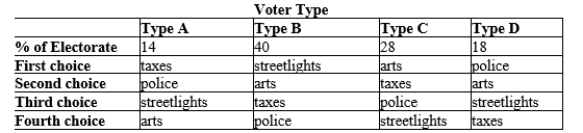 -Refer to Table 22-10. If a Borda count is used, which option will win?
 (Multiple Choice)
4.8/5 (78)
(78) Table 22-18
The following table shows the preferences of four types of voters over four possible alternatives as well as the percentage of the electorate with the given preferences. 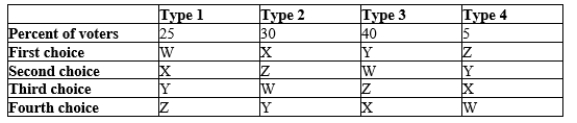 -Refer to Table 22-18. If the vote is conducted using a Borda count where each person's first choice receives 4 points, each person's second choice 3 points, each person's third choice 2 points, and each person's fourth choice 1 point, which alternative would win?
 (Multiple Choice)
4.9/5 (84)
(84) Narrative 22-1
Katie owns a boutique that sells high-end women's clothing and accessories. Shana works part-time at the boutique and frequently is the only employee in this small store. Katie pays Shana a wage that is higher than the market wage for this type of job. When the store is not full of customers, Shana diligently works on displays and cleans to keep the store looking its best. Magda is a customer in the store who asks Shana's opinion on the quality of some jeans she is considering purchasing. Even though she's had several other customers return them due to flaws, Shana tells Magda the quality is great. Belinda is another customer who is returning a necklace without revealing that she lost a gem from it while wearing it.
-Refer to Narrative 22-1. Which of the ladies is an agent?
(Multiple Choice)
4.9/5 (84)
(84) Scott's Painting Company paints houses. Since Scott's business does not have the name recognition of some of the bigger painting companies, Scott advertises a "Five-Year Money Back Guarantee" to indicate to buyers that his service is of high quality. This guarantee is an example of
(Multiple Choice)
4.8/5 (70)
(70) Evidence from experiments in which real people play the ultimatum game supports the idea that people care about fairness as well as about maximization of their personal wealth.
(True/False)
4.9/5 (82)
(82) 
Filters
- Essay(0)
- Multiple Choice(0)
- Short Answer(0)
- True False(0)
- Matching(0)