



 Chat with AI
Exam 22: Frontiers in Microeconomics

Exam 1: Ten Principles of Economics455 Questions
Exam 2: Thinking Like an Economist643 Questions
Exam 3: Interdependence and the Gains From Trade547 Questions
Exam 4: The Market Forces of Supply and Demand693 Questions
Exam 5: Elasticity and Its Application626 Questions
Exam 6: Supply, Demand, and Government Policies668 Questions
Exam 7: Consumers, Producers, and the Efficiency of Markets547 Questions
Exam 8: Applications: the Costs of Taxation509 Questions
Exam 9: Application: International Trade521 Questions
Exam 10: Externalities543 Questions
Exam 11: Public Goods and Common Resources452 Questions
Exam 12: The Design of the Tax System664 Questions
Exam 13: The Costs of Production649 Questions
Exam 14: Firms in Competitive Markets604 Questions
Exam 15: Monopoly662 Questions
Exam 16: Monopolistic Competition649 Questions
Exam 17: Oligopoly522 Questions
Exam 18: The Markets for the Factors of Production592 Questions
Exam 19: Earnings and Discrimination511 Questions
Exam 20: Income Inequality and Poverty478 Questions
Exam 21: The Theory of Consumer Choice570 Questions
Exam 22: Frontiers in Microeconomics461 Questions
Exam 23: Measuring a Nation S Income547 Questions
Exam 24: Measuring the Cost of Living565 Questions
Exam 25: Production and Growth527 Questions
Exam 26: Saving, Investment, and the Financial System637 Questions
Exam 27: Tools of Finance534 Questions
Exam 28: Unemployment and Its Natural Rate701 Questions
Exam 29: The Monetary System540 Questions
Exam 30: Money Growth and Inflation504 Questions
Exam 31: Open-Economy Macroeconomics: Basic Concepts540 Questions
Exam 32: A Macroeconomic Theory of the Open Economy511 Questions
Exam 33: Aggregate Demand and Aggregate Supply572 Questions
Exam 34: The Influence of Monetary and Fiscal Policy on Aggregate Demand523 Questions
Exam 35: The Short-Run Tradeoff Between Inflation and Unemployment536 Questions
Exam 36: Six Debates Over Macroeconomic Policy354 Questions
Select questions type


Table 22-21
The following table shows the number of voters preferring various amounts of spending to develop a river to make it more attractive for canoeing and kayaking. 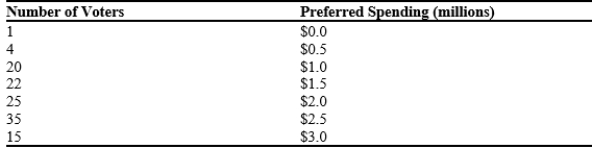 -Refer to Table 22-21. The city council is considering two alternative ballots. The first would allow voters to choose between $1.5 million and $2 million. The second would allow voters to select between $2 million and $2.5 million. If the first ballot is used,
 (Multiple Choice)
4.8/5  (70)
(70) Table 22-1
Three friends -- Linda, Stephanie, and Jamie -- are deciding where to go together for vacation. They all agree that they should go to one of three places: France, Greece, or Italy. They also agree that they will have two pairwise votes to determine where to go on vacation, with the majority determining the outcome on each vote. The first, second, and third choices for each person are as indicated in the table below.  -Refer to Table 22-1. If the first vote pits France against Italy and the second vote pits Greece against the winner of the first vote, then the outcome is as follows:
 (Multiple Choice)
4.9/5 (69)
(69) The Condorcet voting paradox shows that outcomes based on dictatorial preferences do not always obey the property of transitivity.
(True/False)
4.8/5 (83)
(83) A radio story reported a study on the makes and models of cars that were observed going through intersections in the Washington, D.C. area without stopping at the stop signs. According to the story, Volvos were heavily overrepresented; the fraction of cars running stop signs that were Volvos was much greater than the fraction of Volvos in the total population of cars in the D.C. area. This is initially surprising because Volvo has built a reputation as an especially safe car that appeals to sensible, safety-conscious drivers. How is this observation best explained?
(Multiple Choice)
4.9/5 (78)
(78) Insurance companies charge annual premiums to collect revenue, which they then use to pay customers who file claims for damages they incur. As a result of the moral hazard problem (1) what is the effect on the percentage of policy holders making claims, and (2) what is the effect on the average premium charged when compared to a world with no moral hazard problem?
(Multiple Choice)
4.8/5 (84)
(84) Which of the following events best exemplifies the concept of signaling?
(Multiple Choice)
4.9/5 (68)
(68) How have insights from the field of psychology influenced the thinking of economists in recent years?
(Essay)
4.9/5 (66)
(66) Majority rule will produce the outcome most preferred by the median voter.
(True/False)
4.8/5 (81)
(81) Herbert Simon, one of the first social scientists to work at the boundary of economics and psychology, suggested that humans should be viewed not as rational maximers but as
(Short Answer)
4.8/5 (73)
(73) Arrow's impossibility theorem demonstrates the impossibility of the median voter theorem.
(True/False)
4.7/5 (79)
(79) Table 22-24
The citizens of Mayville are having a severe budget shortage and are faced with eliminating athletics from the town high school. The town administrator has determined that the town can afford to maintain one sport. Exactly one of the three choices will prevail, and the choice will be made by way of pairwise voting, with the majority determining the outcome on each vote. The preferences of the voters are summarized in the table below. 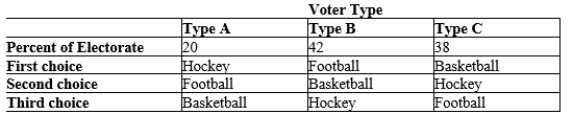 -Refer to Table 22-24. If the town decides to use a Borda count, which sport will win?
 (Short Answer)
4.9/5 (79)
(79) Table 22-1
Three friends -- Linda, Stephanie, and Jamie -- are deciding where to go together for vacation. They all agree that they should go to one of three places: France, Greece, or Italy. They also agree that they will have two pairwise votes to determine where to go on vacation, with the majority determining the outcome on each vote. The first, second, and third choices for each person are as indicated in the table below.
-Refer to Table 22-1. If the friends change their minds and decide to choose a vacation destination using a Borda count, then
-Refer to Table 22-1. If the friends change their minds and decide to choose a vacation destination using a Borda count, then (Multiple Choice)
4.8/5 (79)
(79) Scenario 22-6
Shana owns a boutique that sells high-end women's clothing and accessories. Katie works part-time at the boutique and frequently is the only employee in this small store. Shana pays Katie a wage that is higher than the market wage for this type of job. When the store is not full of customers, Katie diligently works on displays and cleans to keep the store looking its best. Belinda is a customer in the store who asks Katie's opinion on the quality of some jeans she is considering purchasing. Katie tells her the quality is great even though she's had several other customers return them due to flaws. Magda is another customer who is returning a necklace without volunteering that a gem is missing.
-Refer to Scenario 22-6. What is the name for the problem Katie creates by lying about the quality of the jeans?
(Short Answer)
4.7/5 (71)
(71) The mathematical result showing that a majority rule voting system will produce the outcome most preferred by the voter exactly in the middle of the distribution is called the
(Short Answer)
4.8/5 (82)
(82) Suppose that an economics department is offering a student exchange program with a university in Giessen, Germany. If the department requires students to submit an essay in order to be considered for the program, the essay may be an example of
(Multiple Choice)
4.9/5 (70)
(70) Table 22-14
Amy, Beth, and Connie are on a hiring committee. They have interviewed 3 candidates identified by their last names and are going to vote on which one is hired.  '
-Refer to Table 22-14. Which results for pairwise voting are correct?
'
-Refer to Table 22-14. Which results for pairwise voting are correct? (Multiple Choice)
4.9/5 (81)
(81) Lindsay and Tim are playing the ultimatum game starting with $100. Based on the coin toss, Lindsay is the player to propose a division of the $100. If Lindsay acts as economic theory assumes and Tim acts as experimental evidence shows, Tim will
(Essay)
4.9/5 (71)
(71) The failure of majority rule to produce transitive preferences for society is called the
(Short Answer)
4.8/5 (72)
(72) Suppose that there are 175 voters in an election and that 80 of them prefer a $100 budget while the remainder prefer a $150 budget. Which of the following statements is true?
(Multiple Choice)
4.9/5 (68)
(68) People are willing to give up monetary rewards to promote fairness.
(True/False)
4.8/5 (73)
(73) 
Filters
- Essay(0)
- Multiple Choice(0)
- Short Answer(0)
- True False(0)
- Matching(0)