



 Chat with AI
Exam 22: Frontiers in Microeconomics

Exam 1: Ten Principles of Economics455 Questions
Exam 2: Thinking Like an Economist643 Questions
Exam 3: Interdependence and the Gains From Trade547 Questions
Exam 4: The Market Forces of Supply and Demand693 Questions
Exam 5: Elasticity and Its Application626 Questions
Exam 6: Supply, Demand, and Government Policies668 Questions
Exam 7: Consumers, Producers, and the Efficiency of Markets547 Questions
Exam 8: Applications: the Costs of Taxation509 Questions
Exam 9: Application: International Trade521 Questions
Exam 10: Externalities543 Questions
Exam 11: Public Goods and Common Resources452 Questions
Exam 12: The Design of the Tax System664 Questions
Exam 13: The Costs of Production649 Questions
Exam 14: Firms in Competitive Markets604 Questions
Exam 15: Monopoly662 Questions
Exam 16: Monopolistic Competition649 Questions
Exam 17: Oligopoly522 Questions
Exam 18: The Markets for the Factors of Production592 Questions
Exam 19: Earnings and Discrimination511 Questions
Exam 20: Income Inequality and Poverty478 Questions
Exam 21: The Theory of Consumer Choice570 Questions
Exam 22: Frontiers in Microeconomics461 Questions
Exam 23: Measuring a Nation S Income547 Questions
Exam 24: Measuring the Cost of Living565 Questions
Exam 25: Production and Growth527 Questions
Exam 26: Saving, Investment, and the Financial System637 Questions
Exam 27: Tools of Finance534 Questions
Exam 28: Unemployment and Its Natural Rate701 Questions
Exam 29: The Monetary System540 Questions
Exam 30: Money Growth and Inflation504 Questions
Exam 31: Open-Economy Macroeconomics: Basic Concepts540 Questions
Exam 32: A Macroeconomic Theory of the Open Economy511 Questions
Exam 33: Aggregate Demand and Aggregate Supply572 Questions
Exam 34: The Influence of Monetary and Fiscal Policy on Aggregate Demand523 Questions
Exam 35: The Short-Run Tradeoff Between Inflation and Unemployment536 Questions
Exam 36: Six Debates Over Macroeconomic Policy354 Questions
Select questions type


The field of behavioral economics builds a more subtle and complex model of economic behavior using insights from
(Multiple Choice)
4.8/5  (81)
(81) Table 22-5
The citizens of Anytown will decide whether to build a new library, a recreation center, or an arena. Exactly one of the three choices will prevail, and the choice will be made by way of pairwise voting, with the majority determining the outcome on each vote. The preferences of the voters are summarized in the table below.  -Refer to Table 22-5. If the citizens of Anytown use a Borda count, rather than pairwise majority voting, to decide what to build, then they will build a new
 (Multiple Choice)
4.9/5 (76)
(76) If A is preferred to B and B is preferred to C, then we would expect A to be preferred to C. This property is called
(Short Answer)
4.9/5 (79)
(79) A person who makes decisions that are "merely good enough" is called a(n)
(Multiple Choice)
4.9/5 (73)
(73) Bill and Bev are playing the ultimatum game, starting with $50. A coin flip results in Bev being the one to propose a division of the $50. If Bev acts as economic theory assumes, she should propose that
(Multiple Choice)
4.8/5 (87)
(87) Employers may choose to pay their workers a wage that exceeds the equilibrium wage according to
(Multiple Choice)
4.7/5 (89)
(89) Table 22-11
Five voters must choose from among four options: A, B, C, or D. Each voter's preferences are summarized in the table below. Options higher in the table are more preferred by the voter. 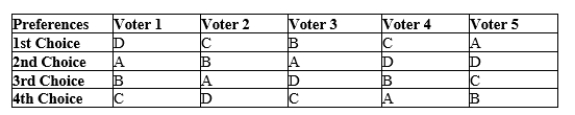 -Refer to Table 22-11. If the vote were conducted according to a Borda count system where each person's first choice receives 4 points, second choice 3 points, third choice 2 points and fourth choice 1 point, the result would be
 (Multiple Choice)
4.9/5 (83)
(83) On car insurance policies, Countrywide Insurance Company offers drivers an option: Policy 1 features a deductible of $1,000, and it requires a driver to pay an annual premium of $500. Policy 2 features a deductible of $250, and it requires a driver to pay an annual premium of $1,000.
(Multiple Choice)
4.8/5 (75)
(75) State one reason why government intervention may not be a good solution to an asymmetric information problem.
(Essay)
4.8/5 (79)
(79) Assume there are two major political parties: the Conservatives and the Liberals. What does the median voter theorem imply about the nature of the platforms (that is, policy stances) of the Conservatives and Liberals?
(Essay)
5.0/5 (77)
(77) Government action in cases of asymmetric information may not be an ideal solution because
(Multiple Choice)
4.8/5 (81)
(81) Frank is given the choice between pizza and hotdogs and chooses pizza. Then, before serving him, his host tells Franks he could have a hamburger. Frank says he wants a hot dog. Which of the properties of Arrow's impossibility theorem does Frank violate?
(Short Answer)
4.8/5 (96)
(96) Arrow's impossibility theorem shows that no voting system can satisfy which of the following properties?
(Multiple Choice)
4.8/5 (82)
(82) Table 22-16
The Johnson family is planning a vacation and, though Mr. and Mrs. Johnson will be paying for the trip, they have decided to use a democratic voting process to choose their destination. The family members' preferences are reflected in the table below.  -Refer to Table 22-16. Suppose that before the family can arrive at their decision, Opryland announced that it will be closed for the season due to flooding. Mr. Johnson recommends using a vote by majority rule and proposes first choosing between the Grand Canyon and Sea World, and then choosing between the winner of the first vote and Disneyland. If everyone votes according to their preferences,
 (Multiple Choice)
4.8/5 (88)
(88) Kim owns a small business in Denver. She travels frequently, meeting with important customers, and attending conferences. Kim hired Matt to work in the Denver office as the day-to-day general manager of the business.
(Multiple Choice)
4.8/5 (91)
(91) 
Filters
- Essay(0)
- Multiple Choice(0)
- Short Answer(0)
- True False(0)
- Matching(0)