



 Chat with AI
Exam 22: Frontiers in Microeconomics

Exam 1: Ten Principles of Economics455 Questions
Exam 2: Thinking Like an Economist643 Questions
Exam 3: Interdependence and the Gains From Trade547 Questions
Exam 4: The Market Forces of Supply and Demand693 Questions
Exam 5: Elasticity and Its Application626 Questions
Exam 6: Supply, Demand, and Government Policies668 Questions
Exam 7: Consumers, Producers, and the Efficiency of Markets547 Questions
Exam 8: Applications: the Costs of Taxation509 Questions
Exam 9: Application: International Trade521 Questions
Exam 10: Externalities543 Questions
Exam 11: Public Goods and Common Resources452 Questions
Exam 12: The Design of the Tax System664 Questions
Exam 13: The Costs of Production649 Questions
Exam 14: Firms in Competitive Markets604 Questions
Exam 15: Monopoly662 Questions
Exam 16: Monopolistic Competition649 Questions
Exam 17: Oligopoly522 Questions
Exam 18: The Markets for the Factors of Production592 Questions
Exam 19: Earnings and Discrimination511 Questions
Exam 20: Income Inequality and Poverty478 Questions
Exam 21: The Theory of Consumer Choice570 Questions
Exam 22: Frontiers in Microeconomics461 Questions
Exam 23: Measuring a Nation S Income547 Questions
Exam 24: Measuring the Cost of Living565 Questions
Exam 25: Production and Growth527 Questions
Exam 26: Saving, Investment, and the Financial System637 Questions
Exam 27: Tools of Finance534 Questions
Exam 28: Unemployment and Its Natural Rate701 Questions
Exam 29: The Monetary System540 Questions
Exam 30: Money Growth and Inflation504 Questions
Exam 31: Open-Economy Macroeconomics: Basic Concepts540 Questions
Exam 32: A Macroeconomic Theory of the Open Economy511 Questions
Exam 33: Aggregate Demand and Aggregate Supply572 Questions
Exam 34: The Influence of Monetary and Fiscal Policy on Aggregate Demand523 Questions
Exam 35: The Short-Run Tradeoff Between Inflation and Unemployment536 Questions
Exam 36: Six Debates Over Macroeconomic Policy354 Questions
Select questions type


The Borda count fails to satisfy which of Kenneth Arrow's properties of a "perfect" voting system?
(Multiple Choice)
4.9/5  (72)
(72) When asymmetric information affects a relationship between two parties, it is always the case that
(Multiple Choice)
4.7/5 (87)
(87) When a corporation decides to include its own corporate stock as part of the compensation for its employees, it is trying to solve the
(Multiple Choice)
4.7/5 (85)
(85) Arrow's impossibility theorem shows that it is impossible to find a better voting system than pairwise majority voting.
(True/False)
4.9/5 (72)
(72) Table 22-7
Suppose that residents of a town are asked to vote on the best way to improve the safety of an intersection. The three choices are: a stoplight, a 4-way stop, and a 2-way stop. The voters are divided into three groups based on their preferences.
Voter Type  -Refer to Table 22-7. If the first vote pits a stoplight against a 4-way stop and the second vote pits a 2-way stop against the winner of the first vote, then the outcome is as follows:
 (Multiple Choice)
4.8/5 (82)
(82) Table 22-12
The following table shows the preferences for the five voters in a city regarding how to deal with the city's diseased trees.  A = do nothing
B = follow the expert's advice to remove every tree
C = remove every 4th tree now and perhaps more later
D = use an untested spraying alternative
-Refer to Table 22-12. Consider the public policy for dealing with the diseased trees. Using pairwise majority voting with A versus B, then the winner of that vote versus C, then the winner of that vote versus D, which policy wins?
A = do nothing
B = follow the expert's advice to remove every tree
C = remove every 4th tree now and perhaps more later
D = use an untested spraying alternative
-Refer to Table 22-12. Consider the public policy for dealing with the diseased trees. Using pairwise majority voting with A versus B, then the winner of that vote versus C, then the winner of that vote versus D, which policy wins? (Multiple Choice)
4.7/5 (88)
(88) The Condorcet voting paradox demonstrates that democratic outcomes do not always obey the property of
(Multiple Choice)
4.8/5 (76)
(76) Students of microeconomic principles often say they are going to study "tonight," because the only way to pass the exam is to study some every night. When "tonight" comes, some students choose to do something else. Come exam day, these students do not do well on their exam. This observation is an example of how people
(Multiple Choice)
4.8/5 (75)
(75) Table 22-1
Three friends -- Linda, Stephanie, and Jamie -- are deciding where to go together for vacation. They all agree that they should go to one of three places: France, Greece, or Italy. They also agree that they will have two pairwise votes to determine where to go on vacation, with the majority determining the outcome on each vote. The first, second, and third choices for each person are as indicated in the table below.  -Refer to Table 22-1. If the first vote pits France against Greece and the second vote pits Italy against the winner of the first vote, then the outcome is as follows:
 (Multiple Choice)
4.9/5 (82)
(82) Which of the following is not an example of a principal trying to solve the moral-hazard problem? The principal
(Multiple Choice)
4.7/5 (72)
(72) Which of the following would be an example of a principal trying to deal with a moral hazard problem?
(Multiple Choice)
4.8/5 (83)
(83) Table 22-2
Three longtime friends-Allen, Brian, and Cody-are deciding how they will spend their Sunday afternoon. They all agree that they should do one of three things: go to a movie, play golf, or go to a baseball game. They also agree that they will have two pairwise votes to determine how to spend their afternoon, with the majority determining the outcome on each vote. The first, second, and third choices for each person are as indicated in the table below.  -Refer to Table 22-2. Which of the following statements is correct regarding the Condorcet paradox and the results of pairwise voting by Allen, Brian, and Cody?
 (Multiple Choice)
4.8/5 (91)
(91) Kenneth Arrow proved that the voting system that satisfied all of the properties of his "perfect" voting system was
(Multiple Choice)
4.8/5 (88)
(88) Table 22-16
The Johnson family is planning a vacation and, though Mr. and Mrs. Johnson will be paying for the trip, they have decided to use a democratic voting process to choose their destination. The family members' preferences are reflected in the table below.  -Refer to Table 22-16. If Mr. Johnson wants to ensure that his 1st choice becomes the family's winning destination, he should propose
 (Multiple Choice)
4.8/5 (76)
(76) Which of the following is not an example of asymmetric information?
(Multiple Choice)
4.8/5 (73)
(73) Table 22-4
The fortunate residents of Anytown have a budget surplus. The mayor decided that it is only fair to have the residents vote on what to do with the surplus. The mayor has narrowed the options down to three possible projects: a playground, a library, or a swimming pool. The voters fall into three categories and have preferences as illustrated in the table.  -Refer to Table 22-4. If the mayor asks the residents to choose between the playground and the swimming pool using pairwise voting,
 (Multiple Choice)
4.8/5 (91)
(91) Scenario 22-4
Three members of the DiCarlo family, Vinny, Maria, and Franki, are choosing the entree for a large family reunion. Their options are: spaghetti, ravioli, lasagne, and pizza. Vinny prefers spaghetti over lasagne, lasagne over ravioli, and ravioli over pizza. Maria prefers ravioli over spaghetti, spaghetti over pizza, and pizza over lasagne. Frankie prefers pizza over ravioli, ravioli over lasagne, and lasagne over spaghetti.
-Refer to Scenario 22-4. If the vote were conducted according to a Borda count system where each person's first choice receives 4 points, second choice 3 points, third choice 2 points, and fourth choice 1 point, the election winner would be
(Multiple Choice)
4.9/5 (72)
(72) In the context of an ultimatum game, the first player proposes a split of $100 to a second player. The second player can either accept the split or both players receive $0. A rational second player will accept any offer
(Multiple Choice)
4.9/5 (70)
(70) Table 22-13
A high school Spanish class and their teacher are planning to take a Spring Break trip abroad but they have to decide where to go. They have narrowed the options to: Spain, Mexico, Ecuador, and Costa Rica. The voters' preferences are shown in the table below. 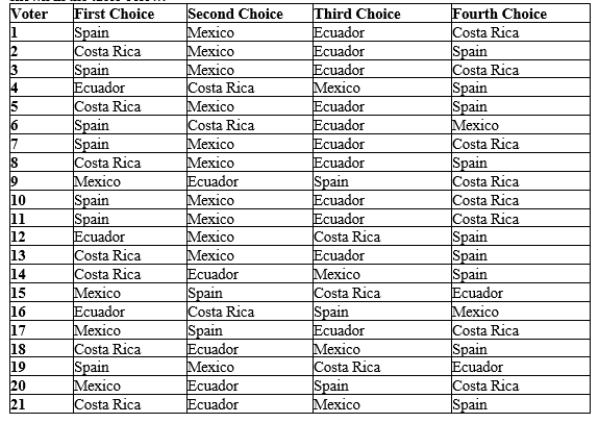 -Refer to Table 22-13. In a pairwise election between Costa Rica and Ecuador and then a second election between the winner and Mexico, which countries are chosen?
 (Multiple Choice)
4.9/5 (74)
(74) 
Filters
- Essay(0)
- Multiple Choice(0)
- Short Answer(0)
- True False(0)
- Matching(0)