



 Chat with AI
Exam 22: Frontiers in Microeconomics

Exam 1: Ten Principles of Economics455 Questions
Exam 2: Thinking Like an Economist643 Questions
Exam 3: Interdependence and the Gains From Trade547 Questions
Exam 4: The Market Forces of Supply and Demand693 Questions
Exam 5: Elasticity and Its Application626 Questions
Exam 6: Supply, Demand, and Government Policies668 Questions
Exam 7: Consumers, Producers, and the Efficiency of Markets547 Questions
Exam 8: Applications: the Costs of Taxation509 Questions
Exam 9: Application: International Trade521 Questions
Exam 10: Externalities543 Questions
Exam 11: Public Goods and Common Resources452 Questions
Exam 12: The Design of the Tax System664 Questions
Exam 13: The Costs of Production649 Questions
Exam 14: Firms in Competitive Markets604 Questions
Exam 15: Monopoly662 Questions
Exam 16: Monopolistic Competition649 Questions
Exam 17: Oligopoly522 Questions
Exam 18: The Markets for the Factors of Production592 Questions
Exam 19: Earnings and Discrimination511 Questions
Exam 20: Income Inequality and Poverty478 Questions
Exam 21: The Theory of Consumer Choice570 Questions
Exam 22: Frontiers in Microeconomics461 Questions
Exam 23: Measuring a Nation S Income547 Questions
Exam 24: Measuring the Cost of Living565 Questions
Exam 25: Production and Growth527 Questions
Exam 26: Saving, Investment, and the Financial System637 Questions
Exam 27: Tools of Finance534 Questions
Exam 28: Unemployment and Its Natural Rate701 Questions
Exam 29: The Monetary System540 Questions
Exam 30: Money Growth and Inflation504 Questions
Exam 31: Open-Economy Macroeconomics: Basic Concepts540 Questions
Exam 32: A Macroeconomic Theory of the Open Economy511 Questions
Exam 33: Aggregate Demand and Aggregate Supply572 Questions
Exam 34: The Influence of Monetary and Fiscal Policy on Aggregate Demand523 Questions
Exam 35: The Short-Run Tradeoff Between Inflation and Unemployment536 Questions
Exam 36: Six Debates Over Macroeconomic Policy354 Questions
Select questions type


Table 22-9 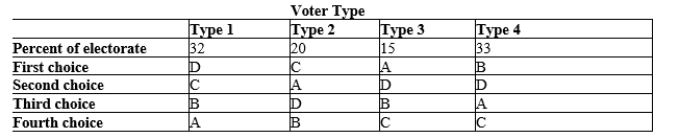 -Refer to Table 22-9. The table shows the preferences of four types of voters over four possible outcomes: A, B, C, D. In addition, the table shows the percentage of voters of each type. Given pairwise voting in which voters choose first between A and B, then between the winner of the first vote and C, and finally between the winner of the second vote and D, which outcome would win?
 (Multiple Choice)
4.8/5  (78)
(78) Mankiw argues that a primary difference between taxing products like gasoline and taxing soda and other sugary drinks is that
(Multiple Choice)
4.8/5 (89)
(89) Economists use basic psychological insights in the field of study called
(Multiple Choice)
5.0/5 (80)
(80) The unanimity property states that the ranking between any two outcomes should not depend on whether some third outcome is available.
(True/False)
4.9/5 (87)
(87) An implication of the median voter theorem is that Republicans and Democrats will try to align their views with those of the median voter.
(True/False)
4.8/5 (84)
(84) Table 22-8
The citizens of Mayville are having a severe budget shortage and are faced with eliminating athletics from the town high school. The town administrator has determined that the town can afford to maintain one sport. Exactly one of the three choices will prevail, and the choice will be made by way of pairwise voting, with the majority determining the outcome on each vote. The preferences of the voters are summarized in the table below. 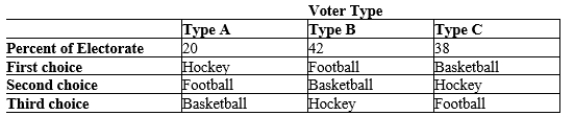 -Refer to Table 22-8. If a Borda count is used, what will be the outcome of the voting?
 (Multiple Choice)
4.8/5 (99)
(99) Table 22-11
Five voters must choose from among four options: A, B, C, or D. Each voter's preferences are summarized in the table below. Options higher in the table are more preferred by the voter.  -Refer to Table 22-11. If the vote were conducted according to a modified Borda count system where each person's first choice receives 10 points, second choice 5 points, third choice 3 points and fourth choice 1 point, the result would be that
 (Multiple Choice)
4.9/5 (81)
(81) A community has five voters who are interested in only one issue: the government's spending on local parks. If Andre would like the government to spend $12,000 on parks, Brandon prefers $7,000, Charlene prefers $4,000, Dennis prefers $2,000, and Ernie prefers $0, how much spending would a politician seeking to win the election select when running against one opponent?
(Multiple Choice)
4.8/5 (83)
(83) Table 22-25
Sophie, Huan, and Santiago are lost with no map or GPS available. They come to an intersection at which they can turn left, turn right, or continue going straight. Their preferences are summarized in the table.  -Refer to Table 22-25. If the travelers decide to use a Borda count, what is the result?
 (Essay)
4.8/5 (83)
(83) Table 22-11
Five voters must choose from among four options: A, B, C, or D. Each voter's preferences are summarized in the table below. Options higher in the table are more preferred by the voter.
-Refer to Table 22-11. Which pairwise voting scheme would result in outcome A?
-Refer to Table 22-11. Which pairwise voting scheme would result in outcome A? (Multiple Choice)
4.8/5 (88)
(88) Suppose there are 3 possible outcomes to a vote: A, B, and C. If voters prefer A to B, C to B, and A to C, which of the following concepts are violated?
(Multiple Choice)
5.0/5 (77)
(77) When a jeweler sells a low quality diamond to a young man who believes the diamond is the highest quality, she is engaging in
(Multiple Choice)
4.8/5 (89)
(89) Harold has always driven cars made by Universal Motors. The last two Universal Motors cars that Harold purchased have had major engine problems resulting in Harold incurring significant cost. Consumer Reports has consistently given Universal Motors poor ratings. Still, Harold plans to purchase another Universal Motors car next fall. Harold's behavior is an example of which systematic mistake that people make?
(Essay)
4.8/5 (75)
(75) Table 22-21
The following table shows the number of voters preferring various amounts of spending to develop a river to make it more attractive for canoeing and kayaking.  -Refer to Table 22-21. Suppose the voters are asked to choose between $1 million and $2.5 million. If all voters cast a vote for the spending amount closest to their own preference, how many votes will the $1 million spending amount receive?
 (Multiple Choice)
4.8/5 (87)
(87) Suppose a group of people read an article on capital punishment. Prior to reading the article, 60% of the members of the group were opposed to capital punishment, while 40% of the members of the group were in favor of capital punishment. According to studies of human decision-making, which of the following is likely?
(Multiple Choice)
4.9/5 (89)
(89) A life insurance company requires new applicants to have a medical exam prior to writing the insurance policy. This requirement is an example of
(Multiple Choice)
4.9/5 (85)
(85) Scenario 22-4
Three members of the DiCarlo family, Vinny, Maria, and Franki, are choosing the entree for a large family reunion. Their options are: spaghetti, ravioli, lasagne, and pizza. Vinny prefers spaghetti over lasagne, lasagne over ravioli, and ravioli over pizza. Maria prefers ravioli over spaghetti, spaghetti over pizza, and pizza over lasagne. Frankie prefers pizza over ravioli, ravioli over lasagne, and lasagne over spaghetti.
-Refer to Scenario 22-4. Maria recommends using a vote by majority rule and proposes first choosing between spaghetti and lasagne, then choosing between the winner of the first vote and ravioli, and finally choosing between the winner of the second vote and pizza. If everyone votes according to his or her preferences,
(Multiple Choice)
4.7/5 (72)
(72) Table 22-25
Sophie, Huan, and Santiago are lost with no map or GPS available. They come to an intersection at which they can turn left, turn right, or continue going straight. Their preferences are summarized in the table.
-Refer to Table 22-25. The travelers decide to conduct pairwise voting with the majority determining the outcome of each vote to decide their next move. Sophie is very confident that the travelers need to go left but she is having a difficult time convincing her friends. If she wants to ensure that the result of the voting is "left," how should she organize the voting?
-Refer to Table 22-25. The travelers decide to conduct pairwise voting with the majority determining the outcome of each vote to decide their next move. Sophie is very confident that the travelers need to go left but she is having a difficult time convincing her friends. If she wants to ensure that the result of the voting is "left," how should she organize the voting? (Essay)
4.8/5 (75)
(75) 
Filters
- Essay(0)
- Multiple Choice(0)
- Short Answer(0)
- True False(0)
- Matching(0)