



 Chat with AI
Exam 22: Frontiers in Microeconomics

Exam 1: Ten Principles of Economics455 Questions
Exam 2: Thinking Like an Economist643 Questions
Exam 3: Interdependence and the Gains From Trade547 Questions
Exam 4: The Market Forces of Supply and Demand693 Questions
Exam 5: Elasticity and Its Application626 Questions
Exam 6: Supply, Demand, and Government Policies668 Questions
Exam 7: Consumers, Producers, and the Efficiency of Markets547 Questions
Exam 8: Applications: the Costs of Taxation509 Questions
Exam 9: Application: International Trade521 Questions
Exam 10: Externalities543 Questions
Exam 11: Public Goods and Common Resources452 Questions
Exam 12: The Design of the Tax System664 Questions
Exam 13: The Costs of Production649 Questions
Exam 14: Firms in Competitive Markets604 Questions
Exam 15: Monopoly662 Questions
Exam 16: Monopolistic Competition649 Questions
Exam 17: Oligopoly522 Questions
Exam 18: The Markets for the Factors of Production592 Questions
Exam 19: Earnings and Discrimination511 Questions
Exam 20: Income Inequality and Poverty478 Questions
Exam 21: The Theory of Consumer Choice570 Questions
Exam 22: Frontiers in Microeconomics461 Questions
Exam 23: Measuring a Nation S Income547 Questions
Exam 24: Measuring the Cost of Living565 Questions
Exam 25: Production and Growth527 Questions
Exam 26: Saving, Investment, and the Financial System637 Questions
Exam 27: Tools of Finance534 Questions
Exam 28: Unemployment and Its Natural Rate701 Questions
Exam 29: The Monetary System540 Questions
Exam 30: Money Growth and Inflation504 Questions
Exam 31: Open-Economy Macroeconomics: Basic Concepts540 Questions
Exam 32: A Macroeconomic Theory of the Open Economy511 Questions
Exam 33: Aggregate Demand and Aggregate Supply572 Questions
Exam 34: The Influence of Monetary and Fiscal Policy on Aggregate Demand523 Questions
Exam 35: The Short-Run Tradeoff Between Inflation and Unemployment536 Questions
Exam 36: Six Debates Over Macroeconomic Policy354 Questions
Select questions type


Maria and Jose installed a "nanny-camera" in their home so that they can view how the nanny is interacting with their children while they are at work. What type of problem are they trying to combat?
(Short Answer)
4.8/5  (77)
(77) Table 22-16
The Johnson family is planning a vacation and, though Mr. and Mrs. Johnson will be paying for the trip, they have decided to use a democratic voting process to choose their destination. The family members' preferences are reflected in the table below.  -Refer to Table 22-16. Mr. Johnson recommends using a vote by majority rule. If he wants to ensure that his 1st choice becomes the family's winning destination, he should propose
 (Multiple Choice)
5.0/5 (76)
(76) In his 1951 book Social Choice and Individual Values, Arrow's perfect voting system satisfies all of the following properties except
(Multiple Choice)
4.8/5 (90)
(90) Life insurance companies usually require applicants to have physicals and disclose information on their health. This practice is designed to address
(Multiple Choice)
4.8/5 (83)
(83) A brand of wine is priced at only $5 per bottle, far below the market price of most high quality wines. Before any reputation exists for the wine, consumers buy very little of this inexpensive wine because they interpret the low price to mean that the wine is of poor quality. The company decides to change the label on the wine to show that it has won awards for quality. This label change is an example of
(Multiple Choice)
4.9/5 (77)
(77) Smoking cessation tools (e.g., nicotine gum) provide evidence that people behave in a time inconsistent manner.
(True/False)
4.9/5 (78)
(78) The problem that results from an agent, who is imperfectly monitored by the principal, engaging in dishonest or otherwise undesirable behavior is called
(Short Answer)
4.7/5 (74)
(74) Suppose that residents of a town are asked to vote on the best day to improve the safety of an intersection. The three choices are: a stoplight, a 4-way stop, and a 2-way stop. The mayor asks the residents to assign 3 points to their first choice, 2 points to their second choice, and 1 point to their last choice. The intersection will be controlled by the method that receives the most points. This voting scheme is called
(Multiple Choice)
4.9/5 (78)
(78) The fact that someone with information about a significant number of illnesses in their family history is likely to purchase health insurance is an example of
(Multiple Choice)
4.9/5 (86)
(86) Table 22-18
The following table shows the preferences of four types of voters over four possible alternatives as well as the percentage of the electorate with the given preferences. 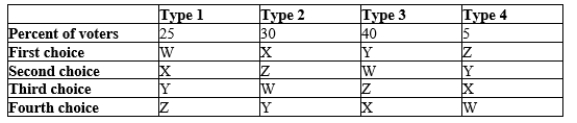 -Refer to Table 22-18. In a majority vote between alternatives X and Y, what percentage of the votes would X receive?
 (Multiple Choice)
4.9/5 (62)
(62) A Principles of Microeconomics professor wants to know how much prior knowledge her students have before beginning the class so she gives them a pre-test. This action is an example of
(Multiple Choice)
4.9/5 (84)
(84) The field of economics in which the tools of economics are used to understand the functioning of government is
(Short Answer)
4.8/5 (67)
(67) A person's tendency to smoke a cigarette after promising himself that he will quit is an example of the behavioral economics insight that people are inconsistent over time
(True/False)
4.8/5 (87)
(87) The classic example of adverse selection is the market for used cars.
(True/False)
4.9/5 (81)
(81) Valerie prefers A to B and she prefers B to C. If Valerie's preferences are transitive, then she prefers A to C.
(True/False)
4.9/5 (80)
(80) Table 22-10
The town of Franklin is facing a severe budget shortage. The town administrator has proposed four options to balance the budget: increase property taxes (taxes), cut the school arts budget (arts), turn off half of the streetlights in the town (streetlights), reduce police patrols (police). Exactly one of the four choices will prevail, and the choice will be made by way of pairwise voting, with the majority determining the outcome on each vote. The preferences of the voters are summarized in the table below. 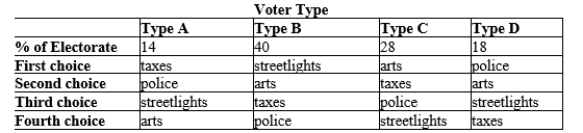 -Refer to Table 22-10. If the town administrator asks voters to choose first between increasing taxes and turning off half of the streetlights, and then between the winner of the first vote and reducing police patrols, and then between the winner of the second vote and cutting the school arts budget, which choice will win the final vote?
 (Multiple Choice)
4.8/5 (85)
(85) The majority of Americans, when asked how many states they could name, think they could name all fifty. However, when they are asked to do so, very few are able to come up with all fifty. This is an example of which systematic mistake that people make?
(Short Answer)
4.9/5 (71)
(71) When each voter has a most-preferred outcome for the expenditure on a particular government program, majority rule will produce the outcome
(Multiple Choice)
4.8/5 (85)
(85) Economic experiments show that people care more about winning a game than about its intrinsic fairness.
(True/False)
4.8/5 (85)
(85) 
Filters
- Essay(0)
- Multiple Choice(0)
- Short Answer(0)
- True False(0)
- Matching(0)