



 Chat with AI
Exam 22: Frontiers in Microeconomics

Exam 1: Ten Principles of Economics455 Questions
Exam 2: Thinking Like an Economist643 Questions
Exam 3: Interdependence and the Gains From Trade547 Questions
Exam 4: The Market Forces of Supply and Demand693 Questions
Exam 5: Elasticity and Its Application626 Questions
Exam 6: Supply, Demand, and Government Policies668 Questions
Exam 7: Consumers, Producers, and the Efficiency of Markets547 Questions
Exam 8: Applications: the Costs of Taxation509 Questions
Exam 9: Application: International Trade521 Questions
Exam 10: Externalities543 Questions
Exam 11: Public Goods and Common Resources452 Questions
Exam 12: The Design of the Tax System664 Questions
Exam 13: The Costs of Production649 Questions
Exam 14: Firms in Competitive Markets604 Questions
Exam 15: Monopoly662 Questions
Exam 16: Monopolistic Competition649 Questions
Exam 17: Oligopoly522 Questions
Exam 18: The Markets for the Factors of Production592 Questions
Exam 19: Earnings and Discrimination511 Questions
Exam 20: Income Inequality and Poverty478 Questions
Exam 21: The Theory of Consumer Choice570 Questions
Exam 22: Frontiers in Microeconomics461 Questions
Exam 23: Measuring a Nation S Income547 Questions
Exam 24: Measuring the Cost of Living565 Questions
Exam 25: Production and Growth527 Questions
Exam 26: Saving, Investment, and the Financial System637 Questions
Exam 27: Tools of Finance534 Questions
Exam 28: Unemployment and Its Natural Rate701 Questions
Exam 29: The Monetary System540 Questions
Exam 30: Money Growth and Inflation504 Questions
Exam 31: Open-Economy Macroeconomics: Basic Concepts540 Questions
Exam 32: A Macroeconomic Theory of the Open Economy511 Questions
Exam 33: Aggregate Demand and Aggregate Supply572 Questions
Exam 34: The Influence of Monetary and Fiscal Policy on Aggregate Demand523 Questions
Exam 35: The Short-Run Tradeoff Between Inflation and Unemployment536 Questions
Exam 36: Six Debates Over Macroeconomic Policy354 Questions
Select questions type


The Condorcet voting paradox applies to situations in which voters
(Multiple Choice)
4.9/5  (87)
(87) Peter was recently hired as a salesman for a national consulting firm. His job involves spending a significant portion of his time out of the office visiting prospects and attending conferences. His firm is paying him a wage that is higher than the equilibrium wage, but he receives much of his income in quarterly bonuses based on how much he sells.
(Multiple Choice)
4.8/5 (92)
(92) Studies show that during the March Madness college basketball tournament, the productivity of the average company in the US falls considerably. This is an example of
(Multiple Choice)
4.8/5 (78)
(78) Which of the following offers an explanation as to why the principal-agent problem exists for a firm?
(Multiple Choice)
4.9/5 (89)
(89) Steve borrowed some money from Summit Bank, telling the loan officer that he intended to use the money to remodel his restaurant. After getting the loan, Steve and his girlfriend immediately took the money and went gambling in Vegas.
(Multiple Choice)
4.7/5 (83)
(83) An example of signaling is a boyfriend giving an expensive, romantic gift to his girlfriend to convey his love for her.
(True/False)
4.7/5 (75)
(75) Suppose there are 3 possible outcomes to a vote: A, B, and C. If voters prefer A to B, B to C, and C to A, which of the following concepts are violated?
(Multiple Choice)
4.8/5 (71)
(71) Which of the following is an attempt to reduce the problem of asymmetric information?
(Multiple Choice)
4.9/5 (76)
(76) Which of the following practices are, at least in part, attempts to reduce moral hazard problems?
(Multiple Choice)
4.8/5 (64)
(64) According to behavioral economics, an employee will likely
(Multiple Choice)
4.8/5 (85)
(85) Which of the following relationships involves asymmetric information?
(Multiple Choice)
4.9/5 (69)
(69) Table 22-22
The town of Fairview is considering a renovation to the high school. The voters in Fairview have different preferences on the budget for the renovation as displayed below. 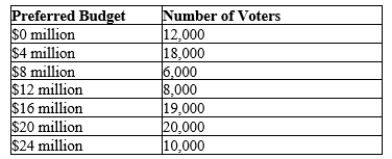 -Refer to Table 22-22. The median voter is one who prefers to spend
 (Multiple Choice)
4.8/5 (82)
(82) Table 22-22
The town of Fairview is considering a renovation to the high school. The voters in Fairview have different preferences on the budget for the renovation as displayed below.
-Refer to Table 22-22. If there is a vote between a budget of $12 million and $16 million, the median voter will vote to spend
-Refer to Table 22-22. If there is a vote between a budget of $12 million and $16 million, the median voter will vote to spend (Multiple Choice)
4.8/5 (79)
(79) People interpret evidence to confirm beliefs they already hold. This statement is an example of which of the following systematic mistakes that people make?
(Multiple Choice)
4.8/5 (84)
(84) According to the median voter theorem, majority rule will produce an outcome that is inconsistent with transitive preferences.
(True/False)
4.8/5 (79)
(79) Economists have found that entrepreneurs are likely to have subjective beliefs about the probability of entrepreneurial success that are higher than the actual objective probabilities. These beliefs are most closely related to which of the following behavior concepts?
(Multiple Choice)
4.9/5 (73)
(73) Arrow's impossibility theorem is "disturbing" in the sense that it proves that
(Multiple Choice)
4.9/5 (71)
(71) Moral hazard and adverse selection are similar asymmetric information problems but moral hazard involves hidden actions while adverse selection involves hidden characteristics.
(True/False)
4.7/5 (73)
(73) When economists assume that people are rational, they assume that
(Multiple Choice)
4.9/5 (81)
(81) 
Filters
- Essay(0)
- Multiple Choice(0)
- Short Answer(0)
- True False(0)
- Matching(0)