



 Chat with AI
Exam 22: Frontiers in Microeconomics

Exam 1: Ten Principles of Economics455 Questions
Exam 2: Thinking Like an Economist643 Questions
Exam 3: Interdependence and the Gains From Trade547 Questions
Exam 4: The Market Forces of Supply and Demand693 Questions
Exam 5: Elasticity and Its Application626 Questions
Exam 6: Supply, Demand, and Government Policies668 Questions
Exam 7: Consumers, Producers, and the Efficiency of Markets547 Questions
Exam 8: Applications: the Costs of Taxation509 Questions
Exam 9: Application: International Trade521 Questions
Exam 10: Externalities543 Questions
Exam 11: Public Goods and Common Resources452 Questions
Exam 12: The Design of the Tax System664 Questions
Exam 13: The Costs of Production649 Questions
Exam 14: Firms in Competitive Markets604 Questions
Exam 15: Monopoly662 Questions
Exam 16: Monopolistic Competition649 Questions
Exam 17: Oligopoly522 Questions
Exam 18: The Markets for the Factors of Production592 Questions
Exam 19: Earnings and Discrimination511 Questions
Exam 20: Income Inequality and Poverty478 Questions
Exam 21: The Theory of Consumer Choice570 Questions
Exam 22: Frontiers in Microeconomics461 Questions
Exam 23: Measuring a Nation S Income547 Questions
Exam 24: Measuring the Cost of Living565 Questions
Exam 25: Production and Growth527 Questions
Exam 26: Saving, Investment, and the Financial System637 Questions
Exam 27: Tools of Finance534 Questions
Exam 28: Unemployment and Its Natural Rate701 Questions
Exam 29: The Monetary System540 Questions
Exam 30: Money Growth and Inflation504 Questions
Exam 31: Open-Economy Macroeconomics: Basic Concepts540 Questions
Exam 32: A Macroeconomic Theory of the Open Economy511 Questions
Exam 33: Aggregate Demand and Aggregate Supply572 Questions
Exam 34: The Influence of Monetary and Fiscal Policy on Aggregate Demand523 Questions
Exam 35: The Short-Run Tradeoff Between Inflation and Unemployment536 Questions
Exam 36: Six Debates Over Macroeconomic Policy354 Questions
Select questions type


Table 22-25
Sophie, Huan, and Santiago are lost with no map or GPS available. They come to an intersection at which they can turn left, turn right, or continue going straight. Their preferences are summarized in the table.  -Refer to Table 22-25. The travelers decide to conduct pairwise voting with the majority determining the outcome of each vote to decide their next move. If they first choose between going left and going straight, and then choose between the winner of the first vote and going right, which direction will they go?
 (Short Answer)
4.7/5  (76)
(76) Table 22-2
Three longtime friends-Allen, Brian, and Cody-are deciding how they will spend their Sunday afternoon. They all agree that they should do one of three things: go to a movie, play golf, or go to a baseball game. They also agree that they will have two pairwise votes to determine how to spend their afternoon, with the majority determining the outcome on each vote. The first, second, and third choices for each person are as indicated in the table below.  -Refer to Table 22-2. If (1) the first vote pits "baseball game" against "movie," and (2) the second vote pits "golf" against the winner of the first vote, then the outcome is as follows:
 (Multiple Choice)
4.9/5 (74)
(74) Table 22-3
Three family members -- Seamus, Maeve, and Siobhan -- are deciding what type of movie to attend. The three choices are an action adventure, comedy, or horror. The first, second, and third choices for each person are as indicated in the table below. 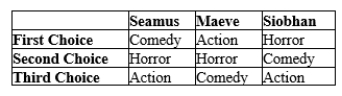 -Refer to Table 22-3. Suppose the three decide to make the decision based on pairwise majority voting. If they first choose between Action and Horror and then choose between the winner of the first vote and Comedy, which movie alternative will win?
 (Multiple Choice)
5.0/5 (84)
(84) Herbert Simon, one of the first social scientists to combine the study of economics and psychology, suggested that humans should be viewed as
(Multiple Choice)
5.0/5 (85)
(85) In American politics, we often observe that during a campaign, the Democratic and Republican positions on many issues are similar, which illustrates
(Multiple Choice)
4.9/5 (78)
(78) Table 22-1
Three friends -- Linda, Stephanie, and Jamie -- are deciding where to go together for vacation. They all agree that they should go to one of three places: France, Greece, or Italy. They also agree that they will have two pairwise votes to determine where to go on vacation, with the majority determining the outcome on each vote. The first, second, and third choices for each person are as indicated in the table below.  -Refer to Table 22-1. Depending on the order of the pairwise voting,
 (Multiple Choice)
4.8/5 (84)
(84) Scenario 22-6
Shana owns a boutique that sells high-end women's clothing and accessories. Katie works part-time at the boutique and frequently is the only employee in this small store. Shana pays Katie a wage that is higher than the market wage for this type of job. When the store is not full of customers, Katie diligently works on displays and cleans to keep the store looking its best. Belinda is a customer in the store who asks Katie's opinion on the quality of some jeans she is considering purchasing. Katie tells her the quality is great even though she's had several other customers return them due to flaws. Magda is another customer who is returning a necklace without volunteering that a gem is missing.
-Refer to Scenario 22-6. Which of the ladies, if any, is committing a moral hazard?
(Short Answer)
4.9/5 (87)
(87) People with hidden health problems are more likely to buy health insurance than are other people. This is an example of
(Multiple Choice)
4.9/5 (92)
(92) Table 22-17  -Refer to Table 22-17. The table shows the preferences of three types of voters over three possible outcomes: A, B, and C. In addition, the table shows the percentage of voters of each type. Based on this information, which of the following statements is true?
 (Multiple Choice)
4.9/5 (70)
(70) Studies of human decision making reveal several systematic mistakes people make. Which of the following is not an example of one of these mistakes?
(Multiple Choice)
4.9/5 (72)
(72) A mother gives her teenage daughter two choices: spend 20 minutes cleaning her room today or spend 25 minutes cleaning her room tomorrow. The same mother gives her same daughter two additional choices: clean out the garage for 20 minutes next Tuesday or 25 minutes next Wednesday. According to economic theory,
(Multiple Choice)
4.8/5 (78)
(78) Table 22-4
The fortunate residents of Anytown have a budget surplus. The mayor decided that it is only fair to have the residents vote on what to do with the surplus. The mayor has narrowed the options down to three possible projects: a playground, a library, or a swimming pool. The voters fall into three categories and have preferences as illustrated in the table.  -Refer to Table 22-4. Which of the following statements is correct regarding the results of pairwise voting in Anytown?
 (Multiple Choice)
4.9/5 (85)
(85) You own an ice cream store and are concerned that an employee may be giving generous scoops to friends and relatives and smaller scoops to some other customers. This is an example of
(Multiple Choice)
4.9/5 (78)
(78) Table 22-20
The table below shows the preferred city budget (in millions) for
in the city of Springfield. 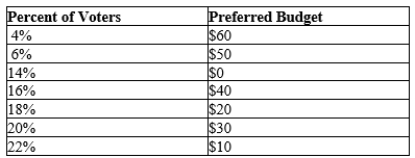 -Refer to Table 22-20. In an election, each voter will select the budget closest to his or her most preferred budget. In which of the following cases does a budget of $32 win?
 (Multiple Choice)
4.8/5 (81)
(81) Suppose you are covered under health insurance or belong to a Health Maintenance Organization (HMO), and you are insured against all or most of the costs of visits to the doctor. As a result you are likely to make greater use of medical services of all kinds. This tendency of people with insurance to change their behavior in a way that leads to more claims against the insurance company is called
(Multiple Choice)
4.8/5 (83)
(83) A driver knows more than his auto insurer about how cautiously he drives. This is an example of
(Multiple Choice)
5.0/5 (91)
(91) Condorcet explained his paradox in a 1951 book called Social Choice and Individual Values.
(True/False)
4.8/5 (83)
(83) 
Filters
- Essay(0)
- Multiple Choice(0)
- Short Answer(0)
- True False(0)
- Matching(0)