



 Chat with AI
Exam 4: The Market Forces of Supply and Demand

Exam 1: Ten Principles of Economics455 Questions
Exam 2: Thinking Like an Economist643 Questions
Exam 3: Interdependence and the Gains From Trade547 Questions
Exam 4: The Market Forces of Supply and Demand693 Questions
Exam 5: Elasticity and Its Application626 Questions
Exam 6: Supply, Demand, and Government Policies668 Questions
Exam 7: Consumers, Producers, and the Efficiency of Markets547 Questions
Exam 8: Applications: the Costs of Taxation509 Questions
Exam 9: Application: International Trade521 Questions
Exam 10: Externalities543 Questions
Exam 11: Public Goods and Common Resources452 Questions
Exam 12: The Design of the Tax System664 Questions
Exam 13: The Costs of Production649 Questions
Exam 14: Firms in Competitive Markets604 Questions
Exam 15: Monopoly662 Questions
Exam 16: Monopolistic Competition649 Questions
Exam 17: Oligopoly522 Questions
Exam 18: The Markets for the Factors of Production592 Questions
Exam 19: Earnings and Discrimination511 Questions
Exam 20: Income Inequality and Poverty478 Questions
Exam 21: The Theory of Consumer Choice570 Questions
Exam 22: Frontiers in Microeconomics461 Questions
Exam 23: Measuring a Nation S Income547 Questions
Exam 24: Measuring the Cost of Living565 Questions
Exam 25: Production and Growth527 Questions
Exam 26: Saving, Investment, and the Financial System637 Questions
Exam 27: Tools of Finance534 Questions
Exam 28: Unemployment and Its Natural Rate701 Questions
Exam 29: The Monetary System540 Questions
Exam 30: Money Growth and Inflation504 Questions
Exam 31: Open-Economy Macroeconomics: Basic Concepts540 Questions
Exam 32: A Macroeconomic Theory of the Open Economy511 Questions
Exam 33: Aggregate Demand and Aggregate Supply572 Questions
Exam 34: The Influence of Monetary and Fiscal Policy on Aggregate Demand523 Questions
Exam 35: The Short-Run Tradeoff Between Inflation and Unemployment536 Questions
Exam 36: Six Debates Over Macroeconomic Policy354 Questions
Select questions type


Figure 4-25
The graph below pertains to the supply of paper to colleges and universities. 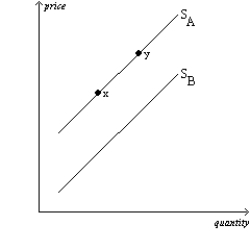 -Refer to Figure 4-25. All else equal, an increase in the use of laptop computers for note-taking would cause a move from
 (Multiple Choice)
4.9/5  (83)
(83) Matthew bakes apple pies that he sells at the local farmer's market. If the price of apples increases, the
(Multiple Choice)
4.8/5 (90)
(90) Figure 4-21 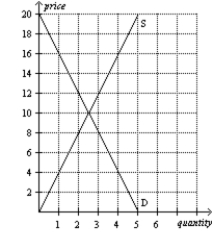 -Refer to Figure 4-21. What is the equilibrium price in this market?
 (Multiple Choice)
4.7/5 (78)
(78) Supply refers to the position of the supply curve, whereas the quantity supplied refers to the amount suppliers wish to sell.
(True/False)
4.8/5 (68)
(68) If muffins and bagels are substitutes, a higher price for bagels would result in a(n)
(Multiple Choice)
4.8/5 (78)
(78) Table 4-7 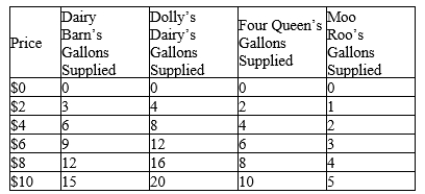 -Refer to Table 4-7. If these are the only four sellers in the market for ice cream, then the market quantity supplied at a price of $8 is
 (Multiple Choice)
4.9/5 (89)
(89) The following table contains a monthly demand schedule for large, single-topping, carry-out pizzas. 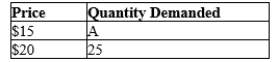 If the law of demand applies to these pizzas, then A could be
 (Multiple Choice)
4.8/5 (76)
(76) Figure 4-26 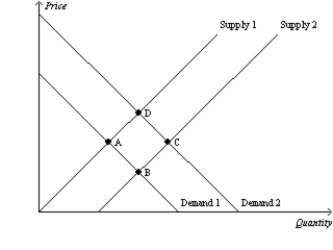 -Refer to Figure 4-26. Which of the following movements would illustrate the effect in the market for wedding cakes resulting from a decrease in the number of pastry chefs?
 (Multiple Choice)
4.9/5 (89)
(89) Which of the following events would cause both the equilibrium price and equilibrium quantity of number two grade potatoes to increase if number two grade potatoes are an inferior good?
(Multiple Choice)
4.9/5 (86)
(86) Which of the following events could cause an increase in the supply of ceiling fans?
(Multiple Choice)
4.9/5 (84)
(84) "Other things equal, when the price of a good rises, the quantity demanded of the good falls, and when the price falls, the quantity demanded rises." This relationship between price and quantity demanded
(Multiple Choice)
4.8/5 (91)
(91) Figure 4-18 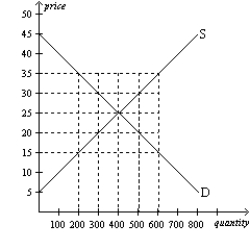 -Refer to Figure 4-18. At what price would there be an excess supply of 200 units of the good?
 (Multiple Choice)
4.7/5 (78)
(78) Table 4-6 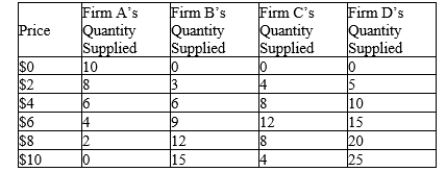 -Refer to Table 4-6. If these are the only four sellers in the market, then when the price decreases from $4 to $2, the market quantity supplied
 (Multiple Choice)
4.9/5 (71)
(71) All goods and services are sold in perfectly competitive markets.
(True/False)
4.9/5 (81)
(81) Pens are normal goods. What will happen to the equilibrium price of pens if the price of pencils rises, consumers experience an increase in income, writing in ink becomes fashionable, people expect the price of pens to rise in the near future, the population increases, fewer firms manufacture pens, and the wages of pen-makers increase?
(Multiple Choice)
4.9/5 (85)
(85) 
Filters
- Essay(0)
- Multiple Choice(0)
- Short Answer(0)
- True False(0)
- Matching(0)