



 Chat with AI
Exam 4: The Market Forces of Supply and Demand

Exam 1: Ten Principles of Economics455 Questions
Exam 2: Thinking Like an Economist643 Questions
Exam 3: Interdependence and the Gains From Trade547 Questions
Exam 4: The Market Forces of Supply and Demand693 Questions
Exam 5: Elasticity and Its Application626 Questions
Exam 6: Supply, Demand, and Government Policies668 Questions
Exam 7: Consumers, Producers, and the Efficiency of Markets547 Questions
Exam 8: Applications: the Costs of Taxation509 Questions
Exam 9: Application: International Trade521 Questions
Exam 10: Externalities543 Questions
Exam 11: Public Goods and Common Resources452 Questions
Exam 12: The Design of the Tax System664 Questions
Exam 13: The Costs of Production649 Questions
Exam 14: Firms in Competitive Markets604 Questions
Exam 15: Monopoly662 Questions
Exam 16: Monopolistic Competition649 Questions
Exam 17: Oligopoly522 Questions
Exam 18: The Markets for the Factors of Production592 Questions
Exam 19: Earnings and Discrimination511 Questions
Exam 20: Income Inequality and Poverty478 Questions
Exam 21: The Theory of Consumer Choice570 Questions
Exam 22: Frontiers in Microeconomics461 Questions
Exam 23: Measuring a Nation S Income547 Questions
Exam 24: Measuring the Cost of Living565 Questions
Exam 25: Production and Growth527 Questions
Exam 26: Saving, Investment, and the Financial System637 Questions
Exam 27: Tools of Finance534 Questions
Exam 28: Unemployment and Its Natural Rate701 Questions
Exam 29: The Monetary System540 Questions
Exam 30: Money Growth and Inflation504 Questions
Exam 31: Open-Economy Macroeconomics: Basic Concepts540 Questions
Exam 32: A Macroeconomic Theory of the Open Economy511 Questions
Exam 33: Aggregate Demand and Aggregate Supply572 Questions
Exam 34: The Influence of Monetary and Fiscal Policy on Aggregate Demand523 Questions
Exam 35: The Short-Run Tradeoff Between Inflation and Unemployment536 Questions
Exam 36: Six Debates Over Macroeconomic Policy354 Questions
Select questions type


For teenagers, a 10 percent increase in the price of cigarettes leads to a
(Multiple Choice)
4.8/5  (82)
(82) Individual supply curves are summed vertically to obtain the market supply curve.
(True/False)
4.9/5 (81)
(81) Demand refers to the amount buyers wish to buy, whereas the quantity demanded refers to the position of the demand curve.
(True/False)
4.8/5 (80)
(80) The line that relates the price of a good and the quantity supplied of that good is called the supply
(Multiple Choice)
4.9/5 (77)
(77) Table 4-13
The demand schedule below pertains to sandwiches demanded per week. 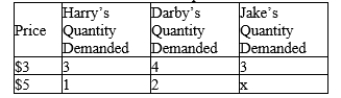 -Refer to Table 4-13. Suppose Harry, Darby, and Jake are the only demanders of sandwiches. Also suppose the following:
• x = 2.
• The current price of a sandwich is $3.00.
• The market quantity supplied of sandwiches is 4.
• The slope of the supply curve is 2.
Then there is currently a
-Refer to Table 4-13. Suppose Harry, Darby, and Jake are the only demanders of sandwiches. Also suppose the following:
• x = 2.
• The current price of a sandwich is $3.00.
• The market quantity supplied of sandwiches is 4.
• The slope of the supply curve is 2.
Then there is currently a (Multiple Choice)
4.9/5 (89)
(89) Table 4-15
The following table shows the number of cases of water each seller is willing to sell at the prices listed.  -Refer to Table 4-15. Assume these are the only four suppliers in this market and the function for market demand is QD=1000-100P, where QD is the quantity demanded and P is the price. If the price is $6 per case, is there a shortage or surplus, and how large is the shortage or surplus?
 (Short Answer)
4.8/5 (89)
(89) Which of the following is not a reason perfect competition is a useful simplification, despite the diversity of market types we find in the world?
(Multiple Choice)
4.9/5 (78)
(78) Figure 4-22 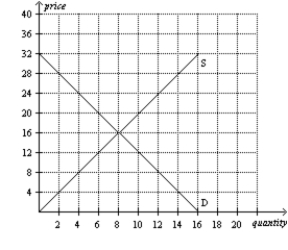 -Refer to Figure 4-22. What is the equilibrium quantity in this market?
 (Multiple Choice)
4.8/5 (71)
(71) Scenario 4-1
Suppose the demand schedule in a market can be represented by the equation 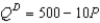 , where
 is the quantity demanded and
 is the price. Also, suppose the supply schedule can be represented by the equation
 , where
 is the quantity supplied.
-Refer to Scenario 4-1. What is the equilibrium price in this market?
, where is the quantity demanded and is the price. Also, suppose the supply schedule can be represented by the equation , where is the quantity supplied.
-Refer to Scenario 4-1. What is the equilibrium price in this market? (Short Answer)
4.7/5 (64)
(64) In any economic system, scarce resources have to be allocated among competing uses. Market economies harness the forces of
(Multiple Choice)
4.7/5 (78)
(78) Figure 4-8 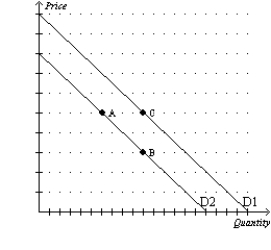 -Refer to Figure 4-8. Suppose the figure shows the market demand for laptop computers. Suppose the price of wireless printers, a complementary good, decreases. Which of the following changes would occur?
 (Multiple Choice)
4.8/5 (67)
(67) A university's football stadium is always sold out, and students who wait in line for hours may be turned away. This indicates
(Multiple Choice)
4.8/5 (69)
(69) If income rises in the market for a normal good, will the demand curve for the normal good shift to the right or to the left?
(Short Answer)
4.9/5 (92)
(92) What will happen in the market for shotgun-shell ammunition now if buyers expect higher shotgun-shell prices in the near future?
(Multiple Choice)
4.8/5 (69)
(69) Holding the nonprice determinants of demand constant, a change in price would
(Multiple Choice)
4.9/5 (85)
(85) Figure 4-13 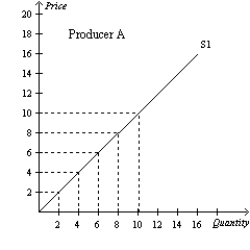
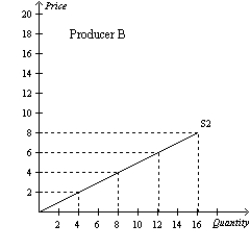 -Refer to Figure 4-13. If Producer A and Producer B are the only producers in the market, then the market quantity supplied when the price is $8 is
 (Multiple Choice)
4.8/5 (73)
(73) Table 4-10
The following table shows the number of cases of water each seller is willing to sell at the prices listed.  -Refer to Table 4-10. If the four suppliers listed are the only suppliers in this market and the market quantity demanded is 500 cases when the price is $5.00, which of the following statements is correct?
 (Multiple Choice)
4.9/5 (71)
(71) If a study by medical researchers finds that eating brown rice causes weight loss while eating white rice causes weight gain, then we likely would see
(Multiple Choice)
4.9/5 (86)
(86) 
Filters
- Essay(0)
- Multiple Choice(0)
- Short Answer(0)
- True False(0)
- Matching(0)