



 Chat with AI
Exam 4: The Market Forces of Supply and Demand

Exam 1: Ten Principles of Economics455 Questions
Exam 2: Thinking Like an Economist643 Questions
Exam 3: Interdependence and the Gains From Trade547 Questions
Exam 4: The Market Forces of Supply and Demand693 Questions
Exam 5: Elasticity and Its Application626 Questions
Exam 6: Supply, Demand, and Government Policies668 Questions
Exam 7: Consumers, Producers, and the Efficiency of Markets547 Questions
Exam 8: Applications: the Costs of Taxation509 Questions
Exam 9: Application: International Trade521 Questions
Exam 10: Externalities543 Questions
Exam 11: Public Goods and Common Resources452 Questions
Exam 12: The Design of the Tax System664 Questions
Exam 13: The Costs of Production649 Questions
Exam 14: Firms in Competitive Markets604 Questions
Exam 15: Monopoly662 Questions
Exam 16: Monopolistic Competition649 Questions
Exam 17: Oligopoly522 Questions
Exam 18: The Markets for the Factors of Production592 Questions
Exam 19: Earnings and Discrimination511 Questions
Exam 20: Income Inequality and Poverty478 Questions
Exam 21: The Theory of Consumer Choice570 Questions
Exam 22: Frontiers in Microeconomics461 Questions
Exam 23: Measuring a Nation S Income547 Questions
Exam 24: Measuring the Cost of Living565 Questions
Exam 25: Production and Growth527 Questions
Exam 26: Saving, Investment, and the Financial System637 Questions
Exam 27: Tools of Finance534 Questions
Exam 28: Unemployment and Its Natural Rate701 Questions
Exam 29: The Monetary System540 Questions
Exam 30: Money Growth and Inflation504 Questions
Exam 31: Open-Economy Macroeconomics: Basic Concepts540 Questions
Exam 32: A Macroeconomic Theory of the Open Economy511 Questions
Exam 33: Aggregate Demand and Aggregate Supply572 Questions
Exam 34: The Influence of Monetary and Fiscal Policy on Aggregate Demand523 Questions
Exam 35: The Short-Run Tradeoff Between Inflation and Unemployment536 Questions
Exam 36: Six Debates Over Macroeconomic Policy354 Questions
Select questions type


What will happen to the equilibrium price and quantity of new cars if the price of gasoline rises, the price of steel rises, public transportation becomes cheaper and more comfortable, and auto-workers negotiate higher wages?
(Multiple Choice)
4.8/5  (78)
(78) Table 4-16
The following table shows the supply and demand schedules in a market. 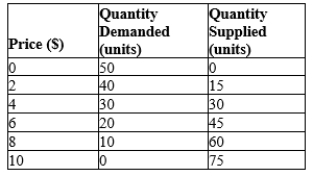 -Refer to Table 4-16. At a price of $8, how large of a surplus will there be in this market?
 (Short Answer)
4.8/5 (62)
(62) Figure 4-12
Firm A
Firm B 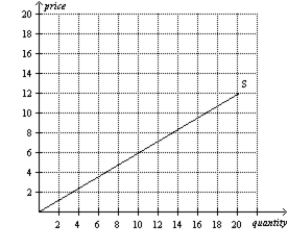
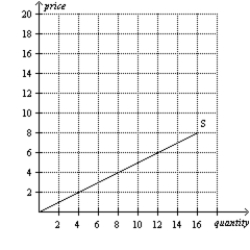 -Refer to Figure 4-12. If these are the only two sellers in the market, then the market quantity supplied at a price of $6 is
 (Multiple Choice)
5.0/5 (73)
(73) Figure 4-5 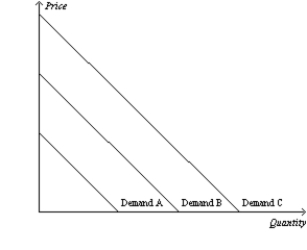 -Refer to Figure 4-5. Which of the following would cause the demand curve to shift from Demand C to Demand A in the market for DVDs?
 (Multiple Choice)
4.8/5 (78)
(78) Which of the following would cause a movement along the supply curve for cupcakes?
(Multiple Choice)
4.7/5 (75)
(75) Table 4-2 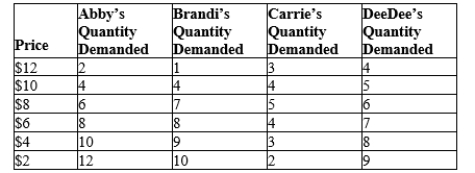 -Refer to Table 4-2. Suppose Abby, Brandi, Carrie, and DeeDee are the only four buyers in the market. When the price decreases from $6 to $4, the market quantity demanded
 (Multiple Choice)
4.9/5 (84)
(84) Figure 4-24
The diagram below pertains to the demand for turkey in the United States. 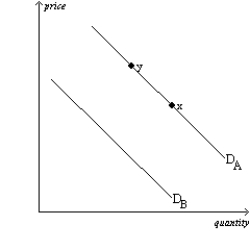 -Refer to Figure 4-24. All else equal, a sale on chicken would cause a move from
 (Multiple Choice)
4.9/5 (72)
(72) A movement along the supply curve might be caused by a change in
(Multiple Choice)
4.8/5 (72)
(72) Recent forest fires in the western states are expected to cause the price of lumber to rise in the next six months. As a result, we can expect the supply of lumber to
(Multiple Choice)
4.8/5 (72)
(72) Most studies have found that tobacco and marijuana are complements rather than substitutes.
(True/False)
4.9/5 (75)
(75) Suppose the demand for calendars increases in November. At the same time, the price of the ink used in the production of calendars increases. In the market for calendars, the equilibrium price rises, but the effect on the equilibrium quantity is ambiguous.
(True/False)
4.8/5 (77)
(77) Table 4-14
The table below shows the quantities demanded of milk per month by four families at various prices.
-Refer to Table 4-14. If the four families listed are the only demanders in this market and the price of a gallon of milk increases from $4.00 to $5.00, what is the change in the market quantity demanded?
(Short Answer)
4.8/5 (75)
(75) Which of these statements best represents the law of demand?
(Multiple Choice)
4.7/5 (66)
(66) Figure 4-7 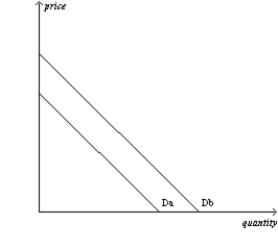 -Refer to Figure 4-7. The movement from Da to Db in the market for potato chips could be caused by a(n)
 (Multiple Choice)
4.9/5 (58)
(58) Which of the following would most likely serve as an example of a monopoly?
(Multiple Choice)
4.8/5 (75)
(75) When the price of a good is high, selling the good is profitable, and so the quantity supplied is large.
(True/False)
4.9/5 (80)
(80) 
Filters
- Essay(0)
- Multiple Choice(0)
- Short Answer(0)
- True False(0)
- Matching(0)