



 Chat with AI
Exam 4: The Market Forces of Supply and Demand

Exam 1: Ten Principles of Economics455 Questions
Exam 2: Thinking Like an Economist643 Questions
Exam 3: Interdependence and the Gains From Trade547 Questions
Exam 4: The Market Forces of Supply and Demand693 Questions
Exam 5: Elasticity and Its Application626 Questions
Exam 6: Supply, Demand, and Government Policies668 Questions
Exam 7: Consumers, Producers, and the Efficiency of Markets547 Questions
Exam 8: Applications: the Costs of Taxation509 Questions
Exam 9: Application: International Trade521 Questions
Exam 10: Externalities543 Questions
Exam 11: Public Goods and Common Resources452 Questions
Exam 12: The Design of the Tax System664 Questions
Exam 13: The Costs of Production649 Questions
Exam 14: Firms in Competitive Markets604 Questions
Exam 15: Monopoly662 Questions
Exam 16: Monopolistic Competition649 Questions
Exam 17: Oligopoly522 Questions
Exam 18: The Markets for the Factors of Production592 Questions
Exam 19: Earnings and Discrimination511 Questions
Exam 20: Income Inequality and Poverty478 Questions
Exam 21: The Theory of Consumer Choice570 Questions
Exam 22: Frontiers in Microeconomics461 Questions
Exam 23: Measuring a Nation S Income547 Questions
Exam 24: Measuring the Cost of Living565 Questions
Exam 25: Production and Growth527 Questions
Exam 26: Saving, Investment, and the Financial System637 Questions
Exam 27: Tools of Finance534 Questions
Exam 28: Unemployment and Its Natural Rate701 Questions
Exam 29: The Monetary System540 Questions
Exam 30: Money Growth and Inflation504 Questions
Exam 31: Open-Economy Macroeconomics: Basic Concepts540 Questions
Exam 32: A Macroeconomic Theory of the Open Economy511 Questions
Exam 33: Aggregate Demand and Aggregate Supply572 Questions
Exam 34: The Influence of Monetary and Fiscal Policy on Aggregate Demand523 Questions
Exam 35: The Short-Run Tradeoff Between Inflation and Unemployment536 Questions
Exam 36: Six Debates Over Macroeconomic Policy354 Questions
Select questions type


Which of the following events must result in a higher price in the market for cigars?
(Multiple Choice)
4.8/5  (76)
(76) The market supply curve shows how the total quantity supplied of a good varies as input prices vary, holding constant all the other factors that influence producers' decisions about how much to sell.
(True/False)
4.9/5 (89)
(89) In a market, to find the total amount supplied at a particular price, we must
(Multiple Choice)
4.9/5 (80)
(80) If car manufacturers begin using new labor-saving technology on their assembly lines, we would not expect
(Multiple Choice)
4.8/5 (87)
(87) An example of a perfectly competitive market would be the market for
(Multiple Choice)
4.9/5 (71)
(71) Table 4-2 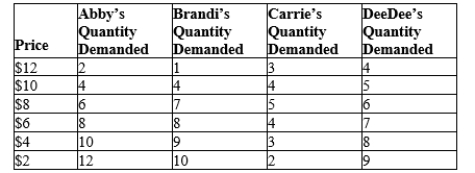 -Refer to Table 4-2. Whose demand does not obey the law of demand?
 (Multiple Choice)
4.9/5 (91)
(91) If the supply of a product decreases, then we would expect equilibrium price
(Multiple Choice)
4.7/5 (90)
(90) Table 4-2
-Refer to Table 4-2. Suppose Abby, Brandi, Carrie, and DeeDee are the only four buyers in the market. If the price is $8, then the market quantity demanded is
-Refer to Table 4-2. Suppose Abby, Brandi, Carrie, and DeeDee are the only four buyers in the market. If the price is $8, then the market quantity demanded is (Multiple Choice)
4.9/5 (82)
(82) Figure 4-31
Consider the market for 2-packs of light bulbs below.
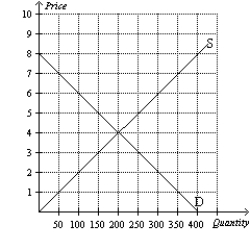 -Refer to Figure 4-31. At a price of $3, is there a shortage or surplus, and how large is the shortage/surplus?
 (Short Answer)
4.9/5 (65)
(65) Figure 4-2 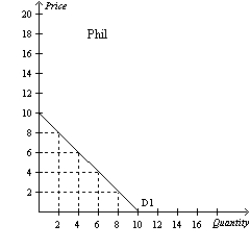
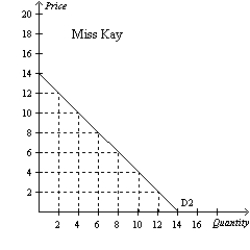 -Refer to Figure 4-2. Suppose Phil and Miss Kay are the only consumers in the market. If the price is $12, then the market quantity demanded is
 (Multiple Choice)
4.9/5 (82)
(82) If the demand for movies increases at the same time as the movie industry adopts labor-saving technology for producing movies, the equilibrium price for movies will increase, but the effect on the equilibrium quantity of movies is ambiguous.
(True/False)
4.9/5 (77)
(77) A reduction in an input price will cause a change in quantity supplied but not a change in supply.
(True/False)
4.9/5 (88)
(88) Figure 4-27
Panel (a)
Panel (b) 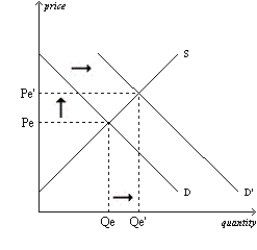
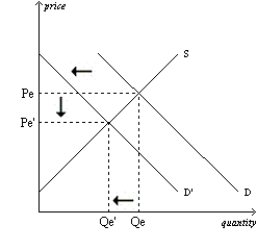 Panel (c)
Panel (d)
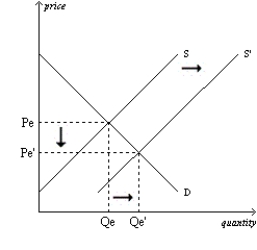
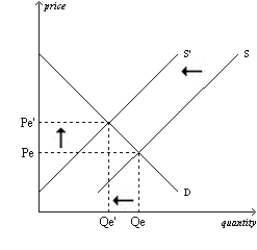 -Refer to Figure 4-27. Which of the four panels represents the market for winter coats as we progress from winter to spring?
Panel (c)
Panel (d)
-Refer to Figure 4-27. Which of the four panels represents the market for winter coats as we progress from winter to spring? (Multiple Choice)
4.9/5 (79)
(79) An increase in the price of blue pens will increase both the equilibrium price and quantity in the market for black pens.
(True/False)
4.9/5 (71)
(71) An increase in the price of ink will shift the supply curve for pens to the left.
(True/False)
4.8/5 (80)
(80) If a decrease in income increases the demand for a good, then the good is a(n)
(Multiple Choice)
4.7/5 (74)
(74) 
Filters
- Essay(0)
- Multiple Choice(0)
- Short Answer(0)
- True False(0)
- Matching(0)