



 Chat with AI
Exam 4: The Market Forces of Supply and Demand

Exam 1: Ten Principles of Economics455 Questions
Exam 2: Thinking Like an Economist643 Questions
Exam 3: Interdependence and the Gains From Trade547 Questions
Exam 4: The Market Forces of Supply and Demand693 Questions
Exam 5: Elasticity and Its Application626 Questions
Exam 6: Supply, Demand, and Government Policies668 Questions
Exam 7: Consumers, Producers, and the Efficiency of Markets547 Questions
Exam 8: Applications: the Costs of Taxation509 Questions
Exam 9: Application: International Trade521 Questions
Exam 10: Externalities543 Questions
Exam 11: Public Goods and Common Resources452 Questions
Exam 12: The Design of the Tax System664 Questions
Exam 13: The Costs of Production649 Questions
Exam 14: Firms in Competitive Markets604 Questions
Exam 15: Monopoly662 Questions
Exam 16: Monopolistic Competition649 Questions
Exam 17: Oligopoly522 Questions
Exam 18: The Markets for the Factors of Production592 Questions
Exam 19: Earnings and Discrimination511 Questions
Exam 20: Income Inequality and Poverty478 Questions
Exam 21: The Theory of Consumer Choice570 Questions
Exam 22: Frontiers in Microeconomics461 Questions
Exam 23: Measuring a Nation S Income547 Questions
Exam 24: Measuring the Cost of Living565 Questions
Exam 25: Production and Growth527 Questions
Exam 26: Saving, Investment, and the Financial System637 Questions
Exam 27: Tools of Finance534 Questions
Exam 28: Unemployment and Its Natural Rate701 Questions
Exam 29: The Monetary System540 Questions
Exam 30: Money Growth and Inflation504 Questions
Exam 31: Open-Economy Macroeconomics: Basic Concepts540 Questions
Exam 32: A Macroeconomic Theory of the Open Economy511 Questions
Exam 33: Aggregate Demand and Aggregate Supply572 Questions
Exam 34: The Influence of Monetary and Fiscal Policy on Aggregate Demand523 Questions
Exam 35: The Short-Run Tradeoff Between Inflation and Unemployment536 Questions
Exam 36: Six Debates Over Macroeconomic Policy354 Questions
Select questions type


A group of buyers and sellers of a particular good or service is called a(n)
(Multiple Choice)
4.8/5  (80)
(80) Figure 4-14 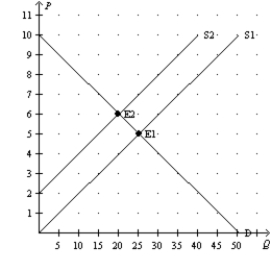 -Refer to Figure 4-14. Which of the following best describes the movement from E1 to E2?
 (Multiple Choice)
4.8/5 (88)
(88) Table 4-4 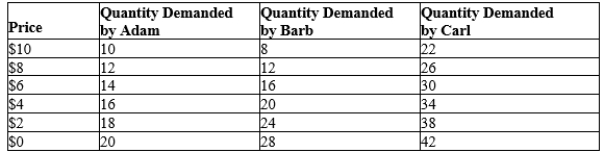 -Refer to Table 4-4. Suppose the market consists of Adam, Barb, and Carl. If the price falls by $2, the quantity demanded in the market increases by
 (Multiple Choice)
4.9/5 (88)
(88) A shortage will occur at any price below equilibrium price and a surplus will occur at any price above equilibrium price.
(True/False)
4.7/5 (74)
(74) Figure 4-25
The graph below pertains to the supply of paper to colleges and universities. 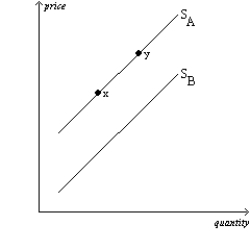 -Refer to Figure 4-25. All else equal, sellers expecting the price of paper to decrease next month when many college students leave campuses for the summer would cause a current move from
 (Multiple Choice)
4.8/5 (69)
(69) Table 4-12
A country club usually only allows members to purchase tickets for its celebrity golf tournament, but the club is considering allowing non-members to purchase tickets this year. The demand and supply schedules are as follows: 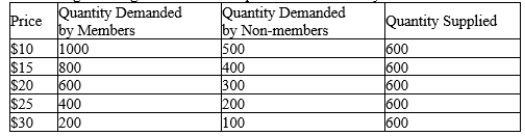 -Refer to Table 4-12. If both members and non-members are allowed to purchase tickets to this year's celebrity golf tournament, then what will be the equilibrium price?
 (Multiple Choice)
4.9/5 (90)
(90) Table 4-15
The following table shows the number of cases of water each seller is willing to sell at the prices listed.  -Refer to Table 4-15. If only Brook Mountain and Cascade Waters operate in this market, what is the market quantity supplied when the price is $3.00 per case?
 (Short Answer)
4.9/5 (73)
(73) When the price of a good is low, selling the good is profitable, and so the quantity supplied is large.
(True/False)
4.9/5 (91)
(91) Which of the following events would cause the price of oranges to fall?
(Multiple Choice)
4.8/5 (78)
(78) Table 4-6 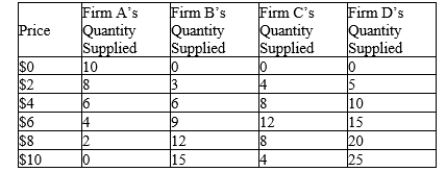 -Refer to Table 4-6. Which supply schedules obey the law of supply?
 (Multiple Choice)
5.0/5 (78)
(78) If the price of steel, an input into the production of automobiles, rises, and at the same time the price of gasoline rises, what will happen to the equilibrium price and quantity of automobiles?
(Essay)
4.9/5 (74)
(74) It is not possible for demand and supply to shift at the same time.
(True/False)
4.8/5 (72)
(72) According to the law of demand, when price increases the quantity demanded of a good
(Short Answer)
4.7/5 (83)
(83) Figure 4-5 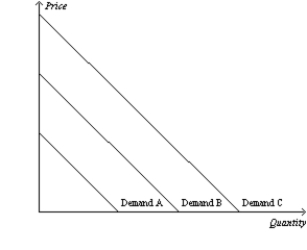 -Refer to Figure 4-5. Which of the following would cause the demand curve to shift from Demand A to Demand B in the market for oranges in the United States?
 (Multiple Choice)
4.8/5 (69)
(69) Figure 4-16 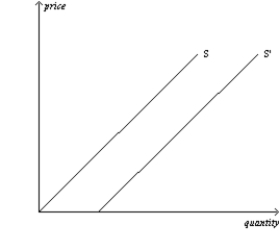 -Refer to Figure 4-16. If the supply curves that are drawn represent supply curves for single-family residential houses, then the movement from S to S' could be caused by a(n)
 (Multiple Choice)
4.8/5 (77)
(77) 
Filters
- Essay(0)
- Multiple Choice(0)
- Short Answer(0)
- True False(0)
- Matching(0)