



 Chat with AI
Exam 4: The Market Forces of Supply and Demand

Exam 1: Ten Principles of Economics455 Questions
Exam 2: Thinking Like an Economist643 Questions
Exam 3: Interdependence and the Gains From Trade547 Questions
Exam 4: The Market Forces of Supply and Demand693 Questions
Exam 5: Elasticity and Its Application626 Questions
Exam 6: Supply, Demand, and Government Policies668 Questions
Exam 7: Consumers, Producers, and the Efficiency of Markets547 Questions
Exam 8: Applications: the Costs of Taxation509 Questions
Exam 9: Application: International Trade521 Questions
Exam 10: Externalities543 Questions
Exam 11: Public Goods and Common Resources452 Questions
Exam 12: The Design of the Tax System664 Questions
Exam 13: The Costs of Production649 Questions
Exam 14: Firms in Competitive Markets604 Questions
Exam 15: Monopoly662 Questions
Exam 16: Monopolistic Competition649 Questions
Exam 17: Oligopoly522 Questions
Exam 18: The Markets for the Factors of Production592 Questions
Exam 19: Earnings and Discrimination511 Questions
Exam 20: Income Inequality and Poverty478 Questions
Exam 21: The Theory of Consumer Choice570 Questions
Exam 22: Frontiers in Microeconomics461 Questions
Exam 23: Measuring a Nation S Income547 Questions
Exam 24: Measuring the Cost of Living565 Questions
Exam 25: Production and Growth527 Questions
Exam 26: Saving, Investment, and the Financial System637 Questions
Exam 27: Tools of Finance534 Questions
Exam 28: Unemployment and Its Natural Rate701 Questions
Exam 29: The Monetary System540 Questions
Exam 30: Money Growth and Inflation504 Questions
Exam 31: Open-Economy Macroeconomics: Basic Concepts540 Questions
Exam 32: A Macroeconomic Theory of the Open Economy511 Questions
Exam 33: Aggregate Demand and Aggregate Supply572 Questions
Exam 34: The Influence of Monetary and Fiscal Policy on Aggregate Demand523 Questions
Exam 35: The Short-Run Tradeoff Between Inflation and Unemployment536 Questions
Exam 36: Six Debates Over Macroeconomic Policy354 Questions
Select questions type


Suppose buyers of coffee and sugar regard the two goods as complements. Then an increase in the price of coffee will cause a(n)
(Multiple Choice)
4.8/5  (82)
(82) The following table contains a demand schedule for a good. 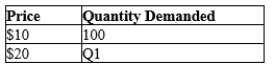 If the law of demand applies to this good, then Q1 could be
 (Multiple Choice)
4.8/5 (85)
(85) Figure 4-5 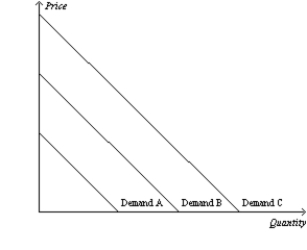 -Refer to Figure 4-5. Which of the following would cause the demand curve to shift from Demand A to Demand B in the market for golf balls in the United States?
 (Multiple Choice)
4.9/5 (76)
(76) If there is an improvement in the technology used to produce a good, then the supply curve for that good will shift to the left.
(True/False)
4.8/5 (70)
(70) Table 4-13
The demand schedule below pertains to sandwiches demanded per week. 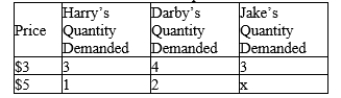 -Refer to Table 4-13. Suppose x = 1. Then the slope of the market demand curve is
 (Multiple Choice)
4.7/5 (80)
(80) Individual demand curves are summed vertically to obtain the market demand curve.
(True/False)
4.8/5 (82)
(82) Suppose that Amanda receives a pay increase. We would expect
(Multiple Choice)
4.7/5 (89)
(89) Suppose the incomes of buyers in a market for a particular normal good decrease and there is also a reduction in input prices. What would we expect to occur in this market?
(Multiple Choice)
4.9/5 (73)
(73) Figure 4-4
Yasmine
Mercedes 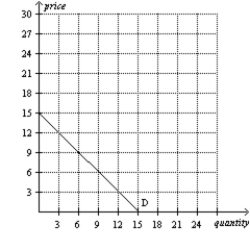
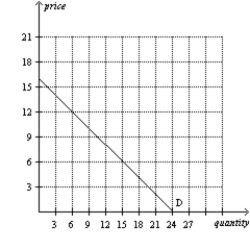 -Refer to Figure 4-4. Suppose Yasmine and Mercedes are the only two consumers in the market. When the market price falls from $12 to $6, the quantity demanded increases by
 (Multiple Choice)
4.8/5 (65)
(65) If orange juice and apple juice are substitutes, an increase in the price of orange juice will shift the demand curve for apple juice to the right.
(True/False)
5.0/5 (81)
(81) Table 4-1 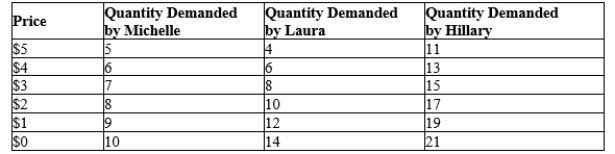 -Refer to Table 4-1. If the market consists of Michelle, Laura, and Hillary and the price falls by $1, the quantity demanded in the market increases by
 (Multiple Choice)
4.9/5 (74)
(74) Fill in the table below, showing whether equilibrium price and equilibrium quantity go up, go down, stay the same, or change ambiguously. 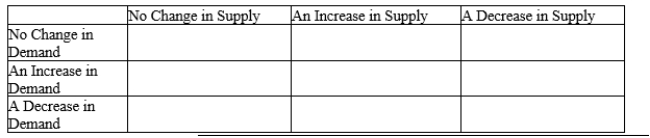
(Essay)
4.7/5 (79)
(79) The sum of all the individual demand curves for a product is called
(Multiple Choice)
4.9/5 (80)
(80) Table 4-13
The demand schedule below pertains to sandwiches demanded per week.
-Refer to Table 4-13. Suppose Harry, Darby, and Jake are the only demanders of sandwiches. Also suppose the following:
• x = 2.
• The current price of a sandwich is $5.00.
• The market quantity supplied of sandwiches is 10.
• The law of supply applies to the supply of sandwiches.
Then there is a
-Refer to Table 4-13. Suppose Harry, Darby, and Jake are the only demanders of sandwiches. Also suppose the following:
• x = 2.
• The current price of a sandwich is $5.00.
• The market quantity supplied of sandwiches is 10.
• The law of supply applies to the supply of sandwiches.
Then there is a (Multiple Choice)
4.8/5 (71)
(71) An increase in demand will cause an increase in price, which will cause an increase in quantity supplied.
(True/False)
4.9/5 (90)
(90) The demand curve is the upward-sloping line relating price and quantity demanded.
(True/False)
4.9/5 (87)
(87) In a market economy, supply and demand determine both the quantity of each good produced and the price at which it is sold.
(True/False)
4.9/5 (73)
(73) A demand schedule is a table that shows the relationship between
(Multiple Choice)
4.8/5 (69)
(69) 
Filters
- Essay(0)
- Multiple Choice(0)
- Short Answer(0)
- True False(0)
- Matching(0)