



 Chat with AI
Exam 4: The Market Forces of Supply and Demand

Exam 1: Ten Principles of Economics455 Questions
Exam 2: Thinking Like an Economist643 Questions
Exam 3: Interdependence and the Gains From Trade547 Questions
Exam 4: The Market Forces of Supply and Demand693 Questions
Exam 5: Elasticity and Its Application626 Questions
Exam 6: Supply, Demand, and Government Policies668 Questions
Exam 7: Consumers, Producers, and the Efficiency of Markets547 Questions
Exam 8: Applications: the Costs of Taxation509 Questions
Exam 9: Application: International Trade521 Questions
Exam 10: Externalities543 Questions
Exam 11: Public Goods and Common Resources452 Questions
Exam 12: The Design of the Tax System664 Questions
Exam 13: The Costs of Production649 Questions
Exam 14: Firms in Competitive Markets604 Questions
Exam 15: Monopoly662 Questions
Exam 16: Monopolistic Competition649 Questions
Exam 17: Oligopoly522 Questions
Exam 18: The Markets for the Factors of Production592 Questions
Exam 19: Earnings and Discrimination511 Questions
Exam 20: Income Inequality and Poverty478 Questions
Exam 21: The Theory of Consumer Choice570 Questions
Exam 22: Frontiers in Microeconomics461 Questions
Exam 23: Measuring a Nation S Income547 Questions
Exam 24: Measuring the Cost of Living565 Questions
Exam 25: Production and Growth527 Questions
Exam 26: Saving, Investment, and the Financial System637 Questions
Exam 27: Tools of Finance534 Questions
Exam 28: Unemployment and Its Natural Rate701 Questions
Exam 29: The Monetary System540 Questions
Exam 30: Money Growth and Inflation504 Questions
Exam 31: Open-Economy Macroeconomics: Basic Concepts540 Questions
Exam 32: A Macroeconomic Theory of the Open Economy511 Questions
Exam 33: Aggregate Demand and Aggregate Supply572 Questions
Exam 34: The Influence of Monetary and Fiscal Policy on Aggregate Demand523 Questions
Exam 35: The Short-Run Tradeoff Between Inflation and Unemployment536 Questions
Exam 36: Six Debates Over Macroeconomic Policy354 Questions
Select questions type


If baked potatoes and sour cream are complements, then an increase in the price of sour cream decreases the demand for baked potatoes.
(True/False)
4.9/5  (81)
(81) A movement along a supply curve is called a change in supply while a shift of the supply curve is called a change in quantity supplied.
(True/False)
4.8/5 (75)
(75) The quantity demanded of a product is the amount that buyers are willing and able to purchase at a particular price.
(True/False)
4.7/5 (96)
(96) Consider the market for portable air conditioners in equilibrium. When a heat wave strikes the equilibrium price
(Multiple Choice)
5.0/5 (90)
(90) Suppose roses are currently selling for $20 per dozen, but the equilibrium price of roses is $30 per dozen. We would expect a
(Multiple Choice)
4.8/5 (92)
(92) The following table contains a demand schedule for a good. 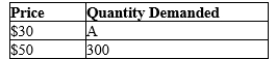 If the law of demand applies to this good, then A could be
 (Multiple Choice)
4.8/5 (75)
(75) Table 4-14
The table below shows the quantities demanded of milk per month by four families at various prices.
-Refer to Table 4-14. If the four families listed are the only demanders in this market and the price of a gallon of milk is $4.00, what is the market quantity demanded?
(Short Answer)
4.9/5 (68)
(68) The following table contains a monthly demand schedule for large, single-topping, carry-out pizzas. 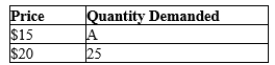 If the law of demand applies to these pizzas, then A could be
 (Multiple Choice)
4.8/5 (73)
(73) Which of the following is not a determinant of the demand for a particular good?
(Multiple Choice)
4.8/5 (101)
(101) Adam Smith suggested that an invisible had guides market economies. In this analogy, what is the baton that the invisible hand uses to conduct the economic orchestra?
(Multiple Choice)
5.0/5 (90)
(90) When quantity supplied decreases at every possible price, we know that the supply curve has
(Multiple Choice)
4.7/5 (75)
(75) Figure 4-25
The graph below pertains to the supply of paper to colleges and universities. 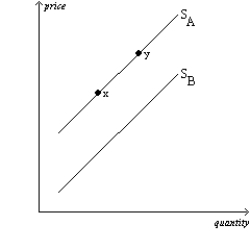 -Refer to Figure 4-25. All else equal, buyers expecting paper to be more expensive in the future would cause a current move from
 (Multiple Choice)
4.9/5 (82)
(82) In a competitive market, each seller has limited control over the price of his product because
(Multiple Choice)
4.7/5 (71)
(71) New oak tables are normal goods. What would happen to the equilibrium price and quantity in the market for oak tables if the price of maple tables rises, the price of oak wood rises, more buyers enter the market for oak tables, and the price of the glue used in the production of the new oak tables increased?
(Multiple Choice)
4.7/5 (80)
(80) Figure 4-11 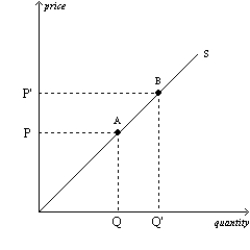 -Refer to Figure 4-11. The movement from point A to point B on the graph represents
 (Multiple Choice)
4.8/5 (85)
(85) Figure 4-7 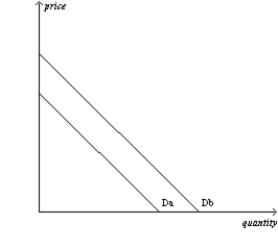 -Refer to Figure 4-7. The movement from Db to Da in the market for potato chips could be caused by a(n)
 (Multiple Choice)
4.7/5 (75)
(75) Suppose goods A and B are substitutes. If the price of good A increases, will the demand for good B increase or decrease?
(Short Answer)
4.9/5 (88)
(88) 
Filters
- Essay(0)
- Multiple Choice(0)
- Short Answer(0)
- True False(0)
- Matching(0)