



 Chat with AI
Exam 12: DNA: The Molecule of Heredity

Exam 1: An Introduction to Life on Earth91 Questions
Exam 2: Atoms, Molecules, and Life90 Questions
Exam 3: Biological Molecules98 Questions
Exam 4: Cell Structure and Function90 Questions
Exam 5: Cell Membrane Structure and Function96 Questions
Exam 6: Energy Flow in the Life of a Cell90 Questions
Exam 7: Capturing Solar Energy: Photosynthesis102 Questions
Exam 8: Harvesting Energy: Glycolysis and Cellular Respiration97 Questions
Exam 9: Cellular Reproduction133 Questions
Exam 10: Meiosis: the Basis of Sexual Reproduction104 Questions
Exam 11: Patterns of Inheritance98 Questions
Exam 12: DNA: The Molecule of Heredity97 Questions
Exam 13: Gene Expression and Regulation93 Questions
Exam 14: Biotechnology91 Questions
Exam 15: Principles of Evolution97 Questions
Exam 16: How Populations Evolve109 Questions
Exam 17: The Origin of Species89 Questions
Exam 18: The History of Life125 Questions
Exam 19: Systematics: Seeking Order Amid Diversity90 Questions
Exam 20: The Diversity of Prokaryotes and Viruses97 Questions
Exam 21: The Diversity of Protists102 Questions
Exam 22: The Diversity of Plants115 Questions
Exam 23: The Diversity of Fungi107 Questions
Exam 24: Animal Diversity I: Invertebrates101 Questions
Exam 25: Animal Diversity Ii: Vertebrates118 Questions
Exam 26: Animal Behavior116 Questions
Exam 27: Population Growth and Regulation114 Questions
Exam 28: Community Interactions125 Questions
Exam 29: Energy Flow and Nutrient Cycling in Ecosystems122 Questions
Exam 30: Earths Diverse Ecosystems126 Questions
Exam 31: Conserving Earths Biodiversity109 Questions
Exam 32: Homeostasis and the Organization of the Animal Body95 Questions
Exam 33: Circulation89 Questions
Exam 34: Respiration92 Questions
Exam 35: Nutrition and Digestion91 Questions
Exam 36: The Urinary System99 Questions
Exam 37: Defenses Against Disease104 Questions
Exam 38: Chemical Control of the Animal Body: the Endocrine System133 Questions
Exam 39: The Nervous System118 Questions
Exam 40: The Senses94 Questions
Exam 41: Action and Support: the Muscles and Skeleton90 Questions
Exam 42: Animal Reproduction120 Questions
Exam 43: Animal Development122 Questions
Exam 44: Plant Anatomy and Nutrient Transport95 Questions
Exam 45: Plant Reproduction and Development90 Questions
Exam 46: Plant Responses to the Environment87 Questions
Select questions type


The DNA of chromosomes is composed of two strands wound about each other in the shape of a __________.
(Short Answer)
4.9/5  (77)
(77) When DNA polymerase encounters thymine in the parental strand, what does it add to the growing daughter strand?
(Multiple Choice)
4.7/5 (82)
(82) DNA polymerase has the ability to match the nucleotide base in the parental strand with a free nucleotide that is complementary to that base. It then forms the covalent bonds between the nucleotides in the growing daughter strand of DNA.
(True/False)
4.8/5 (85)
(85) Which of the following is NOT involved in the DNA replication process?
(Multiple Choice)
4.9/5 (80)
(80) By the early 1950s, many biologists realized that the key to understanding inheritance lay in the structure of
(Multiple Choice)
4.8/5 (86)
(86) When Hershey and Chase labeled phage with radioactive phosphorus, they concluded that the phage injects its DNA, not protein, into its host. These conclusions were based on the observation that the radioactive DNA ended up where?
(Short Answer)
4.8/5 (85)
(85) DNA replication uses __________base pairing to ensure genetic constancy.
(Short Answer)
4.8/5 (96)
(96) In semiconservative replication, a DNA molecule serves as a template for a new DNA molecule, which consists of either both parental strands of DNA or both newly synthesized strands of DNA.
(True/False)
4.7/5 (76)
(76) The number of subunits in a DNA molecule is more important to its function than the sequence of these subunits.
(True/False)
4.8/5 (83)
(83) DNA__________ breaks the hydrogen bonds between complementary base pairs during DNA replication.
(Short Answer)
4.7/5 (77)
(77) Most mutations are harmful or neutral, although in rare instances some can be beneficial.
(True/False)
4.7/5 (80)
(80) Based on this figure, which molecule would attach to the 5ʹ phosphate end of the DNA strand on the right? 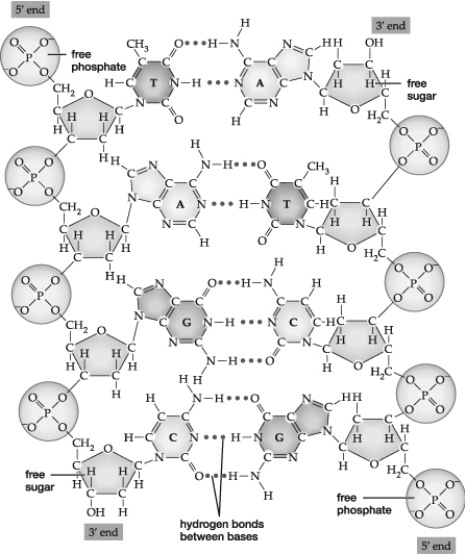
(Multiple Choice)
4.9/5 (63)
(63) Regarding the structure of DNA, which of the following joins adenine and thymine and also guanine and cytosine?
(Multiple Choice)
4.8/5 (84)
(84) Bacterial cells have only one DNA molecule, which is double stranded and is replicated in essentially the same fashion as in eukaryotes. Imagine that, following the techniques of other scientists studying DNA, you created a bacterial cell that contains only radioactive nitrogen in its DNA. You then place the cell in a culture medium containing only ʺregularʺ (nonradioactive) nitrogen. Based on this scenario and your knowledge of DNA structure and replication, how many cells will contain some DNA with radioactive nitrogen after four rounds of cell replication?
(Multiple Choice)
4.9/5 (71)
(71) DNA polymerase and other repair enzymes__________ the newly synthesized DNA strand during and after the replication process.
(Short Answer)
4.8/5 (88)
(88) 
Filters
- Essay(0)
- Multiple Choice(0)
- Short Answer(0)
- True False(0)
- Matching(0)