



 Chat with AI
Exam 10: Worlds of Gas and Liquidthe Giant Planets

Exam 1: Thinking Like an Astronomer 97 Questions
Exam 2: Patterns in the Skymotions of Earth and the Moon101 Questions
Exam 3: Motion of Astronomical Bodies99 Questions
Exam 4: Gravity and Orbits100 Questions
Exam 5: Light100 Questions
Exam 6: The Tools of the Astronomer100 Questions
Exam 7: The Formation of Planetary Systems100 Questions
Exam 8: The Terrestrial Planets and Earths Moon100 Questions
Exam 9: Atmospheres of the Terrestrial Planets100 Questions
Exam 10: Worlds of Gas and Liquidthe Giant Planets100 Questions
Exam 11: Planetary Moons and Rings100 Questions
Exam 12: Dwarf Planets and Small Solar System Bodies100 Questions
Exam 13: Taking the Measure of Stars101 Questions
Exam 14: Our Starthe Sun100 Questions
Exam 15: The Interstellar Medium and Star Formation100 Questions
Exam 16: Evolution of Low-Mass Stars100 Questions
Exam 17: Evolution of High-Mass Stars100 Questions
Exam 18: Relativity and Black Holes97 Questions
Exam 19: Galaxies100 Questions
Exam 20: The Milky Waya Normal Spiral Galaxy100 Questions
Exam 21: The Expanding Universe98 Questions
Exam 22: Cosmology100 Questions
Exam 23: Large-Scale Structure in the Universe103 Questions
Exam 24: Life100 Questions
Select questions type


What measurement tells us that the interiors of Uranus and Neptune are made of mostly water?
(Multiple Choice)
4.8/5  (89)
(89) If you were to fly to Jupiter from Earth, which of these parts of Jupiter would you come into contact with first?
(Multiple Choice)
4.9/5 (76)
(76) The figure below shows a cutaway drawing of some of the layers inside the atmosphere of Jupiter.The rocky core is located at the center.Which of these is a possible list of what the layers contain, starting with layer 1 and moving to layer 3? 
(Multiple Choice)
4.9/5 (75)
(75) Which of the giant planets was predicted to exist mathematically before it was ever seen through a telescope?
(Multiple Choice)
4.9/5 (76)
(76) The Great Red Spot, Jupiter's most prominent storm system, has a diameter that is approximately ________ times Earth's diameter.
(Multiple Choice)
4.8/5 (78)
(78) What causes the horizontal bands on Jupiter and Saturn to have different colors? How can they be used to probe different altitudes in their atmospheres?
(Essay)
4.9/5 (78)
(78) The atmosphere of Earth has only one main volatile component, water.The atmospheres of the giant planets, however, have a number of additional volatiles, such as methane and ammonia.What is the most conspicuous consequence of this difference?
(Essay)
4.9/5 (82)
(82) Which planet receives the least amount of energy from the Sun?
(Multiple Choice)
4.8/5 (85)
(85) The colors of the cloud bands on Jupiter and Saturn are due primarily to differences in their
(Multiple Choice)
4.7/5 (76)
(76) Which of the following methods provides the most accurate measurement of a distant planet's radius?
(Multiple Choice)
4.7/5 (89)
(89) The Kepler-20 system, illustrated in the figure below, has an order of planets that does not match what we expect from current planetary system formation theories.How do we explain this order, and that of other systems with large planets close to their star? 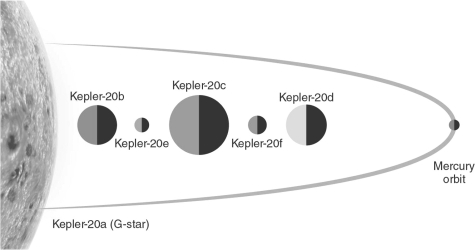
(Essay)
4.7/5 (85)
(85) Impurities in the ice crystals in Jupiter's atmosphere cause
(Multiple Choice)
5.0/5 (74)
(74) You observe a gas giant planet that is much warmer that its expected equilibrium temperature.This is evidence that the gas giant is
(Multiple Choice)
4.8/5 (82)
(82) Suppose Neptune moves with an average orbital speed of 3.5 km/s.If it takes Neptune four hours to pass directly in front of a star, what is Neptune's diameter? Give Neptune's radius in units of Earth diameters, where the diameter of Earth is 12,800 km.
(Essay)
4.9/5 (68)
(68) Where are atmospheric vortices usually found on the giant planets?
(Multiple Choice)
4.9/5 (84)
(84) Which of the following giant planets radiates more energy into space than it receives from the Sun?
(Multiple Choice)
5.0/5 (80)
(80) Which of these planets has a composition that is most like the Sun?
(Multiple Choice)
4.8/5 (64)
(64) Explain why methane never freezes in the upper atmospheres of Jupiter and Saturn, and how this leads to the different appearance of Jupiter and Saturn compared to Uranus and Neptune.
(Essay)
4.8/5 (73)
(73) 
Filters
- Essay(0)
- Multiple Choice(0)
- Short Answer(0)
- True False(0)
- Matching(0)