



 Chat with AI
Exam 10: Worlds of Gas and Liquidthe Giant Planets

Exam 1: Thinking Like an Astronomer 97 Questions
Exam 2: Patterns in the Skymotions of Earth and the Moon101 Questions
Exam 3: Motion of Astronomical Bodies99 Questions
Exam 4: Gravity and Orbits100 Questions
Exam 5: Light100 Questions
Exam 6: The Tools of the Astronomer100 Questions
Exam 7: The Formation of Planetary Systems100 Questions
Exam 8: The Terrestrial Planets and Earths Moon100 Questions
Exam 9: Atmospheres of the Terrestrial Planets100 Questions
Exam 10: Worlds of Gas and Liquidthe Giant Planets100 Questions
Exam 11: Planetary Moons and Rings100 Questions
Exam 12: Dwarf Planets and Small Solar System Bodies100 Questions
Exam 13: Taking the Measure of Stars101 Questions
Exam 14: Our Starthe Sun100 Questions
Exam 15: The Interstellar Medium and Star Formation100 Questions
Exam 16: Evolution of Low-Mass Stars100 Questions
Exam 17: Evolution of High-Mass Stars100 Questions
Exam 18: Relativity and Black Holes97 Questions
Exam 19: Galaxies100 Questions
Exam 20: The Milky Waya Normal Spiral Galaxy100 Questions
Exam 21: The Expanding Universe98 Questions
Exam 22: Cosmology100 Questions
Exam 23: Large-Scale Structure in the Universe103 Questions
Exam 24: Life100 Questions
Select questions type


How might planetary migration have affected Earth in our Solar System's history?
(Essay)
4.8/5  (91)
(91) Uranus and Neptune are bluish green in color because they contain large amounts of
(Multiple Choice)
4.9/5 (82)
(82) As a group, the giant planets all rotate ________ terrestrial planets.
(Multiple Choice)
4.9/5 (70)
(70) If convection on Jupiter weakened, what would happen to the storms in the upper atmosphere?
(Multiple Choice)
4.9/5 (84)
(84) How is the atmosphere of Saturn similar to the atmosphere of Earth?
(Multiple Choice)
4.9/5 (71)
(71) Many extrasolar planets identified by astronomers have masses exceeding that of Jupiter.How does this lead to higher densities for these planets?
(Multiple Choice)
4.9/5 (80)
(80) Referring to the figure below, what is the angular diameter of Neptune if its diameter is 50,000 km and its distance is 30 astronomical units (AU)? Recall that 1 AU = 1.5 * 1011 meters. 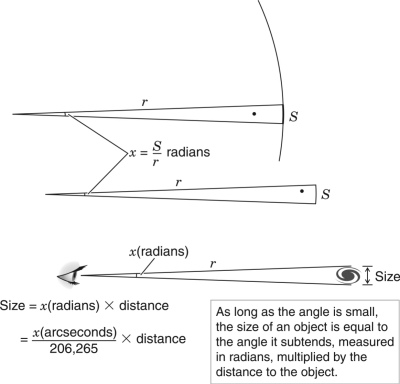
(Multiple Choice)
4.8/5 (81)
(81) The figure below is a picture of Saturn taken by the Hubble Space Telescope.What is causing the circle of light seen near Saturn's pole? 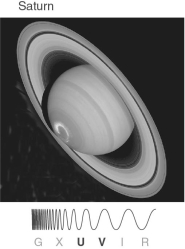
(Multiple Choice)
4.9/5 (77)
(77) Saturn has a lower abundance of helium in its atmosphere than Jupiter does.Why?
(Essay)
4.8/5 (73)
(73) What is the most likely reason that Jupiter radiates more energy than it receives from the Sun?
(Multiple Choice)
4.8/5 (70)
(70) The Jovian atmospheric vortices are created by a combination of the Coriolis effect and
(Multiple Choice)
4.8/5 (74)
(74) If Jupiter's radius is contracting at a rate of 2 cm/yr it would explain
(Multiple Choice)
4.9/5 (80)
(80) Uranus and Neptune contain smaller percentages of hydrogen and helium than Jupiter and Saturn probably because Uranus and Neptune ________ than Jupiter and Saturn.
(Multiple Choice)
4.9/5 (83)
(83) Each season on Uranus lasts approximate 21 Earth years because
(Multiple Choice)
4.9/5 (79)
(79) Based on the flux of sunlight that it gets, Jupiter should have a temperature of 109 K.However, its temperature is observed to be 124 K.How much more energy is Jupiter radiating out into space compared to what it gets from the Sun?
(Essay)
4.7/5 (73)
(73) The strongest planetary magnetic fields in the Solar System are found on which planet?
(Multiple Choice)
4.9/5 (76)
(76) Uranus has an orbital period of 84 Earth years, a rotation period of 17.2 hours, and an obliquity of 98°.Explain what solar days are like near the north pole of Uranus, and how long they last.
(Essay)
5.0/5 (80)
(80) What causes the large magnetic fields of Uranus and Neptune? How does this source help explain why the axes of their magnetic fields are misaligned and significantly offset from their rotational axes?
(Essay)
4.8/5 (74)
(74) Describe and name the types of planets that have been observed in other star systems, but not our own.
(Essay)
4.9/5 (80)
(80) 
Filters
- Essay(0)
- Multiple Choice(0)
- Short Answer(0)
- True False(0)
- Matching(0)