



 Chat with AI
Exam 46: Microbiology and Disease

Exam 1: Introduction to Medical Assisting76 Questions
Exam 2: Healthcare and the Healthcare Team80 Questions
Exam 3: Professionalism and Success75 Questions
Exam 4: Interpersonal Communication97 Questions
Exam 5: Legal and Ethical Issues85 Questions
Exam 6: Infection Control Fundamentals74 Questions
Exam 7: Safety and Patient Reception73 Questions
Exam 8: Office Equipment and Supplies155 Questions
Exam 9: Examination and Treatment Areas97 Questions
Exam 10: Written and Electronic Communication84 Questions
Exam 11: Medical Records and Documentation75 Questions
Exam 12: Electronic Health Records72 Questions
Exam 13: Managing Medical Records74 Questions
Exam 14: Telephone Techniques89 Questions
Exam 15: Patient Education75 Questions
Exam 16: Schedule Management80 Questions
Exam 17: Insurance Billing80 Questions
Exam 18: Diagnostic Coding74 Questions
Exam 19: Procedure Coding75 Questions
Exam 20: Patient Collections and Financial Management142 Questions
Exam 21: Organization of the Body145 Questions
Exam 22: The Integumentary System100 Questions
Exam 23: The Skeletal System154 Questions
Exam 24: The Muscular System100 Questions
Exam 25: The Cardiovascular System89 Questions
Exam 26: The Blood74 Questions
Exam 27: The Lymphatic and Immune Systems78 Questions
Exam 28: The Respiratory System91 Questions
Exam 29: The Nervous System130 Questions
Exam 30: The Urinary System91 Questions
Exam 31: The Reproductive Systems124 Questions
Exam 32: The Digestive System112 Questions
Exam 33: The Endocrine System80 Questions
Exam 34: Special Senses92 Questions
Exam 35: Infection Control Practices105 Questions
Exam 36: Patient Interview and History96 Questions
Exam 37: Vital Signs and Measurements93 Questions
Exam 38: Assisting With a General Physical Exam75 Questions
Exam 39: Assisting in Reproductive and Urinary Specialties74 Questions
Exam 40: Assisting in Pediatrics75 Questions
Exam 41: Assisting in Geriatrics75 Questions
Exam 42: Assisting in Other Medical Specialties75 Questions
Exam 43: Assisting in Eye and Ear Care75 Questions
Exam 44: Assisting in Minor Surgery92 Questions
Exam 45: Orientation to the Lab85 Questions
Exam 46: Microbiology and Disease117 Questions
Exam 47: Processing and Testing Urine and Stool Samples95 Questions
Exam 48: Collecting, Processing, and Testing Blood Specimens75 Questions
Exam 49: Electrocardiography and Pulmonary Function Testing94 Questions
Exam 50: Diagnostic Imaging79 Questions
Exam 51: Principles of Pharmacology104 Questions
Exam 52: Math and Dosage Calculations74 Questions
Exam 53: Medication Administration76 Questions
Exam 54: Physical Therapy and Rehabilitation78 Questions
Exam 55: Nutrition and Health90 Questions
Exam 56: Practice Management76 Questions
Exam 57: Emergency Preparedness105 Questions
Exam 58: Preparing for the World of Work76 Questions
Select questions type


Which classification of microorganisms contains protozoans, fungi, and parasites?
(Multiple Choice)
4.7/5  (77)
(77) A preparation of a specimen in a liquid that allows the organisms to remain alive and mobile while being identified is a(n) ____.
(Multiple Choice)
4.9/5 (78)
(78) Which of the following involves culturing a specimen and then testing the isolated bacterium's susceptibility to antibiotics?
(Multiple Choice)
4.9/5 (77)
(77) Which of the following, found in insects such as ticks and mites, are responsible for diseases such as Rocky Mountain spotted fever and typhus?
(Multiple Choice)
4.8/5 (85)
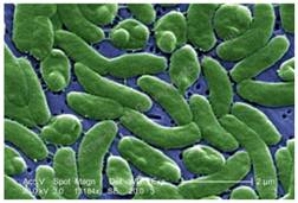
(85) 
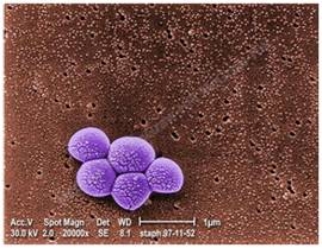
Amy is a 9-year-old patient who has a high fever, headache, and an itchy rash. Although Amy usually has a good appetite, her mother says she has not been hungry for the last few days. The rash is starting to blister. Which of the following diseases might you suspect?
(Multiple Choice)
4.9/5 (92)
(92) What information must be included on a laboratory request form?
(Multiple Choice)
4.8/5 (85)
(85) Which of the following is characteristic of a subcellular microorganism?
(Multiple Choice)
4.8/5 (65)
(65) A(n) ________ is an agent prescribed by a physician that kills microorganisms or suppresses their growth.
(Short Answer)
4.7/5 (84)
(84) A single-celled eukaryotic organism that is generally much larger than bacteria and is found in soil and water is called a(n) _______. These organisms can cause diseases such as malaria and amebic dysentery.
(Short Answer)
4.7/5 (82)
(82) The respiratory disease that causes fever, cough, sore throat, runny or stuffy nose, muscle or body aches, headaches, and fatigue, and is spread by airborne transmission is ____.
(Multiple Choice)
5.0/5 (93)
(93) Large, fuzzy, multicelled fungi that produce spores are called ________.
(Short Answer)
4.8/5 (69)
(69) Iodine is an example of a(n) ________, which is a substance that intensifies or deepens the response of a specimen to a stain.
(Short Answer)
4.7/5 (70)
(70) A(n) ________ is a solution of a dye or group of dyes that imparts a color to microorganisms.
(Short Answer)
5.0/5 (83)
(83) Which type of specimen is examined for the presence of parasites such as roundworms or tapeworms?
(Multiple Choice)
4.8/5 (88)
(88) The parasitic insect pictured here burrows under the skin and causes ____. 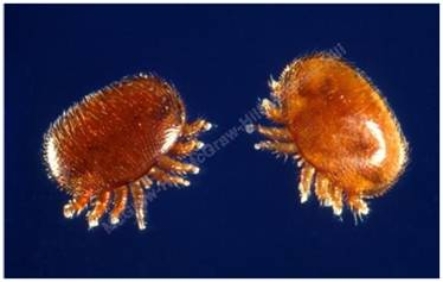
(Multiple Choice)
4.8/5 (93)
(93) A living microorganism or its toxin that may cause human disease that is transported through the US mail must be marked as a(n) ____.
(Multiple Choice)
4.8/5 (78)
(78) Bacterial species that retain the purple dye even after the decolorizer is added and appear blue or violet are referred to as ________ ________ bacteria.
(Short Answer)
4.9/5 (72)
(72) 
Filters
- Essay(0)
- Multiple Choice(0)
- Short Answer(0)
- True False(0)
- Matching(0)