



 Chat with AI
Exam 46: Microbiology and Disease

Exam 1: Introduction to Medical Assisting76 Questions
Exam 2: Healthcare and the Healthcare Team80 Questions
Exam 3: Professionalism and Success75 Questions
Exam 4: Interpersonal Communication97 Questions
Exam 5: Legal and Ethical Issues85 Questions
Exam 6: Infection Control Fundamentals74 Questions
Exam 7: Safety and Patient Reception73 Questions
Exam 8: Office Equipment and Supplies155 Questions
Exam 9: Examination and Treatment Areas97 Questions
Exam 10: Written and Electronic Communication84 Questions
Exam 11: Medical Records and Documentation75 Questions
Exam 12: Electronic Health Records72 Questions
Exam 13: Managing Medical Records74 Questions
Exam 14: Telephone Techniques89 Questions
Exam 15: Patient Education75 Questions
Exam 16: Schedule Management80 Questions
Exam 17: Insurance Billing80 Questions
Exam 18: Diagnostic Coding74 Questions
Exam 19: Procedure Coding75 Questions
Exam 20: Patient Collections and Financial Management142 Questions
Exam 21: Organization of the Body145 Questions
Exam 22: The Integumentary System100 Questions
Exam 23: The Skeletal System154 Questions
Exam 24: The Muscular System100 Questions
Exam 25: The Cardiovascular System89 Questions
Exam 26: The Blood74 Questions
Exam 27: The Lymphatic and Immune Systems78 Questions
Exam 28: The Respiratory System91 Questions
Exam 29: The Nervous System130 Questions
Exam 30: The Urinary System91 Questions
Exam 31: The Reproductive Systems124 Questions
Exam 32: The Digestive System112 Questions
Exam 33: The Endocrine System80 Questions
Exam 34: Special Senses92 Questions
Exam 35: Infection Control Practices105 Questions
Exam 36: Patient Interview and History96 Questions
Exam 37: Vital Signs and Measurements93 Questions
Exam 38: Assisting With a General Physical Exam75 Questions
Exam 39: Assisting in Reproductive and Urinary Specialties74 Questions
Exam 40: Assisting in Pediatrics75 Questions
Exam 41: Assisting in Geriatrics75 Questions
Exam 42: Assisting in Other Medical Specialties75 Questions
Exam 43: Assisting in Eye and Ear Care75 Questions
Exam 44: Assisting in Minor Surgery92 Questions
Exam 45: Orientation to the Lab85 Questions
Exam 46: Microbiology and Disease117 Questions
Exam 47: Processing and Testing Urine and Stool Samples95 Questions
Exam 48: Collecting, Processing, and Testing Blood Specimens75 Questions
Exam 49: Electrocardiography and Pulmonary Function Testing94 Questions
Exam 50: Diagnostic Imaging79 Questions
Exam 51: Principles of Pharmacology104 Questions
Exam 52: Math and Dosage Calculations74 Questions
Exam 53: Medication Administration76 Questions
Exam 54: Physical Therapy and Rehabilitation78 Questions
Exam 55: Nutrition and Health90 Questions
Exam 56: Practice Management76 Questions
Exam 57: Emergency Preparedness105 Questions
Exam 58: Preparing for the World of Work76 Questions
Select questions type


Which of the following cause eye disease, venereal disease, and a form of pneumonia?
(Multiple Choice)
4.9/5  (87)
(87) Procedures for packaging and labeling a specimen for mail delivery are set by ____.
(Multiple Choice)
4.8/5 (92)
(92) Which of the following types of bacteria are responsible for diseases such as cholera?
(Multiple Choice)
4.8/5 (88)
(88) A(n) ________ ________ stain is used to identify bacteria that have a waxy cell wall, such as the bacterium that causes tuberculosis.
(Short Answer)
4.8/5 (77)
(77) Which type of bacteria causes boils, acne, abscesses, food poisoning, and a type of pneumonia?
(Multiple Choice)
4.9/5 (91)
(91) Determination of the number of bacteria present in specimens is called ____.
(Multiple Choice)
5.0/5 (76)
(76) Three-year-old Tyler's parents report that he has had a runny nose and a mild cough for the last several days. They brought him to the clinic because the coughing has become "terrible" during the past 24 hours. While getting the history from the parents, you notice a "whoop" sound as Tyler inhales after a severe coughing spell. Which of the following diseases is the most probable cause of Tyler's cough?
(Multiple Choice)
4.8/5 (88)
(88) The organism pictured here spreads bacteria that causes Lyme disease and is considered a ____. 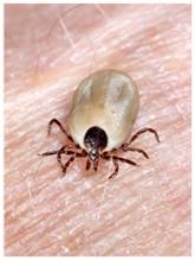
(Multiple Choice)
4.8/5 (83)
(83) The determination of the type of pathogen on a culture plate is referred to as a(n) ________ analysis of the specimen.
(Short Answer)
4.9/5 (70)
(70) The spiral-shaped bacterium pictured here is classified as a ____. 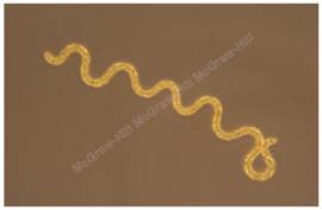
(Multiple Choice)
5.0/5 (87)
(87) A specimen may be directly viewed as a(n) ________ ________, which is a preparation of a specimen in a liquid that allows the organisms to remain alive and mobile while they are being identified.
(Short Answer)
4.8/5 (58)
(58) A specimen may be directly viewed as a(n) ________, in which a specimen is spread thinly and evenly across a slide.
(Short Answer)
4.9/5 (76)
(76) A distinct group of organisms seen on the surface of the culture medium is called a(n) ________.
(Short Answer)
4.9/5 (93)
(93) A(n) ________ agent is a living microorganism or its toxin that may cause human disease. A label with this and a biohazard symbol must be affixed to a package containing a microbiologic specimen sent through the mail.
(Short Answer)
4.9/5 (84)
(84) In which of the following is a specimen spread thinly and unevenly across a slide?
(Multiple Choice)
4.9/5 (88)
(88) A substance that can intensify or deepen the response of a specimen to a stain is called a(n) ____.
(Multiple Choice)
4.9/5 (85)
(85) Bacteria that grow best in the absence of oxygen are referred to as ________.
(Short Answer)
4.8/5 (76)
(76) Which of the following are bacteria that grow best in the presence of oxygen?
(Multiple Choice)
4.9/5 (79)
(79) 
Filters
- Essay(0)
- Multiple Choice(0)
- Short Answer(0)
- True False(0)
- Matching(0)