



 Chat with AI
Exam 6: Infection Control Fundamentals

Exam 1: Introduction to Medical Assisting76 Questions
Exam 2: Healthcare and the Healthcare Team80 Questions
Exam 3: Professionalism and Success75 Questions
Exam 4: Interpersonal Communication97 Questions
Exam 5: Legal and Ethical Issues85 Questions
Exam 6: Infection Control Fundamentals74 Questions
Exam 7: Safety and Patient Reception73 Questions
Exam 8: Office Equipment and Supplies155 Questions
Exam 9: Examination and Treatment Areas97 Questions
Exam 10: Written and Electronic Communication84 Questions
Exam 11: Medical Records and Documentation75 Questions
Exam 12: Electronic Health Records72 Questions
Exam 13: Managing Medical Records74 Questions
Exam 14: Telephone Techniques89 Questions
Exam 15: Patient Education75 Questions
Exam 16: Schedule Management80 Questions
Exam 17: Insurance Billing80 Questions
Exam 18: Diagnostic Coding74 Questions
Exam 19: Procedure Coding75 Questions
Exam 20: Patient Collections and Financial Management142 Questions
Exam 21: Organization of the Body145 Questions
Exam 22: The Integumentary System100 Questions
Exam 23: The Skeletal System154 Questions
Exam 24: The Muscular System100 Questions
Exam 25: The Cardiovascular System89 Questions
Exam 26: The Blood74 Questions
Exam 27: The Lymphatic and Immune Systems78 Questions
Exam 28: The Respiratory System91 Questions
Exam 29: The Nervous System130 Questions
Exam 30: The Urinary System91 Questions
Exam 31: The Reproductive Systems124 Questions
Exam 32: The Digestive System112 Questions
Exam 33: The Endocrine System80 Questions
Exam 34: Special Senses92 Questions
Exam 35: Infection Control Practices105 Questions
Exam 36: Patient Interview and History96 Questions
Exam 37: Vital Signs and Measurements93 Questions
Exam 38: Assisting With a General Physical Exam75 Questions
Exam 39: Assisting in Reproductive and Urinary Specialties74 Questions
Exam 40: Assisting in Pediatrics75 Questions
Exam 41: Assisting in Geriatrics75 Questions
Exam 42: Assisting in Other Medical Specialties75 Questions
Exam 43: Assisting in Eye and Ear Care75 Questions
Exam 44: Assisting in Minor Surgery92 Questions
Exam 45: Orientation to the Lab85 Questions
Exam 46: Microbiology and Disease117 Questions
Exam 47: Processing and Testing Urine and Stool Samples95 Questions
Exam 48: Collecting, Processing, and Testing Blood Specimens75 Questions
Exam 49: Electrocardiography and Pulmonary Function Testing94 Questions
Exam 50: Diagnostic Imaging79 Questions
Exam 51: Principles of Pharmacology104 Questions
Exam 52: Math and Dosage Calculations74 Questions
Exam 53: Medication Administration76 Questions
Exam 54: Physical Therapy and Rehabilitation78 Questions
Exam 55: Nutrition and Health90 Questions
Exam 56: Practice Management76 Questions
Exam 57: Emergency Preparedness105 Questions
Exam 58: Preparing for the World of Work76 Questions
Select questions type


In medical settings, where many people are hosts to pathogens and many others are susceptible, using medical ________ can break the cycle by preventing the transmission of pathogens.

Free
(Short Answer)
4.9/5  (67)
(67) Correct Answer: Verified
asepsis
OSHA's ________ clause requires employers to maintain a workplace free from hazards that are recognized as likely to cause death or serious injury.
Free
(Short Answer)
4.9/5 (84)
(84) Correct Answer:Verified
Verifiedgeneral duty
A medical assistant can help break the cycle of infection in the office by ____.
Free
(Multiple Choice)
4.8/5 (82)
(82) Correct Answer:Verified
VerifiedC
The infection cycle begins when a pathogen is established in the _________.
(Multiple Choice)
4.7/5 (89)
(89) The penalty for failure to correct a prior OSHA violation is a ____.
(Multiple Choice)
4.9/5 (84)
(84) The goal of OSHA's final rule on Hazard Communication is to transition from workers' "right to know" to the workers' "right to ________."
(Short Answer)
4.9/5 (80)
(80) Performing mouth-to-mouth resuscitation is a Category I task, and OSHA recommends the use of _________ airway equipment, in addition to wearing gloves.
(Short Answer)
4.8/5 (68)
(68) A(n) ________ case is a manifestation of an infection that is so slight that it is unnoticeable.
(Short Answer)
4.9/5 (67)
(67) The most important aseptic procedure for a medical assistant is ____.
(Multiple Choice)
4.8/5 (81)
(81) Fleas, ticks, and mosquitoes are ________ that often carry organisms responsible for disease.
(Short Answer)
4.9/5 (79)
(79) Red bags or bags that have a biohazardous waste label are used for ____.
(Multiple Choice)
4.8/5 (80)
(80) Any inanimate object that can be contaminated by an infected person and then transmit the infective agent to a susceptible host is considered a(n) ________.
(Short Answer)
4.7/5 (67)
(67) The body's ability to resist pathogens and disease is called ____.
(Multiple Choice)
4.8/5 (82)
(82) 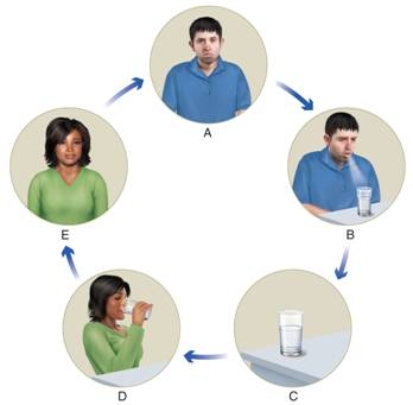 -Which item on the diagram of the cycle of infection is the method by which a pathogen spreads to another host?
 (Multiple Choice)
4.8/5 (76)
(76) When a person develops food poisoning after eating at a restaurant salad bar, the most likely form of transmission is ____.
(Multiple Choice)
4.9/5 (80)
(80) A reservoir host who is unaware of the presence of the pathogen and so spreads the disease is a ____.
(Multiple Choice)
4.9/5 (80)
(80) The appropriate way to handle and dispose of contaminated sharps is to ____.
(Multiple Choice)
4.8/5 (79)
(79) 
Filters
- Essay(0)
- Multiple Choice(0)
- Short Answer(0)
- True False(0)
- Matching(0)