



 Chat with AI
Exam 48: Collecting, Processing, and Testing Blood Specimens

Exam 1: Introduction to Medical Assisting76 Questions
Exam 2: Healthcare and the Healthcare Team80 Questions
Exam 3: Professionalism and Success75 Questions
Exam 4: Interpersonal Communication97 Questions
Exam 5: Legal and Ethical Issues85 Questions
Exam 6: Infection Control Fundamentals74 Questions
Exam 7: Safety and Patient Reception73 Questions
Exam 8: Office Equipment and Supplies155 Questions
Exam 9: Examination and Treatment Areas97 Questions
Exam 10: Written and Electronic Communication84 Questions
Exam 11: Medical Records and Documentation75 Questions
Exam 12: Electronic Health Records72 Questions
Exam 13: Managing Medical Records74 Questions
Exam 14: Telephone Techniques89 Questions
Exam 15: Patient Education75 Questions
Exam 16: Schedule Management80 Questions
Exam 17: Insurance Billing80 Questions
Exam 18: Diagnostic Coding74 Questions
Exam 19: Procedure Coding75 Questions
Exam 20: Patient Collections and Financial Management142 Questions
Exam 21: Organization of the Body145 Questions
Exam 22: The Integumentary System100 Questions
Exam 23: The Skeletal System154 Questions
Exam 24: The Muscular System100 Questions
Exam 25: The Cardiovascular System89 Questions
Exam 26: The Blood74 Questions
Exam 27: The Lymphatic and Immune Systems78 Questions
Exam 28: The Respiratory System91 Questions
Exam 29: The Nervous System130 Questions
Exam 30: The Urinary System91 Questions
Exam 31: The Reproductive Systems124 Questions
Exam 32: The Digestive System112 Questions
Exam 33: The Endocrine System80 Questions
Exam 34: Special Senses92 Questions
Exam 35: Infection Control Practices105 Questions
Exam 36: Patient Interview and History96 Questions
Exam 37: Vital Signs and Measurements93 Questions
Exam 38: Assisting With a General Physical Exam75 Questions
Exam 39: Assisting in Reproductive and Urinary Specialties74 Questions
Exam 40: Assisting in Pediatrics75 Questions
Exam 41: Assisting in Geriatrics75 Questions
Exam 42: Assisting in Other Medical Specialties75 Questions
Exam 43: Assisting in Eye and Ear Care75 Questions
Exam 44: Assisting in Minor Surgery92 Questions
Exam 45: Orientation to the Lab85 Questions
Exam 46: Microbiology and Disease117 Questions
Exam 47: Processing and Testing Urine and Stool Samples95 Questions
Exam 48: Collecting, Processing, and Testing Blood Specimens75 Questions
Exam 49: Electrocardiography and Pulmonary Function Testing94 Questions
Exam 50: Diagnostic Imaging79 Questions
Exam 51: Principles of Pharmacology104 Questions
Exam 52: Math and Dosage Calculations74 Questions
Exam 53: Medication Administration76 Questions
Exam 54: Physical Therapy and Rehabilitation78 Questions
Exam 55: Nutrition and Health90 Questions
Exam 56: Practice Management76 Questions
Exam 57: Emergency Preparedness105 Questions
Exam 58: Preparing for the World of Work76 Questions
Select questions type


The clear, yellow liquid in which the formed elements of blood are suspended is called _______.

Free
(Short Answer)
4.7/5  (61)
(61) Correct Answer: Verified
plasma
Which of the following is the term for red blood cells, white blood cells, and platelets?
Free
(Multiple Choice)
4.8/5 (68)
(68) Correct Answer:Verified
VerifiedD
A vein commonly used for venipuncture and indicated by number 2 in the figure is the ________ vein.
Free
(Short Answer)
4.9/5 (86)
(86) Correct Answer:Verified
Verifiedbasilic
When blood is centrifuged, the heavier red blood cells move to one end of the tube, lighter plasma moves to the other end, and the ________ ________ that contains the white blood cells and platelets is between the two.
(Short Answer)
4.8/5 (71)
(71) A blood collection tube with a gold stopper contains a silicone serum separator and is used for studies requiring blood ________.
(Short Answer)
4.8/5 (78)
(78) 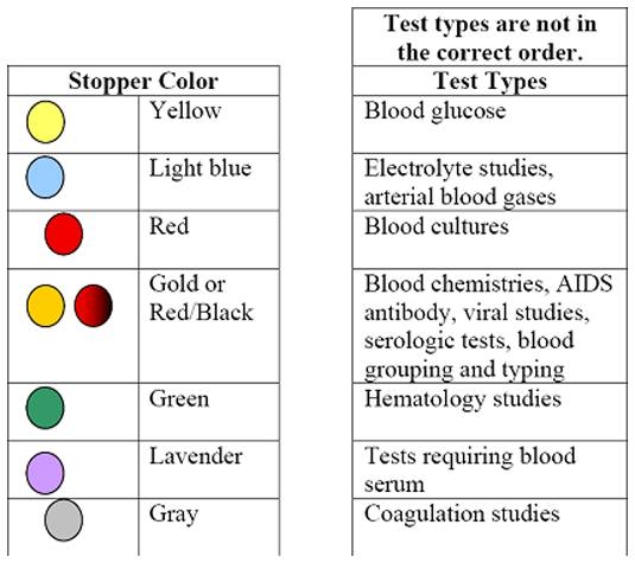 -A(n) blood collection tube with a ________ stopper contains heparin.
 (Short Answer)
4.9/5 (87)
(87) Which of the following would you include when performing venipuncture using an evacuation system?
(Multiple Choice)
4.9/5 (62)
(62) In addition to using appropriate engineered safety devices, NIOSH recommends that health-care workers ____.
(Multiple Choice)
4.8/5 (74)
(74) Which blood test can help identify coronary artery disease and atherosclerosis?
(Multiple Choice)
4.8/5 (96)
(96) The rupturing of red blood cells, releasing hemoglobin, is called ________.
(Short Answer)
4.8/5 (71)
(71) After explaining the process, you are drawing blood on 82-year-old Mrs. Green using an evacuated tube system. As you insert the third tube into the holder, the Mrs. Green begins to cry. You ask if she is in pain and she says, "No, but I am so scared! Why do they need this much blood? I must have a terrible disease!" Which of the following is your best response?
(Multiple Choice)
4.7/5 (93)
(93) A blood test that measures creatine kinase (CK) can identify ____.
(Multiple Choice)
4.9/5 (78)
(78) A small, disposable instrument with a sharp point used to puncture the skin and make a shallow incision is called a(n) ________.
(Short Answer)
4.9/5 (89)
(89) Which of the following is used in the capillary puncture technique?
(Multiple Choice)
4.8/5 (71)
(71) The total volume of plasma and formed elements is called ________ blood.
(Short Answer)
4.9/5 (75)
(75) The addition of a(n) ________ to a blood collection tube causes the blood to remain in a liquid state.
(Short Answer)
4.8/5 (58)
(58) A laboratory _______ form must be filled out when sending blood specimens to a reference laboratory for testing.
(Short Answer)
4.9/5 (81)
(81) Which procedure for obtaining a blood sample is usually performed on the middle finger or the ring finger?
(Multiple Choice)
4.9/5 (77)
(77) Julia is a pretty, 16-year-old patient who has come to the office for her annual physical. The physician has asked you to draw blood for routine blood tests. When she realizes that you are going to draw her blood, she frowns and backs away. She tells you that when "they" drew her blood last year, it left a huge, ugly bruise that took weeks to go away. Which of the following would be your best response?
(Multiple Choice)
4.9/5 (77)
(77) 
Filters
- Essay(0)
- Multiple Choice(0)
- Short Answer(0)
- True False(0)
- Matching(0)