



 Chat with AI
Exam 43: Plant Anatomy and Nutrient Transport

Exam 1: An Introduction to Life on Earth91 Questions
Exam 2: Atoms, Molecules, and Life90 Questions
Exam 3: Biological Molecules98 Questions
Exam 4: Cell Structure and Function90 Questions
Exam 5: Cell Membrane Structure and Function96 Questions
Exam 6: Energy Flow in the Life of a Cell90 Questions
Exam 7: Capturing Solar Energy: Photosynthesis101 Questions
Exam 8: Harvesting Energy: Glycolysis and Cellular Respiration91 Questions
Exam 9: The Continuity of Life: Cellular Reproduction90 Questions
Exam 10: Patterns of Inheritance93 Questions
Exam 11: Dna: the Molecule of Heredity90 Questions
Exam 12: Gene Expression and Regulation90 Questions
Exam 13: Biotechnology90 Questions
Exam 14: Principles of Evolution98 Questions
Exam 15: How Populations Evolve110 Questions
Exam 16: The Origin of Species92 Questions
Exam 17: The History of Life119 Questions
Exam 18: Systematics: Seeking Order Amidst Diversity91 Questions
Exam 19: The Diversity of Prokaryotes and Viruses97 Questions
Exam 20: The Diversity of Protists102 Questions
Exam 21: The Diversity of Plants103 Questions
Exam 22: The Diversity of Fungi105 Questions
Exam 23: Animal Diversity I: Invertebrates101 Questions
Exam 24: Animal Diversity Ii: Vertebrates118 Questions
Exam 25: Animal Behavior119 Questions
Exam 26: Population Growth and Regulation116 Questions
Exam 27: Community Interactions124 Questions
Exam 28: How Do Ecosystems Work124 Questions
Exam 29: Earths Diverse Ecosystems126 Questions
Exam 30: Conserving Earths Biodiversity110 Questions
Exam 31: Homeostasis and the Organization of the Animal Body95 Questions
Exam 32: Circulation89 Questions
Exam 33: Respiration92 Questions
Exam 34: Nutrition and Digestion91 Questions
Exam 35: The Urinary System90 Questions
Exam 36: Defenses Against Disease89 Questions
Exam 37: Chemical Control of the Animal Body: the Endocrine System129 Questions
Exam 38: The Nervous System111 Questions
Exam 39: The Senses90 Questions
Exam 40: Action and Support: the Muscles and Skeleton90 Questions
Exam 41: Animal Reproduction117 Questions
Exam 42: Animal Development123 Questions
Exam 43: Plant Anatomy and Nutrient Transport95 Questions
Exam 44: Plant Reproduction and Development90 Questions
Exam 45: Plant Responses to the Environment87 Questions
Select questions type


Which of these tissue types is/are found throughout young plant bodies?
(Multiple Choice)
4.9/5  (80)
(80) You discovered an unidentified weed and cut it almost to the ground with the lawn mower. Soon it was as tall as it was before you cut it. This growth is likely due to which growth region?
(Multiple Choice)
4.9/5 (67)
(67) What type of cell activity occurs in the meristem regions of plants?
(Multiple Choice)
4.8/5 (86)
(86) Based on this figure, estimate the age of this tree in years. 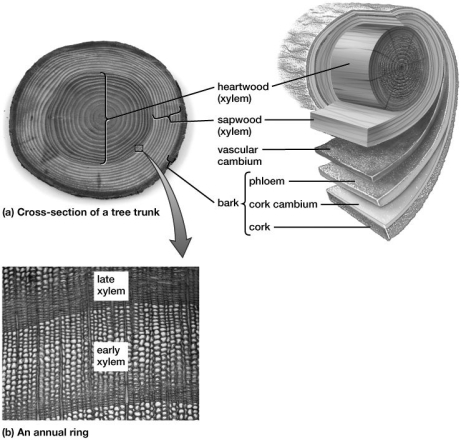
(Multiple Choice)
4.9/5 (87)
(87) As a 7-year-old child, you helped your father nail a birdhouse 7 feet high on a 10-foot-tall maple tree. If the tree grew an average of 12 inches per year, except during a dry year when it grew only 2 inches, how high in the tree is the birdhouse when you are 18 years old?
(Multiple Choice)
4.9/5 (81)
(81) You discover a plant that has unusual fruit around the seed and leaves with parallel veins. In which of the two major groups of flowering plants does it belong, and why?
(Multiple Choice)
4.9/5 (74)
(74) A plant that has only primary growth and no secondary growth does NOT have any:
(Multiple Choice)
4.8/5 (92)
(92) Which of these pathways BEST summarizes the route of a mineral that is absorbed by a plant?
(Multiple Choice)
4.8/5 (75)
(75) In the summer, when plants are storing sugar that is being produced in their leaves and roots, the root is the ________ and the leaves are the ________.
(Multiple Choice)
4.7/5 (87)
(87) Which of the following is the correct order of the tissues in a young dicot stem, from the center out?
(Multiple Choice)
4.9/5 (72)
(72) If a beaver eats the bark all the way around a tree trunk (a process called "girdling"), why does the tree die?
(Multiple Choice)
4.9/5 (74)
(74) The most widely accepted explanation for the transport of sugars in phloem is the ________ theory.
(Multiple Choice)
4.8/5 (82)
(82) Water-conducting cells that are narrow and have small central cavities are called:
(Multiple Choice)
4.8/5 (76)
(76) 
Filters
- Essay(0)
- Multiple Choice(0)
- Short Answer(0)
- True False(0)
- Matching(0)