



 Chat with AI
Exam 35: The Urinary System

Exam 1: An Introduction to Life on Earth91 Questions
Exam 2: Atoms, Molecules, and Life90 Questions
Exam 3: Biological Molecules98 Questions
Exam 4: Cell Structure and Function90 Questions
Exam 5: Cell Membrane Structure and Function96 Questions
Exam 6: Energy Flow in the Life of a Cell90 Questions
Exam 7: Capturing Solar Energy: Photosynthesis101 Questions
Exam 8: Harvesting Energy: Glycolysis and Cellular Respiration91 Questions
Exam 9: The Continuity of Life: Cellular Reproduction90 Questions
Exam 10: Patterns of Inheritance93 Questions
Exam 11: Dna: the Molecule of Heredity90 Questions
Exam 12: Gene Expression and Regulation90 Questions
Exam 13: Biotechnology90 Questions
Exam 14: Principles of Evolution98 Questions
Exam 15: How Populations Evolve110 Questions
Exam 16: The Origin of Species92 Questions
Exam 17: The History of Life119 Questions
Exam 18: Systematics: Seeking Order Amidst Diversity91 Questions
Exam 19: The Diversity of Prokaryotes and Viruses97 Questions
Exam 20: The Diversity of Protists102 Questions
Exam 21: The Diversity of Plants103 Questions
Exam 22: The Diversity of Fungi105 Questions
Exam 23: Animal Diversity I: Invertebrates101 Questions
Exam 24: Animal Diversity Ii: Vertebrates118 Questions
Exam 25: Animal Behavior119 Questions
Exam 26: Population Growth and Regulation116 Questions
Exam 27: Community Interactions124 Questions
Exam 28: How Do Ecosystems Work124 Questions
Exam 29: Earths Diverse Ecosystems126 Questions
Exam 30: Conserving Earths Biodiversity110 Questions
Exam 31: Homeostasis and the Organization of the Animal Body95 Questions
Exam 32: Circulation89 Questions
Exam 33: Respiration92 Questions
Exam 34: Nutrition and Digestion91 Questions
Exam 35: The Urinary System90 Questions
Exam 36: Defenses Against Disease89 Questions
Exam 37: Chemical Control of the Animal Body: the Endocrine System129 Questions
Exam 38: The Nervous System111 Questions
Exam 39: The Senses90 Questions
Exam 40: Action and Support: the Muscles and Skeleton90 Questions
Exam 41: Animal Reproduction117 Questions
Exam 42: Animal Development123 Questions
Exam 43: Plant Anatomy and Nutrient Transport95 Questions
Exam 44: Plant Reproduction and Development90 Questions
Exam 45: Plant Responses to the Environment87 Questions
Select questions type


Wastes are moved from blood to nephron by:

Free
(Multiple Choice)
4.8/5  (86)
(86) Correct Answer: Verified
D
Glucose and amino acids are reabsorbed from the filtrate by the:
Free
(Multiple Choice)
4.7/5 (86)
(86) Correct Answer:Verified
VerifiedB
The function of antidiuretic hormone is to:
Free
(Multiple Choice)
4.7/5 (96)
(96) Correct Answer:Verified
VerifiedC
About how much urine would you expect to come out of an average adult, per urination?
(Multiple Choice)
4.9/5 (76)
(76) When a patient is on a kidney hemodialysis machine, dissolved substances move from the patient's blood to the fluid in the machine primarily by:
(Multiple Choice)
4.9/5 (83)
(83) All of the following are functions of the vertebrate urinary system EXCEPT:
(Multiple Choice)
4.8/5 (80)
(80) What happens to ADH when you drink a lot of water? What effect does that have on your urine output?
(Essay)
4.7/5 (70)
(70) Animals produce different types of urine depending on their environment and their need to conserve water. True or False?
(True/False)
4.9/5 (75)
(75) What effect will an increase in the release of ADH have on blood volume?
(Multiple Choice)
4.8/5 (83)
(83) Which of the following describes the role of urinary systems in maintaining cellular homeostasis?
(Multiple Choice)
5.0/5 (72)
(72) Amino acids that are metabolized by the body's cells are ultimately broken down to urea by the:
(Multiple Choice)
4.8/5 (66)
(66) Based on this figure, what pathway is used during urinary catheterization, in which a tube is inserted into a patient in order to drain urine from the bladder? 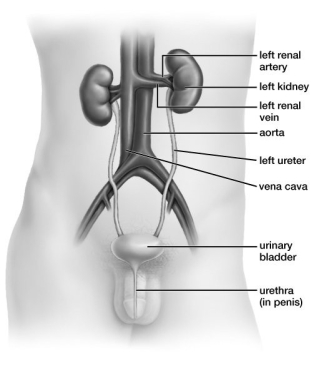
(Multiple Choice)
4.9/5 (88)
(88) 
Filters
- Essay(0)
- Multiple Choice(0)
- Short Answer(0)
- True False(0)
- Matching(0)