



 Chat with AI
Exam 5: Cell Membrane Structure and Function

Exam 1: An Introduction to Life on Earth91 Questions
Exam 2: Atoms, Molecules, and Life90 Questions
Exam 3: Biological Molecules98 Questions
Exam 4: Cell Structure and Function90 Questions
Exam 5: Cell Membrane Structure and Function96 Questions
Exam 6: Energy Flow in the Life of a Cell90 Questions
Exam 7: Capturing Solar Energy: Photosynthesis101 Questions
Exam 8: Harvesting Energy: Glycolysis and Cellular Respiration91 Questions
Exam 9: The Continuity of Life: Cellular Reproduction90 Questions
Exam 10: Patterns of Inheritance93 Questions
Exam 11: Dna: the Molecule of Heredity90 Questions
Exam 12: Gene Expression and Regulation90 Questions
Exam 13: Biotechnology90 Questions
Exam 14: Principles of Evolution98 Questions
Exam 15: How Populations Evolve110 Questions
Exam 16: The Origin of Species92 Questions
Exam 17: The History of Life119 Questions
Exam 18: Systematics: Seeking Order Amidst Diversity91 Questions
Exam 19: The Diversity of Prokaryotes and Viruses97 Questions
Exam 20: The Diversity of Protists102 Questions
Exam 21: The Diversity of Plants103 Questions
Exam 22: The Diversity of Fungi105 Questions
Exam 23: Animal Diversity I: Invertebrates101 Questions
Exam 24: Animal Diversity Ii: Vertebrates118 Questions
Exam 25: Animal Behavior119 Questions
Exam 26: Population Growth and Regulation116 Questions
Exam 27: Community Interactions124 Questions
Exam 28: How Do Ecosystems Work124 Questions
Exam 29: Earths Diverse Ecosystems126 Questions
Exam 30: Conserving Earths Biodiversity110 Questions
Exam 31: Homeostasis and the Organization of the Animal Body95 Questions
Exam 32: Circulation89 Questions
Exam 33: Respiration92 Questions
Exam 34: Nutrition and Digestion91 Questions
Exam 35: The Urinary System90 Questions
Exam 36: Defenses Against Disease89 Questions
Exam 37: Chemical Control of the Animal Body: the Endocrine System129 Questions
Exam 38: The Nervous System111 Questions
Exam 39: The Senses90 Questions
Exam 40: Action and Support: the Muscles and Skeleton90 Questions
Exam 41: Animal Reproduction117 Questions
Exam 42: Animal Development123 Questions
Exam 43: Plant Anatomy and Nutrient Transport95 Questions
Exam 44: Plant Reproduction and Development90 Questions
Exam 45: Plant Responses to the Environment87 Questions
Select questions type


Molecules that permeate a plasma membrane by facilitated diffusion:

Free
(Multiple Choice)
4.9/5  (81)
(81) Correct Answer: Verified
B
If you forget to water your favorite plant, all of the following will occur at a cellular level EXCEPT:
Free
(Multiple Choice)
5.0/5 (82)
(82) Correct Answer:Verified
VerifiedC
A freshwater protozoan, such as Paramecium, tends to ________ because it lives in a ________ environment.
Free
(Multiple Choice)
4.9/5 (75)
(75) Correct Answer:Verified
VerifiedA
In general, which of the following is largely responsible for moving substances across the plasma membrane, communicating with other cells, and identifying the cell?
(Multiple Choice)
4.9/5 (75)
(75) The cells of the intestinal epithelium (lining)are joined to one another by ________ that prevent substances from passing between the cells of this tissue.
(Essay)
5.0/5 (84)
(84) The antibiotic polymyxin B attaches itself to the phospholipids in the phospholipid bilayer and increases the permeability of the membrane. Describe what will occur as a result.
(Essay)
4.8/5 (79)
(79) Which process accounts for the movement of solids into some animal cells?
(Multiple Choice)
4.8/5 (60)
(60) The bacterium Vibrio cholerae releases a toxin that blocks a channel protein in the membranes of cells that line the intestine. This toxin prevents the movement of positively charged sodium ions out of the intestine and into these cells. If the sodium ions could not move into the cells, how would this affect the movement of water?
(Multiple Choice)
4.7/5 (80)
(80) If a frog egg cell is placed into a hypotonic solution, it will:
(Multiple Choice)
4.9/5 (87)
(87) If the radius of one cell were twice as large as the radius of another cell, how much higher or lower would its surface area-to-volume ratio be? 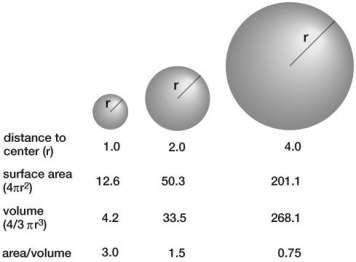
(Multiple Choice)
4.8/5 (77)
(77) Based on these four illustrations of diffusion, which mode would most likely be used to transport oxidized zinc (which has a charge of +2)through the cell membrane? 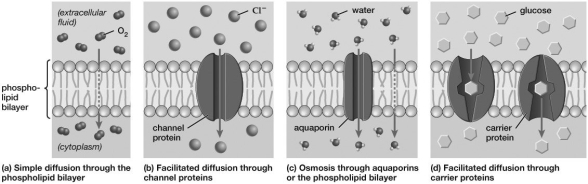
(Multiple Choice)
4.8/5 (79)
(79) Osmosis is the diffusion of water molecules across selectively water-permeable membranes. True or False?
(True/False)
4.8/5 (90)
(90) What structure in the membrane causes plasma membranes to resist freezing?
(Multiple Choice)
4.7/5 (85)
(85) Communication between cells occurs via ________ in plant cells and via ________ in animal cells.
(Essay)
4.8/5 (81)
(81) ISO membranes are inside-out membrane vesicles used by researchers in membrane studies. As a molecule diffuses into the vesicle, it will encounter the layers of the membrane in the following order:
(Multiple Choice)
4.9/5 (84)
(84) 
Filters
- Essay(0)
- Multiple Choice(0)
- Short Answer(0)
- True False(0)
- Matching(0)