



 Chat with AI
Exam 9: The Continuity of Life: Cellular Reproduction

Exam 1: An Introduction to Life on Earth91 Questions
Exam 2: Atoms, Molecules, and Life90 Questions
Exam 3: Biological Molecules98 Questions
Exam 4: Cell Structure and Function90 Questions
Exam 5: Cell Membrane Structure and Function96 Questions
Exam 6: Energy Flow in the Life of a Cell90 Questions
Exam 7: Capturing Solar Energy: Photosynthesis101 Questions
Exam 8: Harvesting Energy: Glycolysis and Cellular Respiration91 Questions
Exam 9: The Continuity of Life: Cellular Reproduction90 Questions
Exam 10: Patterns of Inheritance93 Questions
Exam 11: Dna: the Molecule of Heredity90 Questions
Exam 12: Gene Expression and Regulation90 Questions
Exam 13: Biotechnology90 Questions
Exam 14: Principles of Evolution98 Questions
Exam 15: How Populations Evolve110 Questions
Exam 16: The Origin of Species92 Questions
Exam 17: The History of Life119 Questions
Exam 18: Systematics: Seeking Order Amidst Diversity91 Questions
Exam 19: The Diversity of Prokaryotes and Viruses97 Questions
Exam 20: The Diversity of Protists102 Questions
Exam 21: The Diversity of Plants103 Questions
Exam 22: The Diversity of Fungi105 Questions
Exam 23: Animal Diversity I: Invertebrates101 Questions
Exam 24: Animal Diversity Ii: Vertebrates118 Questions
Exam 25: Animal Behavior119 Questions
Exam 26: Population Growth and Regulation116 Questions
Exam 27: Community Interactions124 Questions
Exam 28: How Do Ecosystems Work124 Questions
Exam 29: Earths Diverse Ecosystems126 Questions
Exam 30: Conserving Earths Biodiversity110 Questions
Exam 31: Homeostasis and the Organization of the Animal Body95 Questions
Exam 32: Circulation89 Questions
Exam 33: Respiration92 Questions
Exam 34: Nutrition and Digestion91 Questions
Exam 35: The Urinary System90 Questions
Exam 36: Defenses Against Disease89 Questions
Exam 37: Chemical Control of the Animal Body: the Endocrine System129 Questions
Exam 38: The Nervous System111 Questions
Exam 39: The Senses90 Questions
Exam 40: Action and Support: the Muscles and Skeleton90 Questions
Exam 41: Animal Reproduction117 Questions
Exam 42: Animal Development123 Questions
Exam 43: Plant Anatomy and Nutrient Transport95 Questions
Exam 44: Plant Reproduction and Development90 Questions
Exam 45: Plant Responses to the Environment87 Questions
Select questions type


Which of the following are permanently differentiated cells?

Free
(Multiple Choice)
5.0/5  (88)
(88) Correct Answer: Verified
C
Eukaryotic chromosomes are made up of only DNA. True or False?
Free
(True/False)
4.8/5 (77)
(77) Correct Answer:Verified
VerifiedFalse
How many nucleotides are in a human chromosome?
Free
(Multiple Choice)
4.9/5 (79)
(79) Correct Answer:Verified
VerifiedD
In a haploid daughter cell produced by meiosis, the homologous chromosomes have:
(Multiple Choice)
4.9/5 (78)
(78) Which type of eukaryotic cell contains two types of each chromosome?
(Multiple Choice)
4.7/5 (73)
(73) Inside the nucleus, the two strands of nucleic acids that exist in the form of a double helix make up the molecule called ________.
(Essay)
4.9/5 (82)
(82) Which of the following is the correct sequence in a cyclin-Cdk pathway?
(Multiple Choice)
4.9/5 (68)
(68) In a eukaryotic cell that is undergoing cell division, what will become a new chromosome?
(Multiple Choice)
4.9/5 (88)
(88) A bacterial cell splits into two new cells by a process called:
(Multiple Choice)
4.8/5 (67)
(67) The ant Myrmecia pilosula has the smallest number of chromosomes possible in a eukaryote: females possess only one pair of chromosomes, and males have only one chromosome! Put another way, female M. pilosula can be described as having the haploid condition n = 1 and the diploid condition 2n = 2. Based on this scenario as well as your knowledge of gamete formation a female M. pilosula can produce gametes with ________ different sets of chromosomes.
(Multiple Choice)
4.9/5 (83)
(83) Based on this figure, what would be the consequence of exposure to a synthetic chemical in the environment that mimics the structure and shape of a growth factor? 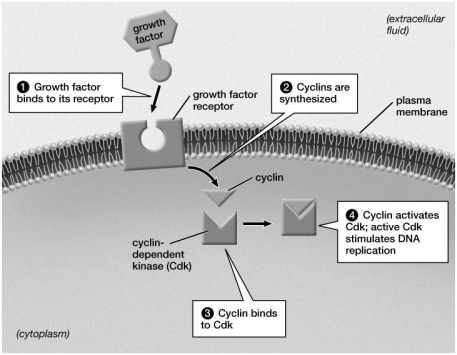
(Multiple Choice)
5.0/5 (77)
(77) A photograph of all the stained, prepared chromosomes in a eukaryotic cell is referred to as a:
(Multiple Choice)
4.8/5 (79)
(79) The site on a chromosome where microtubules attach during cell division is the:
(Multiple Choice)
4.8/5 (75)
(75) What is the function of the histones that are found in a chromosome?
(Multiple Choice)
5.0/5 (88)
(88) All of the following may be found in a DNA nucleotide EXCEPT:
(Multiple Choice)
4.9/5 (73)
(73) 
Filters
- Essay(0)
- Multiple Choice(0)
- Short Answer(0)
- True False(0)
- Matching(0)