



 Chat with AI
Exam 34: Nutrition and Digestion

Exam 1: An Introduction to Life on Earth91 Questions
Exam 2: Atoms, Molecules, and Life90 Questions
Exam 3: Biological Molecules98 Questions
Exam 4: Cell Structure and Function90 Questions
Exam 5: Cell Membrane Structure and Function96 Questions
Exam 6: Energy Flow in the Life of a Cell90 Questions
Exam 7: Capturing Solar Energy: Photosynthesis101 Questions
Exam 8: Harvesting Energy: Glycolysis and Cellular Respiration91 Questions
Exam 9: The Continuity of Life: Cellular Reproduction90 Questions
Exam 10: Patterns of Inheritance93 Questions
Exam 11: Dna: the Molecule of Heredity90 Questions
Exam 12: Gene Expression and Regulation90 Questions
Exam 13: Biotechnology90 Questions
Exam 14: Principles of Evolution98 Questions
Exam 15: How Populations Evolve110 Questions
Exam 16: The Origin of Species92 Questions
Exam 17: The History of Life119 Questions
Exam 18: Systematics: Seeking Order Amidst Diversity91 Questions
Exam 19: The Diversity of Prokaryotes and Viruses97 Questions
Exam 20: The Diversity of Protists102 Questions
Exam 21: The Diversity of Plants103 Questions
Exam 22: The Diversity of Fungi105 Questions
Exam 23: Animal Diversity I: Invertebrates101 Questions
Exam 24: Animal Diversity Ii: Vertebrates118 Questions
Exam 25: Animal Behavior119 Questions
Exam 26: Population Growth and Regulation116 Questions
Exam 27: Community Interactions124 Questions
Exam 28: How Do Ecosystems Work124 Questions
Exam 29: Earths Diverse Ecosystems126 Questions
Exam 30: Conserving Earths Biodiversity110 Questions
Exam 31: Homeostasis and the Organization of the Animal Body95 Questions
Exam 32: Circulation89 Questions
Exam 33: Respiration92 Questions
Exam 34: Nutrition and Digestion91 Questions
Exam 35: The Urinary System90 Questions
Exam 36: Defenses Against Disease89 Questions
Exam 37: Chemical Control of the Animal Body: the Endocrine System129 Questions
Exam 38: The Nervous System111 Questions
Exam 39: The Senses90 Questions
Exam 40: Action and Support: the Muscles and Skeleton90 Questions
Exam 41: Animal Reproduction117 Questions
Exam 42: Animal Development123 Questions
Exam 43: Plant Anatomy and Nutrient Transport95 Questions
Exam 44: Plant Reproduction and Development90 Questions
Exam 45: Plant Responses to the Environment87 Questions
Select questions type


The bacterium shown to be associated with the majority of gastric ulcers is:

Free
(Multiple Choice)
4.8/5  (86)
(86) Correct Answer: Verified
D
Which of these dietary changes should I make following surgery to remove my gallbladder? (Hint: How does the gallbladder assist in digestion?)
Free
(Multiple Choice)
4.8/5 (84)
(84) Correct Answer:Verified
VerifiedA
You need the mineral ________ in your diet in order to make thyroid hormone.
(Essay)
4.8/5 (83)
(83) If you chew on a piece of bread long enough, it will begin to taste sweet because:
(Multiple Choice)
4.9/5 (80)
(80) Sodium and potassium are minerals that are important in the function of:
(Multiple Choice)
4.9/5 (80)
(80) Based on the nutritional label in this figure, what is needed in the greatest quantity (or activity)to thoroughly digest this food? 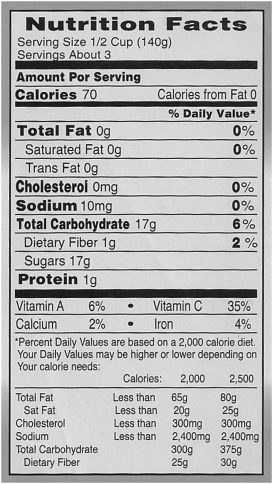
(Multiple Choice)
4.8/5 (77)
(77) Your roommate tells you that, because she has no time to eat healthy foods, she is taking megadoses of vitamins. You warn her that this may be dangerous. Which vitamin overdose would be most dangerous to her?
(Multiple Choice)
4.7/5 (75)
(75) Imagine that you are examining the teeth in the skull of an unidentified animal. The incisors are flat, the canines are pointed, and molars and premolars are present. This animal was most likely a(n):
(Multiple Choice)
4.7/5 (89)
(89) The amount of energy necessary to raise the temperature of 1 gram of water by 1°C is called:
(Multiple Choice)
4.7/5 (65)
(65) After getting up late and leaving home without any breakfast, you realize that you are late to class and begin sprinting to reach the lecture hall two blocks away. Which of the following is the most likely energy source for your activity?
(Multiple Choice)
4.8/5 (85)
(85) Different species of animals have very different nutritional requirements and gastrointestinal tract (GIT)specializations, depending on their primary diets. For example, carnivorous animals have moderate-length intestines, fast gut passage rates, and high protein requirements, in accordance with the high-protein, easily digested prey they consume. Based on your knowledge of nutrition and digestion and on the example provided in this scenario, what do you conclude about ruminants, which eat low-protein, difficult-to-digest plant leaves?
(Multiple Choice)
5.0/5 (83)
(83) Humans are able to synthesize all the lipids they need. True or False?
(True/False)
4.9/5 (75)
(75) Cellulose is the most abundant carbohydrate on Earth. True or False?
(True/False)
4.8/5 (80)
(80) ________ is the molecule used by animals as a source of quick energy.
(Multiple Choice)
4.7/5 (81)
(81) A deficiency of ________ has been associated with birth defects.
(Multiple Choice)
4.8/5 (65)
(65) Which of these groups is the most concentrated energy source?
(Multiple Choice)
4.7/5 (89)
(89) 
Filters
- Essay(0)
- Multiple Choice(0)
- Short Answer(0)
- True False(0)
- Matching(0)