



 Chat with AI
Exam 36: Defenses Against Disease

Exam 1: An Introduction to Life on Earth91 Questions
Exam 2: Atoms, Molecules, and Life90 Questions
Exam 3: Biological Molecules98 Questions
Exam 4: Cell Structure and Function90 Questions
Exam 5: Cell Membrane Structure and Function96 Questions
Exam 6: Energy Flow in the Life of a Cell90 Questions
Exam 7: Capturing Solar Energy: Photosynthesis101 Questions
Exam 8: Harvesting Energy: Glycolysis and Cellular Respiration91 Questions
Exam 9: The Continuity of Life: Cellular Reproduction90 Questions
Exam 10: Patterns of Inheritance93 Questions
Exam 11: Dna: the Molecule of Heredity90 Questions
Exam 12: Gene Expression and Regulation90 Questions
Exam 13: Biotechnology90 Questions
Exam 14: Principles of Evolution98 Questions
Exam 15: How Populations Evolve110 Questions
Exam 16: The Origin of Species92 Questions
Exam 17: The History of Life119 Questions
Exam 18: Systematics: Seeking Order Amidst Diversity91 Questions
Exam 19: The Diversity of Prokaryotes and Viruses97 Questions
Exam 20: The Diversity of Protists102 Questions
Exam 21: The Diversity of Plants103 Questions
Exam 22: The Diversity of Fungi105 Questions
Exam 23: Animal Diversity I: Invertebrates101 Questions
Exam 24: Animal Diversity Ii: Vertebrates118 Questions
Exam 25: Animal Behavior119 Questions
Exam 26: Population Growth and Regulation116 Questions
Exam 27: Community Interactions124 Questions
Exam 28: How Do Ecosystems Work124 Questions
Exam 29: Earths Diverse Ecosystems126 Questions
Exam 30: Conserving Earths Biodiversity110 Questions
Exam 31: Homeostasis and the Organization of the Animal Body95 Questions
Exam 32: Circulation89 Questions
Exam 33: Respiration92 Questions
Exam 34: Nutrition and Digestion91 Questions
Exam 35: The Urinary System90 Questions
Exam 36: Defenses Against Disease89 Questions
Exam 37: Chemical Control of the Animal Body: the Endocrine System129 Questions
Exam 38: The Nervous System111 Questions
Exam 39: The Senses90 Questions
Exam 40: Action and Support: the Muscles and Skeleton90 Questions
Exam 41: Animal Reproduction117 Questions
Exam 42: Animal Development123 Questions
Exam 43: Plant Anatomy and Nutrient Transport95 Questions
Exam 44: Plant Reproduction and Development90 Questions
Exam 45: Plant Responses to the Environment87 Questions
Select questions type


Antimicrobial skin secretions include:

Free
(Multiple Choice)
4.9/5  (88)
(88) Correct Answer: Verified
E
Which of the following is responsible for starting fevers?
Free
(Multiple Choice)
4.8/5 (81)
(81) Correct Answer:Verified
VerifiedD
List the human body's three lines of defense against disease.
Free
(Essay)
4.9/5 (74)
(74) Correct Answer:Verified
Verifiednonspecific external barriers (e.g., skin and mucous membranes); nonspecific internal responses; and specific (adaptive)immune responses
The proteins released by macrophages, which are responsible for starting fevers, are called ________.
(Essay)
4.7/5 (86)
(86) Why do physicians recommend that their patients avoid taking aspirin for a low-grade fever?
(Multiple Choice)
4.9/5 (86)
(86) In the body, a whitish mixture of dead bacteria, damaged tissue, and living and dead white blood cells often associated with an infection is called ________.
(Essay)
4.7/5 (63)
(63) What mechanisms do natural killer cells use to destroy body cells that have been infected by cancer or a virus?
(Essay)
5.0/5 (73)
(73) Which of the following is a consequence of histamine release?
(Multiple Choice)
4.8/5 (81)
(81) As shown in this figure, upon reexposure to pollen, the pollen binds to: 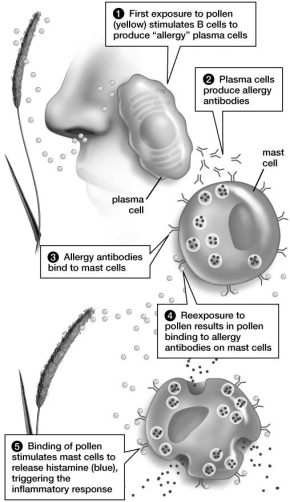
(Multiple Choice)
4.8/5 (81)
(81) Would you expect someone with AIDS to have a fever in response to an infection?
(Multiple Choice)
4.8/5 (74)
(74) Last summer you were stung by a bee for the first time in your life. You developed only a small area of redness and swelling at the site. However, if you are stung again and have a very severe reaction that occurs more rapidly, you know that this is due to the activity of:
(Multiple Choice)
4.9/5 (85)
(85) 
Filters
- Essay(0)
- Multiple Choice(0)
- Short Answer(0)
- True False(0)
- Matching(0)