



 Chat with AI
Exam 25: Animal Behavior

Exam 1: An Introduction to Life on Earth91 Questions
Exam 2: Atoms, Molecules, and Life90 Questions
Exam 3: Biological Molecules98 Questions
Exam 4: Cell Structure and Function90 Questions
Exam 5: Cell Membrane Structure and Function96 Questions
Exam 6: Energy Flow in the Life of a Cell90 Questions
Exam 7: Capturing Solar Energy: Photosynthesis101 Questions
Exam 8: Harvesting Energy: Glycolysis and Cellular Respiration91 Questions
Exam 9: The Continuity of Life: Cellular Reproduction90 Questions
Exam 10: Patterns of Inheritance93 Questions
Exam 11: Dna: the Molecule of Heredity90 Questions
Exam 12: Gene Expression and Regulation90 Questions
Exam 13: Biotechnology90 Questions
Exam 14: Principles of Evolution98 Questions
Exam 15: How Populations Evolve110 Questions
Exam 16: The Origin of Species92 Questions
Exam 17: The History of Life119 Questions
Exam 18: Systematics: Seeking Order Amidst Diversity91 Questions
Exam 19: The Diversity of Prokaryotes and Viruses97 Questions
Exam 20: The Diversity of Protists102 Questions
Exam 21: The Diversity of Plants103 Questions
Exam 22: The Diversity of Fungi105 Questions
Exam 23: Animal Diversity I: Invertebrates101 Questions
Exam 24: Animal Diversity Ii: Vertebrates118 Questions
Exam 25: Animal Behavior119 Questions
Exam 26: Population Growth and Regulation116 Questions
Exam 27: Community Interactions124 Questions
Exam 28: How Do Ecosystems Work124 Questions
Exam 29: Earths Diverse Ecosystems126 Questions
Exam 30: Conserving Earths Biodiversity110 Questions
Exam 31: Homeostasis and the Organization of the Animal Body95 Questions
Exam 32: Circulation89 Questions
Exam 33: Respiration92 Questions
Exam 34: Nutrition and Digestion91 Questions
Exam 35: The Urinary System90 Questions
Exam 36: Defenses Against Disease89 Questions
Exam 37: Chemical Control of the Animal Body: the Endocrine System129 Questions
Exam 38: The Nervous System111 Questions
Exam 39: The Senses90 Questions
Exam 40: Action and Support: the Muscles and Skeleton90 Questions
Exam 41: Animal Reproduction117 Questions
Exam 42: Animal Development123 Questions
Exam 43: Plant Anatomy and Nutrient Transport95 Questions
Exam 44: Plant Reproduction and Development90 Questions
Exam 45: Plant Responses to the Environment87 Questions
Select questions type


In male bighorn sheep, the dominant male is the one with the largest horns. True or False?

Free
(True/False)
4.9/5  (90)
(90) Correct Answer: Verified
True
Smiling when happy seems to be an expression common to all human societies, suggesting that this behavior is probably:
Free
(Multiple Choice)
5.0/5 (76)
(76) Correct Answer:Verified
VerifiedA
In a wolf pack, the alpha is the ________ animal.
Free
(Essay)
4.7/5 (79)
(79) Correct Answer:Verified
Verifieddominant
Pheromones affect only the animal that produces them. True or False?
(True/False)
4.8/5 (88)
(88) Konrad Lorenz taught ducks to behave as though he were their mother by providing the appropriate stimulus during a sensitive period. This form of learning is called:
(Multiple Choice)
4.9/5 (86)
(86) Sticklebacks are territorial. Based on the territories established, which fish in the illustration will assume submissive behavior? 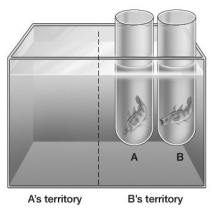
(Multiple Choice)
4.9/5 (70)
(70) Human babies are born with a startle reflex. This is an example of a(n)________ behavior.
(Essay)
4.9/5 (82)
(82) Complex societies involving a caste system (humans excluded)are found among:
(Multiple Choice)
4.7/5 (81)
(81) An adaptive change in behavior that results from experience is called:
(Multiple Choice)
4.8/5 (78)
(78) A newly hatched duck adopts the first large, moving object it sees as its mother. This is an example of ________.
(Essay)
4.9/5 (76)
(76) Male bullfrogs produce loud calls during the mating season to attract females. Most females prefer males that have the loudest calls. What can we reasonably conclude about this situation?
(Multiple Choice)
4.8/5 (93)
(93) When a 2-month-old baby is shown a piece of white paper with two dark, eye-sized spots, the baby will:
(Multiple Choice)
4.9/5 (85)
(85) Which of the following is a disadvantage for animals living in groups?
(Multiple Choice)
4.9/5 (73)
(73) At the start of the breeding season, male stickleback fish undergo a number of significant changes. Their bellies become bright red and they become aggressive toward other males of the species, establishing and defending territories in which they build their nests. Although most male-male encounters consist solely of the resident lunging at an intruder, if this fails to drive off the intruder, the resident may bite. Females choose to mate with males that have large territories and well-constructed nests. What would you expect to happen as nest sites become scarcer?
(Multiple Choice)
4.7/5 (86)
(86) Chemicals produced by an individual that influence the behavior of members of the same species are called:
(Multiple Choice)
4.8/5 (72)
(72) A female dog in estrus attracts males with pheromones. True or False?
(True/False)
4.8/5 (68)
(68) 
Filters
- Essay(0)
- Multiple Choice(0)
- Short Answer(0)
- True False(0)
- Matching(0)