



 Chat with AI
Exam 25: Animal Behavior

Exam 1: An Introduction to Life on Earth91 Questions
Exam 2: Atoms, Molecules, and Life90 Questions
Exam 3: Biological Molecules98 Questions
Exam 4: Cell Structure and Function90 Questions
Exam 5: Cell Membrane Structure and Function96 Questions
Exam 6: Energy Flow in the Life of a Cell90 Questions
Exam 7: Capturing Solar Energy: Photosynthesis101 Questions
Exam 8: Harvesting Energy: Glycolysis and Cellular Respiration91 Questions
Exam 9: The Continuity of Life: Cellular Reproduction90 Questions
Exam 10: Patterns of Inheritance93 Questions
Exam 11: Dna: the Molecule of Heredity90 Questions
Exam 12: Gene Expression and Regulation90 Questions
Exam 13: Biotechnology90 Questions
Exam 14: Principles of Evolution98 Questions
Exam 15: How Populations Evolve110 Questions
Exam 16: The Origin of Species92 Questions
Exam 17: The History of Life119 Questions
Exam 18: Systematics: Seeking Order Amidst Diversity91 Questions
Exam 19: The Diversity of Prokaryotes and Viruses97 Questions
Exam 20: The Diversity of Protists102 Questions
Exam 21: The Diversity of Plants103 Questions
Exam 22: The Diversity of Fungi105 Questions
Exam 23: Animal Diversity I: Invertebrates101 Questions
Exam 24: Animal Diversity Ii: Vertebrates118 Questions
Exam 25: Animal Behavior119 Questions
Exam 26: Population Growth and Regulation116 Questions
Exam 27: Community Interactions124 Questions
Exam 28: How Do Ecosystems Work124 Questions
Exam 29: Earths Diverse Ecosystems126 Questions
Exam 30: Conserving Earths Biodiversity110 Questions
Exam 31: Homeostasis and the Organization of the Animal Body95 Questions
Exam 32: Circulation89 Questions
Exam 33: Respiration92 Questions
Exam 34: Nutrition and Digestion91 Questions
Exam 35: The Urinary System90 Questions
Exam 36: Defenses Against Disease89 Questions
Exam 37: Chemical Control of the Animal Body: the Endocrine System129 Questions
Exam 38: The Nervous System111 Questions
Exam 39: The Senses90 Questions
Exam 40: Action and Support: the Muscles and Skeleton90 Questions
Exam 41: Animal Reproduction117 Questions
Exam 42: Animal Development123 Questions
Exam 43: Plant Anatomy and Nutrient Transport95 Questions
Exam 44: Plant Reproduction and Development90 Questions
Exam 45: Plant Responses to the Environment87 Questions
Select questions type


The insects in the photograph are demonstrating ________ communication. 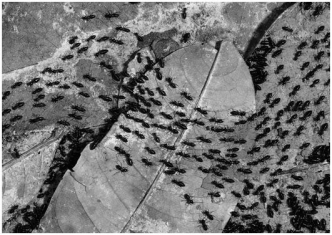
(Multiple Choice)
5.0/5  (89)
(89) A lion spraying urine on a tree is an example of ________-based communication.
(Essay)
4.9/5 (75)
(75) Living in a social group increases the risk of contracting an infectious disease. True or False?
(True/False)
4.8/5 (83)
(83) The function of honeybee drones is to bring nectar back to the hive. True or False?
(True/False)
4.7/5 (87)
(87) Living in a social group decreases the odds of finding a mate. True or False?
(True/False)
4.9/5 (84)
(84) Nesting geese will roll softballs (placed next to their nests by biologists)into their nests, perhaps because the balls resemble eggs that might have rolled out of the nest. This behavior is most likely:
(Multiple Choice)
4.9/5 (89)
(89) A strong association learned during a sensitive period of an animal's development is referred to as:
(Multiple Choice)
4.9/5 (79)
(79) According to ethologists, ________ is defined as the capacity to make changes in behavior on the basis of experience.
(Essay)
5.0/5 (82)
(82) Aggressive encounters between individuals of the same species:
(Multiple Choice)
4.8/5 (84)
(84) Martha McClintock found that the menstrual cycles of female college roommates became synchronous after 6 months of living together. She also found that armpit odors from one group of women affected the menstrual cycles of other women who sniffed the odors. These findings might indicate that:
(Multiple Choice)
4.9/5 (70)
(70) Dominance hierarchies minimize aggression in social animals. True or False?
(True/False)
4.8/5 (83)
(83) Foraging honeybees communicate the location of a source of food by:
(Multiple Choice)
4.8/5 (86)
(86) 
Filters
- Essay(0)
- Multiple Choice(0)
- Short Answer(0)
- True False(0)
- Matching(0)