



 Chat with AI
Exam 14: B: Money, Banking, and Money Creation

Exam 1: B: Limits, Alternatives, and Choices265 Questions
Exam 1: A: - Limits, Alternatives, and Choices60 Questions
Exam 2: B: The Market System and the Circular Flow119 Questions
Exam 2: A: - The Market System and the Circular Flow42 Questions
Exam 3: B: Demand, Supply, and Market Equilibrium291 Questions
Exam 3: A: - Demand, Supply, and Market Equilibrium51 Questions
Exam 4: B: Market Failures: Public Goods and Externalities133 Questions
Exam 4: A: - Market Failures: Public Goods and Externalities36 Questions
Exam 5: B: Governments Role and Government Failure121 Questions
Exam 5: A: Governments Role and Government Failure1 Questions
Exam 6: B: an Introduction to Macroeconomics65 Questions
Exam 6: A: an Introduction to Macroeconomics31 Questions
Exam 7: B: Measuring the Economys Output191 Questions
Exam 7: A: Measuring the Economys Output30 Questions
Exam 8: B: Economic Growth122 Questions
Exam 8: A: Economic Growth35 Questions
Exam 9: B: Business Cycles, Unemployment, and Inflation193 Questions
Exam 9: A: Business Cycles, Unemployment, and Inflation40 Questions
Exam 10: B: Basic Macroeconomic Relationships200 Questions
Exam 10: A: Basic Macroeconomic Relationships26 Questions
Exam 11: B: The Aggregate Expenditures Model238 Questions
Exam 11: A: The Aggregate Expenditures Model47 Questions
Exam 12: B: Aggregate Demand and Aggregate Supply203 Questions
Exam 12: A: Aggregate Demand and Aggregate Supply35 Questions
Exam 13: B: Fiscal Policy, Deficits, Surpluses, and Debt234 Questions
Exam 13: A: Fiscal Policy, Deficits, Surpluses, and Debt53 Questions
Exam 14: B: Money, Banking, and Money Creation206 Questions
Exam 14: A: Money, Banking, and Money Creation56 Questions
Exam 15: B: Interest Rates and Monetary Policy239 Questions
Exam 15: A: Interest Rates and Monetary Policy47 Questions
Exam 17: C: Financial Economics323 Questions
Exam 16: A: Long-Run Macroeconomic Adjustments28 Questions
Exam 16: B: Long-Run Macroeconomic Adjustments122 Questions
Exam 17: A: International Trade40 Questions
Exam 17: B: International Trade188 Questions
Exam 18: A: The Balance of Payments and Exchange Rates30 Questions
Exam 18: B: The Balance of Payments and Exchange Rates133 Questions
Exam 22: The Economics of Developing Countries254 Questions
Select questions type


If actual reserves in the banking system are $50,000, excess reserves are $5,000, and demand deposits are $225,000, then the money multiplier:
(Multiple Choice)
4.7/5  (77)
(77) If we assume m to be equal to the maximum amount of dollar that can be created from a single dollar of excess reserves and R to be equal to the desired reserve ratio, then we can say that for the banking system:
(Multiple Choice)
4.8/5 (84)
(84) Chartered banks monetize claims when they sell securities to the Bank of Canada.
(True/False)
5.0/5 (81)
(81)  Refer to the above information.The value of the dollar in year 4 is:
 (Multiple Choice)
4.9/5 (72)
(72) A chartered bank that is temporarily short in the level of reserves it wishes to hold will borrow from another chartered bank:
(Multiple Choice)
4.9/5 (79)
(79) The multiple by which the chartered banking system can increase the supply of money on the basis of each dollar of excess reserves is equal to:
(Multiple Choice)
4.9/5 (76)
(76) 1.Foreign currency deposits of residents booked in Canada 2.Personal savings deposits at the chartered banks
3)Currency (coins and paper money)
4)Demand deposits
5)Government securities
6)Non-personal notice deposits at the chartered banks
Refer to the above information.Which of the following is not included in any of the official definitions of money?
(Multiple Choice)
4.9/5 (75)
(75) The following balance sheet is for the First National Bank.Assume the reserve ratio is 15 percent. 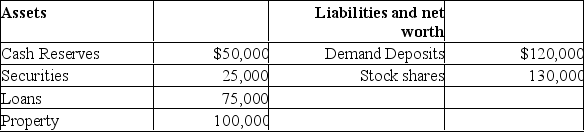 Refer to the above data.This bank can make new loans of up to:
 (Multiple Choice)
4.8/5 (69)
(69) The basic source of money in our economy is the Department of Finance.
(True/False)
4.9/5 (77)
(77) Money eliminates the need for a coincidence of wants primarily through its use as a:
(Multiple Choice)
4.8/5 (75)
(75) The balance sheet below is for chartered bank ABC.Assume the desired reserve ratio is 20 percent.All figures are in billions.  Refer to the above information.The amount by which this single chartered bank and the amount by which the banking system can increase loans are respectively:
 (Multiple Choice)
4.7/5 (82)
(82) Stock market price quotations best exemplify money serving as a:
(Multiple Choice)
4.7/5 (84)
(84) The primary purpose of the desired reserve is to provide the means by which the monetary authorities can influence the lending ability of chartered banks.
(True/False)
4.9/5 (90)
(90) A $200 price tag on a cashmere sweater in a department store window is an example of money functioning as a:
(Multiple Choice)
4.8/5 (80)
(80) The balance sheet below is for chartered bank EFG.Assume the desired reserve ratio is 25 percent.All figures are in billions.  Refer to the above information.The amount by which this single chartered bank and the amount by which the banking system can increase loans are respectively:
 (Multiple Choice)
4.8/5 (79)
(79) The following is a consolidated balance sheet for the chartered banking system.All figures are in billions.Assume that the desired reserve ratio is 20 percent.  Refer to the above information.The maximum amount by which this chartered banking system can expand the supply of money by lending is:
 (Multiple Choice)
4.9/5 (75)
(75) Currency and coins held by banks are part of the M1 definition of money supply.
(True/False)
4.9/5 (69)
(69) 
Filters
- Essay(0)
- Multiple Choice(0)
- Short Answer(0)
- True False(0)
- Matching(0)