



 Chat with AI
Exam 14: B: Money, Banking, and Money Creation

Exam 1: B: Limits, Alternatives, and Choices265 Questions
Exam 1: A: - Limits, Alternatives, and Choices60 Questions
Exam 2: B: The Market System and the Circular Flow119 Questions
Exam 2: A: - The Market System and the Circular Flow42 Questions
Exam 3: B: Demand, Supply, and Market Equilibrium291 Questions
Exam 3: A: - Demand, Supply, and Market Equilibrium51 Questions
Exam 4: B: Market Failures: Public Goods and Externalities133 Questions
Exam 4: A: - Market Failures: Public Goods and Externalities36 Questions
Exam 5: B: Governments Role and Government Failure121 Questions
Exam 5: A: Governments Role and Government Failure1 Questions
Exam 6: B: an Introduction to Macroeconomics65 Questions
Exam 6: A: an Introduction to Macroeconomics31 Questions
Exam 7: B: Measuring the Economys Output191 Questions
Exam 7: A: Measuring the Economys Output30 Questions
Exam 8: B: Economic Growth122 Questions
Exam 8: A: Economic Growth35 Questions
Exam 9: B: Business Cycles, Unemployment, and Inflation193 Questions
Exam 9: A: Business Cycles, Unemployment, and Inflation40 Questions
Exam 10: B: Basic Macroeconomic Relationships200 Questions
Exam 10: A: Basic Macroeconomic Relationships26 Questions
Exam 11: B: The Aggregate Expenditures Model238 Questions
Exam 11: A: The Aggregate Expenditures Model47 Questions
Exam 12: B: Aggregate Demand and Aggregate Supply203 Questions
Exam 12: A: Aggregate Demand and Aggregate Supply35 Questions
Exam 13: B: Fiscal Policy, Deficits, Surpluses, and Debt234 Questions
Exam 13: A: Fiscal Policy, Deficits, Surpluses, and Debt53 Questions
Exam 14: B: Money, Banking, and Money Creation206 Questions
Exam 14: A: Money, Banking, and Money Creation56 Questions
Exam 15: B: Interest Rates and Monetary Policy239 Questions
Exam 15: A: Interest Rates and Monetary Policy47 Questions
Exam 17: C: Financial Economics323 Questions
Exam 16: A: Long-Run Macroeconomic Adjustments28 Questions
Exam 16: B: Long-Run Macroeconomic Adjustments122 Questions
Exam 17: A: International Trade40 Questions
Exam 17: B: International Trade188 Questions
Exam 18: A: The Balance of Payments and Exchange Rates30 Questions
Exam 18: B: The Balance of Payments and Exchange Rates133 Questions
Exam 22: The Economics of Developing Countries254 Questions
Select questions type


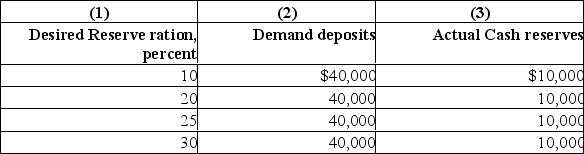 Refer to the above information.If the desired reserve ratio falls from 25 percent to 10 percent, excess reserves of this single bank will:
 (Multiple Choice)
4.9/5  (77)
(77) When we say that the Canadian banking system is fractional reserve system, it means:
(Multiple Choice)
4.8/5 (79)
(79) What function is money serving when you deposit money in a savings account?
(Multiple Choice)
4.7/5 (86)
(86) Refer to the information below.When the desired reserve ratio is 25 percent, the excess reserves of this single bank are: 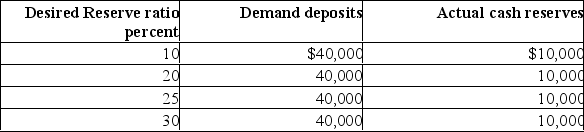
(Multiple Choice)
4.9/5 (83)
(83) The chartered banking system of Canada allows the system to lend:
(Multiple Choice)
5.0/5 (76)
(76) If actual cash reserves in the banking system are $8,000, demand deposits are $70,000, and the desired reserve ratio is 10 percent, then excess reserves:
(Multiple Choice)
4.8/5 (74)
(74) Refer to the information below which shows the demand deposits and actual reserves of a banking system.When the desired reserve ratio is 20 percent, the money creating potential of the entire banking system is: 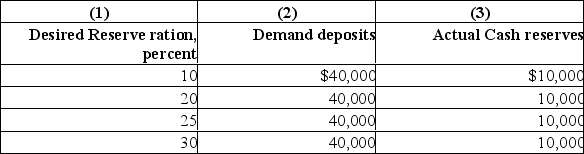
(Multiple Choice)
4.7/5 (73)
(73) Suppose a chartered banking system has $100,000 of outstanding demand deposits and actual cash reserves of $35,000.If the desired reserve ratio is 20 percent, the banking system can expand the supply of money by the maximum amount of:
(Multiple Choice)
4.7/5 (100)
(100) One of the three basic functions of money is to serve as legal tender.
(True/False)
4.8/5 (71)
(71) The supply of money increases when the public purchases government securities from chartered banks.
(True/False)
4.8/5 (76)
(76) A chartered bank has actual cash reserves of $1 million and demand-deposit liabilities of $9 million, and the desired reserve ratio is 10 percent.The excess reserves of the bank are:
(Multiple Choice)
4.9/5 (96)
(96) The following balance sheet is for the First National Bank.Assume the desired reserve ratio is 15 percent.  Refer to the above data, this chartered bank has excess reserves of:
 (Multiple Choice)
4.8/5 (76)
(76) The ABC Bank has $5,000 in excess reserves and the desired reserve ratio is 30.The bank must have:
(Multiple Choice)
4.9/5 (82)
(82) 
Filters
- Essay(0)
- Multiple Choice(0)
- Short Answer(0)
- True False(0)
- Matching(0)