



 Chat with AI
Exam 14: B: Money, Banking, and Money Creation

Exam 1: B: Limits, Alternatives, and Choices265 Questions
Exam 1: A: - Limits, Alternatives, and Choices60 Questions
Exam 2: B: The Market System and the Circular Flow119 Questions
Exam 2: A: - The Market System and the Circular Flow42 Questions
Exam 3: B: Demand, Supply, and Market Equilibrium291 Questions
Exam 3: A: - Demand, Supply, and Market Equilibrium51 Questions
Exam 4: B: Market Failures: Public Goods and Externalities133 Questions
Exam 4: A: - Market Failures: Public Goods and Externalities36 Questions
Exam 5: B: Governments Role and Government Failure121 Questions
Exam 5: A: Governments Role and Government Failure1 Questions
Exam 6: B: an Introduction to Macroeconomics65 Questions
Exam 6: A: an Introduction to Macroeconomics31 Questions
Exam 7: B: Measuring the Economys Output191 Questions
Exam 7: A: Measuring the Economys Output30 Questions
Exam 8: B: Economic Growth122 Questions
Exam 8: A: Economic Growth35 Questions
Exam 9: B: Business Cycles, Unemployment, and Inflation193 Questions
Exam 9: A: Business Cycles, Unemployment, and Inflation40 Questions
Exam 10: B: Basic Macroeconomic Relationships200 Questions
Exam 10: A: Basic Macroeconomic Relationships26 Questions
Exam 11: B: The Aggregate Expenditures Model238 Questions
Exam 11: A: The Aggregate Expenditures Model47 Questions
Exam 12: B: Aggregate Demand and Aggregate Supply203 Questions
Exam 12: A: Aggregate Demand and Aggregate Supply35 Questions
Exam 13: B: Fiscal Policy, Deficits, Surpluses, and Debt234 Questions
Exam 13: A: Fiscal Policy, Deficits, Surpluses, and Debt53 Questions
Exam 14: B: Money, Banking, and Money Creation206 Questions
Exam 14: A: Money, Banking, and Money Creation56 Questions
Exam 15: B: Interest Rates and Monetary Policy239 Questions
Exam 15: A: Interest Rates and Monetary Policy47 Questions
Exam 17: C: Financial Economics323 Questions
Exam 16: A: Long-Run Macroeconomic Adjustments28 Questions
Exam 16: B: Long-Run Macroeconomic Adjustments122 Questions
Exam 17: A: International Trade40 Questions
Exam 17: B: International Trade188 Questions
Exam 18: A: The Balance of Payments and Exchange Rates30 Questions
Exam 18: B: The Balance of Payments and Exchange Rates133 Questions
Exam 22: The Economics of Developing Countries254 Questions
Select questions type


The multiple by which the chartered banking system can expand the supply of money on the basis of excess reserves:
(Multiple Choice)
4.9/5  (77)
(77) The following is a consolidated balance sheet for the chartered banking system.All figures are in billions.Assume that the desired reserve ratio is 20 percent. 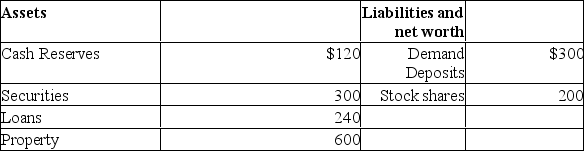 Refer to the above information.The amount of excess reserves is:
 (Multiple Choice)
4.8/5 (69)
(69) The following balance sheet shows the assets and liabilities of the ABC National Bank.Assume the desired reserve ratio is 20 percent. 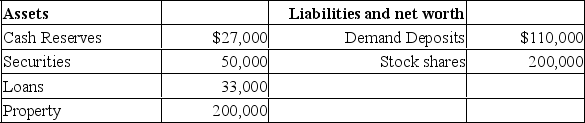 Refer to the above information.This bank can safely expand its loans by a maximum of:
 (Multiple Choice)
4.7/5 (75)
(75) The basic reason why the chartered banking system can increase its demand deposits by a multiple of its excess reserves is that:
(Multiple Choice)
4.9/5 (93)
(93) If the desired reserve ratio were 15 percent, the value of the monetary multiplier would be:
(Multiple Choice)
4.8/5 (72)
(72) If you write a cheque on a bank in Saskatoon to purchase a new Nissan Murano, you are employing money as:
(Multiple Choice)
4.8/5 (73)
(73) When we say that money serves as a store of value, we mean that it is:
(Multiple Choice)
4.9/5 (83)
(83) Assume that Smith deposits $600 in currency in the XYZ Bank.Later that same day Jones negotiates a loan for $1,200 at the same bank.In what direction and by what amount has this single transaction changed the supply of money?
(Multiple Choice)
4.7/5 (82)
(82) Suppose a chartered bank has demand deposits of $500,000 and the desired reserve ratio is 10 percent.If the institution has excess reserves of $4,000, then its actual cash reserves are:
(Multiple Choice)
4.9/5 (75)
(75)  Refer to the above information.The value of the dollar in year 2 is:
 (Multiple Choice)
4.7/5 (80)
(80) When a borrower repays a loan of $4000, either in cash or by cheque, the supply of money is reduced by $4000.
(True/False)
5.0/5 (81)
(81) 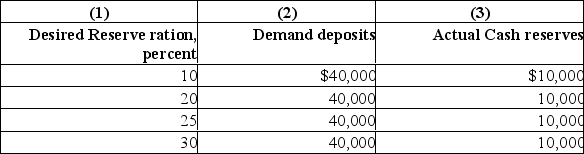 Refer to the above information for a single chartered bank.When the desired reserve ratio is 30 percent, the money multiplier is:
 (Multiple Choice)
4.9/5 (89)
(89) Which of the following describes the fundamental identity embodied in a balance sheet?
(Multiple Choice)
4.9/5 (86)
(86) The goldsmith's ability to create money was based on the fact that:
(Multiple Choice)
4.9/5 (89)
(89) The two basic functions of the Canadian chartered banks and saving institutions are:
(Multiple Choice)
4.9/5 (71)
(71) When we say that money serves as a unit of account, we mean that it is:
(Multiple Choice)
4.8/5 (86)
(86) A single chartered bank has a desired reserve ratio of 25 percent.If the bank has no excess reserves initially and $5,000 cash is deposited in the bank, it can increase its loans by a maximum of:
(Multiple Choice)
4.9/5 (79)
(79) 
Filters
- Essay(0)
- Multiple Choice(0)
- Short Answer(0)
- True False(0)
- Matching(0)