



 Chat with AI
Exam 14: B: Money, Banking, and Money Creation

Exam 1: B: Limits, Alternatives, and Choices265 Questions
Exam 1: A: - Limits, Alternatives, and Choices60 Questions
Exam 2: B: The Market System and the Circular Flow119 Questions
Exam 2: A: - The Market System and the Circular Flow42 Questions
Exam 3: B: Demand, Supply, and Market Equilibrium291 Questions
Exam 3: A: - Demand, Supply, and Market Equilibrium51 Questions
Exam 4: B: Market Failures: Public Goods and Externalities133 Questions
Exam 4: A: - Market Failures: Public Goods and Externalities36 Questions
Exam 5: B: Governments Role and Government Failure121 Questions
Exam 5: A: Governments Role and Government Failure1 Questions
Exam 6: B: an Introduction to Macroeconomics65 Questions
Exam 6: A: an Introduction to Macroeconomics31 Questions
Exam 7: B: Measuring the Economys Output191 Questions
Exam 7: A: Measuring the Economys Output30 Questions
Exam 8: B: Economic Growth122 Questions
Exam 8: A: Economic Growth35 Questions
Exam 9: B: Business Cycles, Unemployment, and Inflation193 Questions
Exam 9: A: Business Cycles, Unemployment, and Inflation40 Questions
Exam 10: B: Basic Macroeconomic Relationships200 Questions
Exam 10: A: Basic Macroeconomic Relationships26 Questions
Exam 11: B: The Aggregate Expenditures Model238 Questions
Exam 11: A: The Aggregate Expenditures Model47 Questions
Exam 12: B: Aggregate Demand and Aggregate Supply203 Questions
Exam 12: A: Aggregate Demand and Aggregate Supply35 Questions
Exam 13: B: Fiscal Policy, Deficits, Surpluses, and Debt234 Questions
Exam 13: A: Fiscal Policy, Deficits, Surpluses, and Debt53 Questions
Exam 14: B: Money, Banking, and Money Creation206 Questions
Exam 14: A: Money, Banking, and Money Creation56 Questions
Exam 15: B: Interest Rates and Monetary Policy239 Questions
Exam 15: A: Interest Rates and Monetary Policy47 Questions
Exam 17: C: Financial Economics323 Questions
Exam 16: A: Long-Run Macroeconomic Adjustments28 Questions
Exam 16: B: Long-Run Macroeconomic Adjustments122 Questions
Exam 17: A: International Trade40 Questions
Exam 17: B: International Trade188 Questions
Exam 18: A: The Balance of Payments and Exchange Rates30 Questions
Exam 18: B: The Balance of Payments and Exchange Rates133 Questions
Exam 22: The Economics of Developing Countries254 Questions
Select questions type


The amount that a chartered bank can lend is determined by its:
(Multiple Choice)
5.0/5  (78)
(78) If the desired reserve ratio were 100 percent, the value of the money multiplier would be:
(Multiple Choice)
4.9/5 (85)
(85) If the price index rises from 100 to 120, the value of the dollar:
(Multiple Choice)
4.8/5 (72)
(72) The following is information about a banking system: new currency deposited in the system = $40 billion; desired reserve ratio = 20%; excess reserves prior to the new currency deposit = $0.Refer to the above information.The banking system will be able to expand the money supply through loans by:
(Multiple Choice)
4.9/5 (80)
(80) Balance sheets always balance because assets must always equal liabilities plus net worth.
(True/False)
4.9/5 (66)
(66) When chartered banks retire outstanding loans, the supply of money is increased.
(True/False)
4.9/5 (86)
(86) A chartered bank has demand-deposit liabilities of $500,000, cash reserves of $150,000, and a desired reserve ratio of 20 percent.The amount by which this single chartered bank and the amount by which the banking system can increase loans are respectively:
(Multiple Choice)
4.9/5 (85)
(85) Henry Trudeau deposits $2,000 in currency in the First Street Bank.Later that same day Jane Harris negotiates a loan for $5,400 at the same bank.This loan alone will:
(Multiple Choice)
4.8/5 (75)
(75) If you are estimating your total expenses for school next semester, you are using money as:
(Multiple Choice)
4.8/5 (87)
(87) A cheque for $10,000 drawn on Bank A by a depositor and deposited in Bank B will increase the excess reserves in Bank B by $10,000.
(True/False)
4.8/5 (82)
(82) Refer to the information below.The M1 definition of money comprises item(s): 1.Foreign currency deposits of residents booked in Canada
2)Personal savings deposits
3)Currency (coins and paper money)
4)Demand deposits
5)Government securities
6)Nonpersonal notice deposits
(Multiple Choice)
4.8/5 (83)
(83) What is one significant characteristic of fractional reserve banking?
(Multiple Choice)
4.8/5 (74)
(74) The following balance sheet is for the First National Bank.Assume the desired reserve ratio is 15 percent. 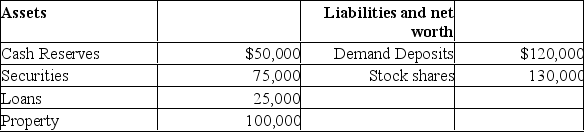 Refer to the above data.If a cheque for $14,000 is drawn and cleared against this bank, its reserves and demand deposits will be, respectively:
 (Multiple Choice)
4.9/5 (70)
(70) If we let P equal the price level expressed as an index number and D equal the value of the dollar, then we can say that:
(Multiple Choice)
4.9/5 (64)
(64) 
Filters
- Essay(0)
- Multiple Choice(0)
- Short Answer(0)
- True False(0)
- Matching(0)