



 Chat with AI
Exam 11: How Cells Reproduce

Exam 1: The Science of Biology68 Questions
Exam 2: Lifes Chemical Basis79 Questions
Exam 3: Molecules of Life56 Questions
Exam 4: Cell Structure64 Questions
Exam 5: Ground Rules of Metabolism58 Questions
Exam 6: Where It Starts-Photosynthesis87 Questions
Exam 7: Releasing Chemical Energy80 Questions
Exam 8: DNA Structure and Function75 Questions
Exam 9: From DNA to Protein65 Questions
Exam 10: Control of Gene Expression61 Questions
Exam 11: How Cells Reproduce75 Questions
Exam 12: Meiosis and Sexual Reproduction68 Questions
Exam 13: Patterns in Inherited Traits54 Questions
Exam 14: Human Inheritance41 Questions
Exam 15: Biotechnology71 Questions
Exam 16: Evidence of Evolution69 Questions
Exam 17: Processes of Evolution83 Questions
Exam 18: Lifes Origin and Early Evolution49 Questions
Exam 19: Viruses, Bacteria, and Archaea42 Questions
Exam 20: The Protists56 Questions
Exam 21: Plant Evolution55 Questions
Exam 22: Fungi50 Questions
Exam 23: Animals I: Major Invertebrate Groups72 Questions
Exam 24: Animals Ii: the Chordates76 Questions
Exam 25: Plant Tissues67 Questions
Exam 26: Plant Nutrition and Transport67 Questions
Exam 27: Plant Reproduction and Development71 Questions
Exam 28: Animal Tissues and Organ Systems78 Questions
Exam 29: Neural Control80 Questions
Exam 30: Sensory Perception62 Questions
Exam 31: Endocrine Control65 Questions
Exam 32: Structural Support and Movement52 Questions
Exam 33: Circulation66 Questions
Exam 34: Immunity57 Questions
Exam 35: Respiration63 Questions
Exam 36: Digestion and Human Nutrition57 Questions
Exam 37: Maintaining the Internal Environment63 Questions
Exam 38: Reproduction and Development88 Questions
Exam 39: Animal Behavior73 Questions
Exam 40: Population Ecology55 Questions
Exam 41: Community Ecology73 Questions
Exam 42: Ecosystems52 Questions
Exam 43: The Biosphere74 Questions
Exam 44: Human Effects on the Biosphere73 Questions
Select questions type


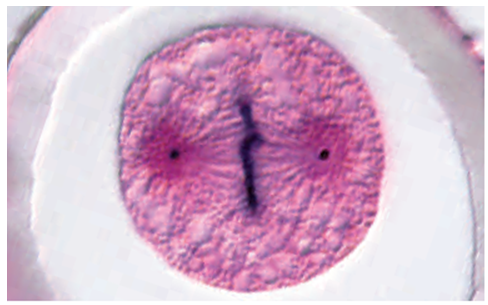 -The cell in the accompanying figure is in ____.

Match the correct term with its corresponding description:
-cancer
(Multiple Choice)
4.9/5  (83)
(83) In animal cells, the cytoplasm divides by formation of a ____, while in plant cells, cytoplasmic division occurs by formation of a ____.
(Multiple Choice)
4.9/5 (80)
(80) During interphase, the chromosomes are loose and thread-like but they tightly condense in preparation for mitosis. Why?
(Essay)
4.8/5 (76)
(76) The chromosomes have arrived at opposite poles by the beginning of ____.
(Multiple Choice)
4.8/5 (76)
(76) Which cell structure is present during plant cell division but not animal cell division?
(Multiple Choice)
5.0/5 (80)
(80) Any gene that can transform a normal cell into a tumor cell is called a(n) ____.
(Multiple Choice)
4.9/5 (76)
(76) Match each stage with the events listed.
A)sister chromatids separate
B)chromosomes start to condense
C)new nuclei form
D)all duplicated chromosomes are aligned at the spindle equator _______ metaphase
_______ prophase
_______ telophase
_______ anaphase
(Short Answer)
4.9/5 (82)
(82) Match each term with its corresponding description.
-centromere
(Multiple Choice)
4.9/5 (81)
(81) Match each term with its corresponding description.
-spindle
(Multiple Choice)
4.8/5 (97)
(97) Normal checkpoint genes encoding proteins that promote mitosis are called ____.
(Multiple Choice)
4.8/5 (85)
(85) Match the correct term with its corresponding description:
-metastasis
(Multiple Choice)
4.9/5 (80)
(80) Explain National Geographic Explorer Iain Couzin's concept of the parallels between cancer cell migration and animal swarms.
(Essay)
4.7/5 (86)
(86) 
Filters
- Essay(0)
- Multiple Choice(0)
- Short Answer(0)
- True False(0)
- Matching(0)